
Introduction to Bistro Cookery - Taster - Feeling Liverish
A new year - a new cookery course!
This one proposes to introduce us to the manifold delights of Bistro Cookery. Ah, Truite Amandine, Moules Marinière, Coquilles Saint-Jacques. I can't wait!
We are beginning this journey of discovery with liver... Wait, what??
This one proposes to introduce us to the manifold delights of Bistro Cookery. Ah, Truite Amandine, Moules Marinière, Coquilles Saint-Jacques. I can't wait!
We are beginning this journey of discovery with liver... Wait, what??
Despite my insistence to the contrary, it turns out that liver and onion is a French Bistro standard Sorry chefs!
Known as Foie de Veau à la Lyonnaise, it's exclusively made with veal liver (which probably makes it much finer than our own sweated calf lamb liver) but it rarely if ever appears to include bacon.
Typically the dish is just veal liver, floured and quick-fried, then dressed with caramelised onions and parsley.
Sometimes the frying pan is de-glazed with a splash of vinegar and broth which is then poured over the top.
In classic Rosbif fashion our own liver and onions is a much heftier, porky, gravy-laden dish that is usually served with mashed potato and greens.
We served ours with some reds.
Well here are some trademark PaulPointers™ relayed from this week's class:
Tut!
If for any reason you find yourself in possession of a giant catering pack of either kind of liver slices, which you inexplicably neglected to photograph, and having consumed all the fried liver a body can stomach, you can always make pâté 😉
Known as Foie de Veau à la Lyonnaise, it's exclusively made with veal liver (which probably makes it much finer than our own sweated calf lamb liver) but it rarely if ever appears to include bacon.
Typically the dish is just veal liver, floured and quick-fried, then dressed with caramelised onions and parsley.
Sometimes the frying pan is de-glazed with a splash of vinegar and broth which is then poured over the top.
In classic Rosbif fashion our own liver and onions is a much heftier, porky, gravy-laden dish that is usually served with mashed potato and greens.
We served ours with some reds.
Well here are some trademark PaulPointers™ relayed from this week's class:
- You can allegedly check the sharpness of the college's knives by looking for reflections from the edge of the blade. This may be because the college knives are so abused as to completely flatten their edges so they act more like hammers than knives.
- Teacher Paul has no patience for fancy salts. Like sea. Rock salt was good enough for his ancestors and it's good enough for him.
- Teacher Paul has a horror of dirty or cold serving plates. Get those plates warmed in the oven and wipe off those damn stains, students!
Tut!
If for any reason you find yourself in possession of a giant catering pack of either kind of liver slices, which you inexplicably neglected to photograph, and having consumed all the fried liver a body can stomach, you can always make pâté 😉
menu
Liverish
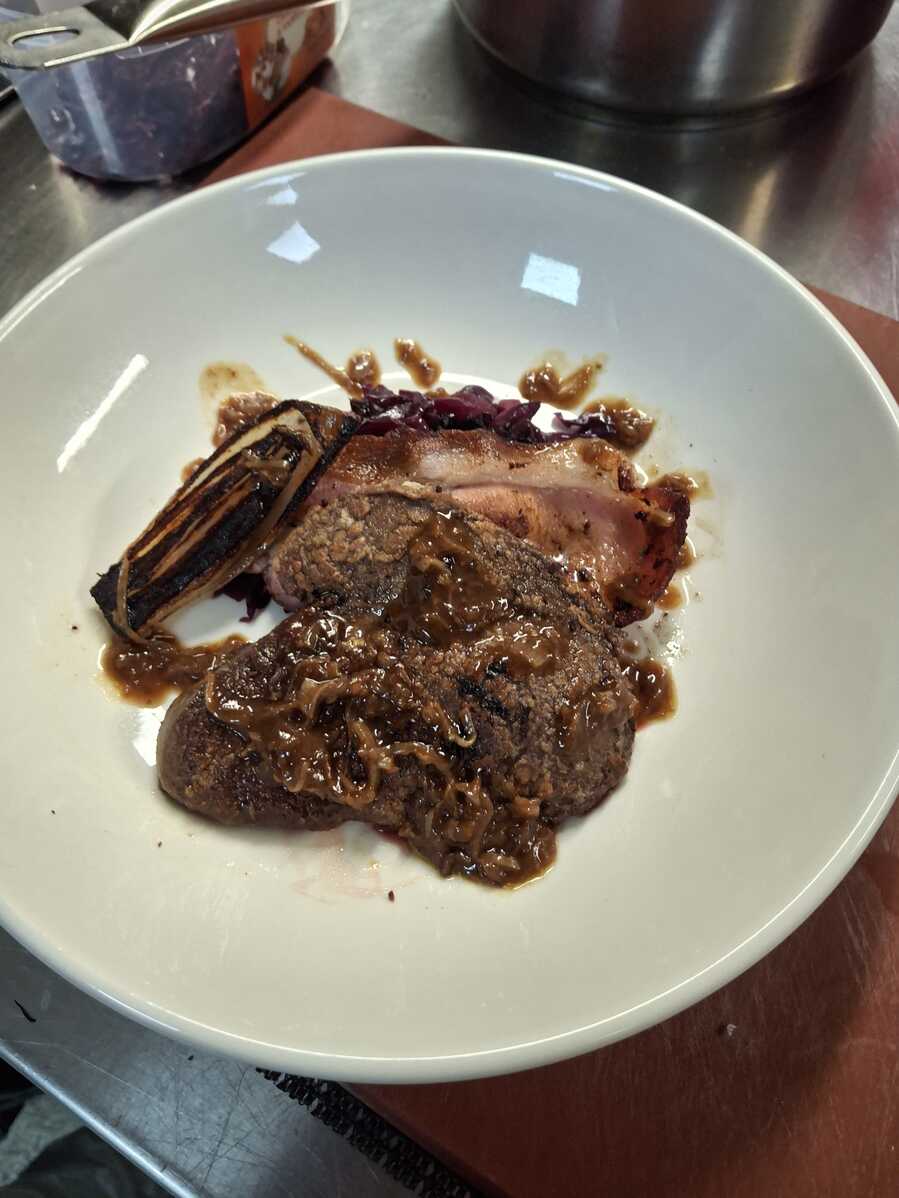
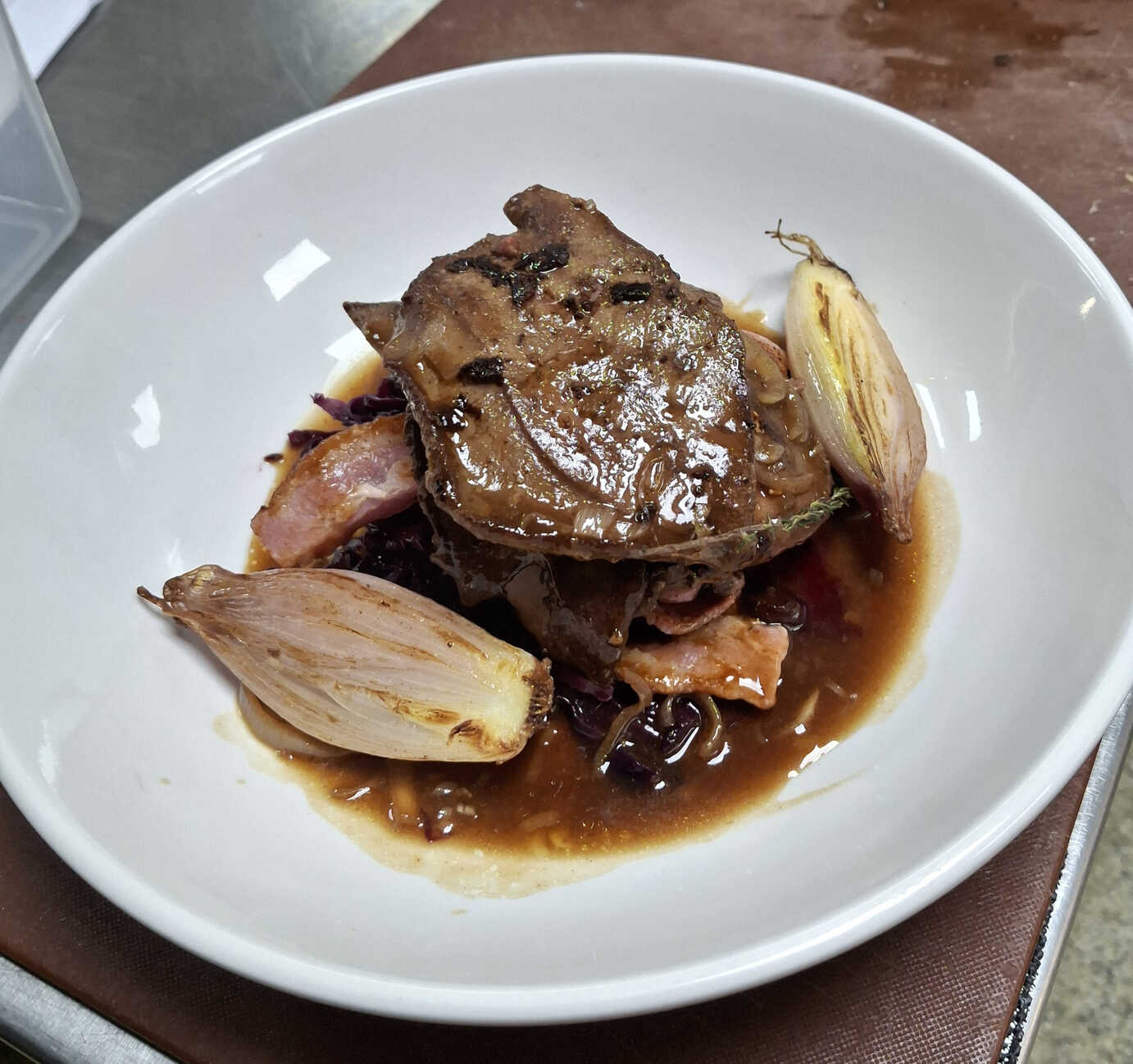
Liver and Bacon
Liver and Bacon
With onion, er shallot gravy.
Braised Red Cabbage
The side of greens reds.
BYO Mash
Bring your own!
Braised Red Cabbage
class veg side
In which we learn that Macédoine is a French cookery term meaning a salad of fruit or vegetables cut into 4mm dice.
It originates in such fruit salads from the Macedonian region, north of Greece, and the term is also used to refer to the dicing technique itself.
I'm not entirely convinced cinnamon is a great flavour for serving with liver, but nutmeg would definitely work.
Don't overdo the apple.
I'm not entirely convinced cinnamon is a great flavour for serving with liver, but nutmeg would definitely work.
Don't overdo the apple.
Ingredients
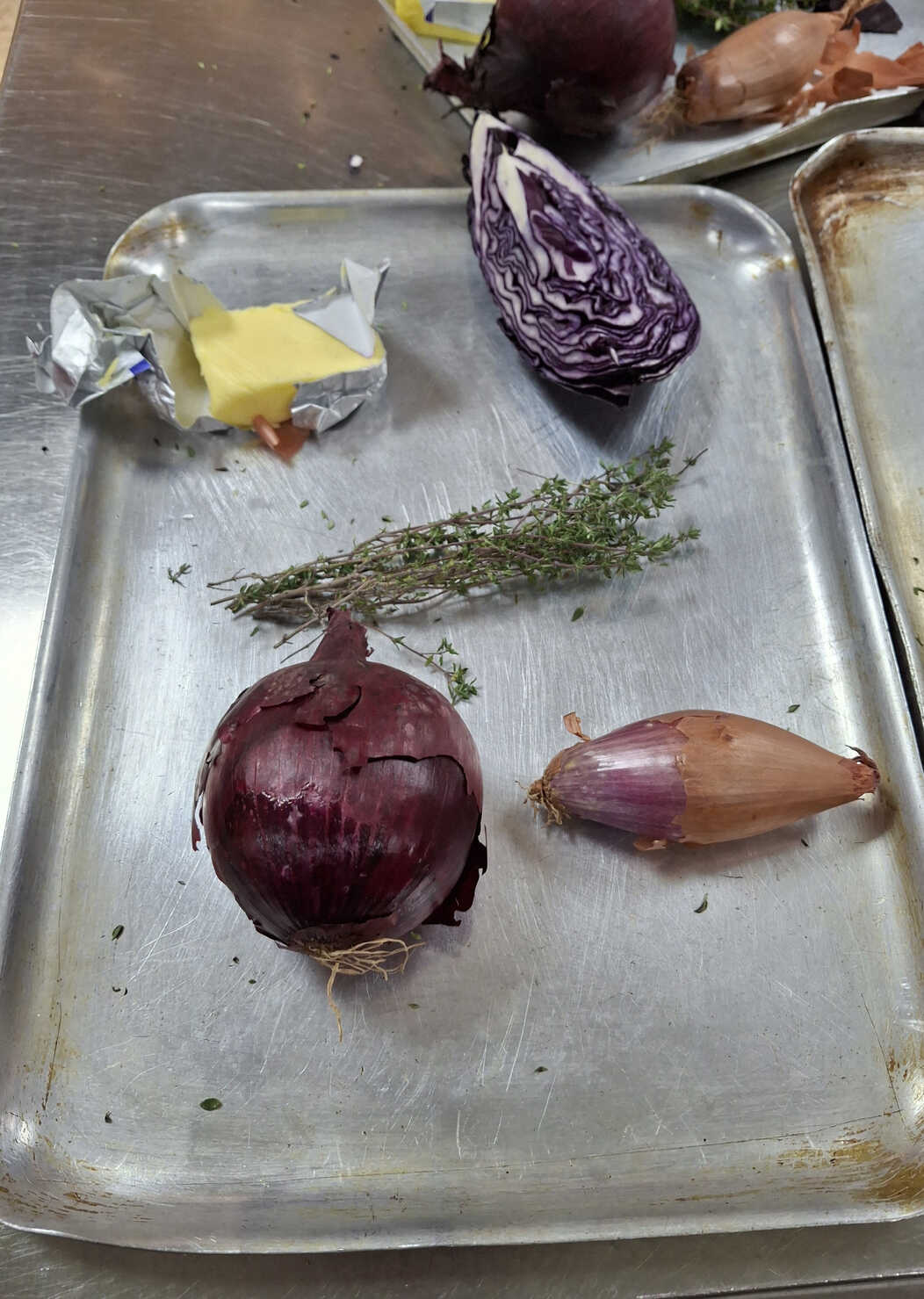
- red cabbage, shredded
- knob of butter
- apple, peeled, macedonoise
- onion or shallot, brunoise
- salt & pepper
- vinegar
- (raspberry?) jam or other jelly
- cinnamon
- bay leaves
Julienne, or finely slice, the red cabbage discarding tough or thick stalks.
Finely dice the shallot or red onion into brunoise.
Core the apple and either grate it, or peel and cut into small cubes or macédoine.
Melt a hefty knob of butter in a casserole or heavy pan and add the fruit and vegetables and give them a good stir.
Season with salt and pepper. Add a splash of vinegar and a dollop of honey, jam, or jelly such as redcurrant.
Finely dice the shallot or red onion into brunoise.
Core the apple and either grate it, or peel and cut into small cubes or macédoine.
Melt a hefty knob of butter in a casserole or heavy pan and add the fruit and vegetables and give them a good stir.
Season with salt and pepper. Add a splash of vinegar and a dollop of honey, jam, or jelly such as redcurrant.
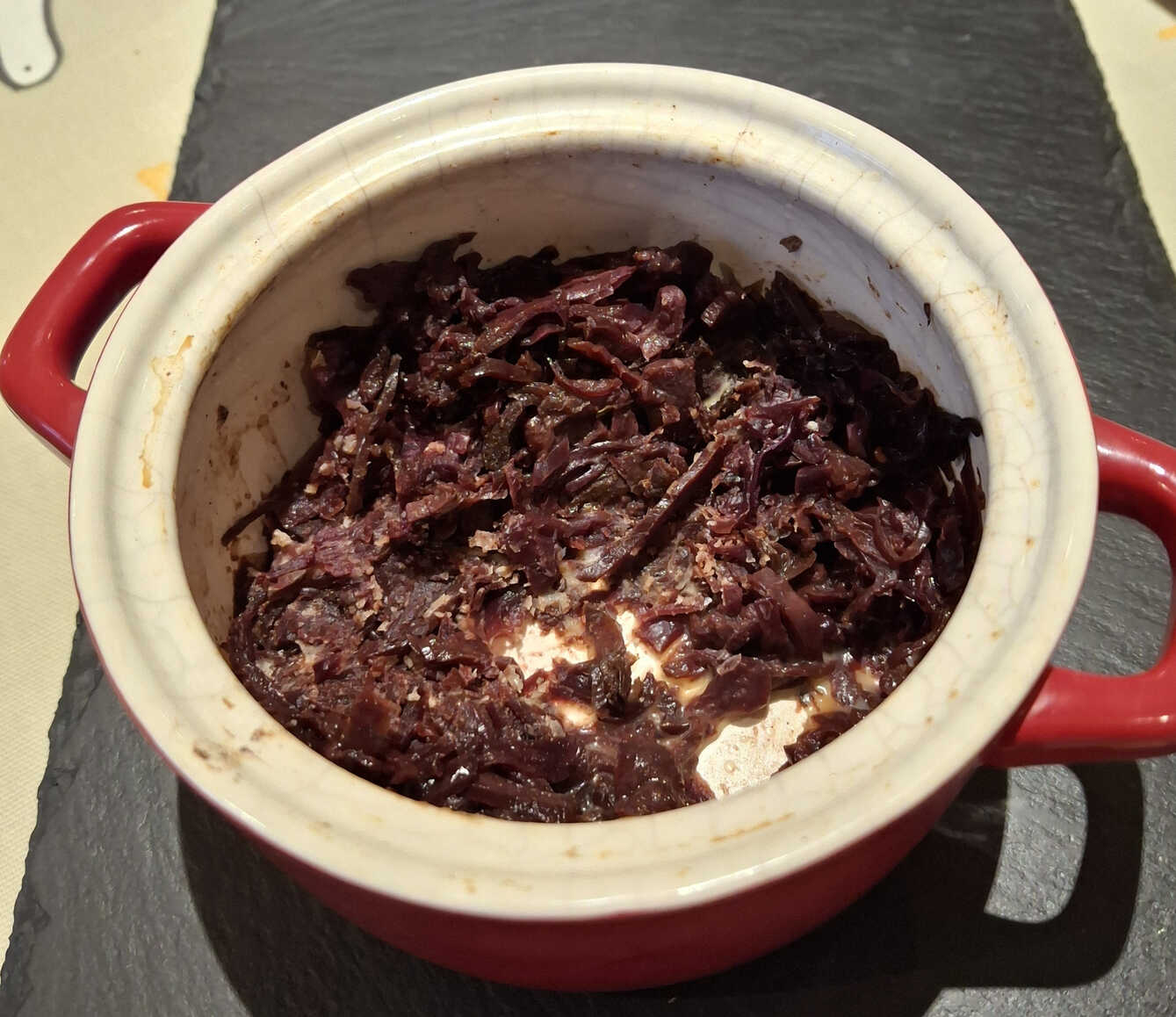
Good when the cabbage has become rich and jammy.
Liver and Bacon with Shallot Gravy
class main meat
Ah, liver. Probably the most popular meat in Britain. In the 1300s!
And that was only because the Lords of the Manors ate all the animals' good bits.
Still, it's not completely repugnant when properly cooked. Which means lightly since it has a tendency to turn into shoe leather when cooked for a second too long. It also helps to choose the right liver.
The French seem to enjoy veal liver, which is obviously the most tender, but you won't find any white veal in Britain since we are crippled by our suicidal empathy for cows, ducks and migrants.
Otherwise you can use regular rosé calf's liver - still mild and delicate, lamb's liver (as we did) which is equally tender but more gamey, pig's liver which has a stronger coppery flavour, or ox liver which Teacher Paul suggests is ideal for feeding to the cat though it is sometimes used in longer braised dishes.
If you are lucky enough to get your liver whole you will need to peel away its silvery outer membrane and trim off any thick tubes or gristly lumps, or greenish bile before slicing.
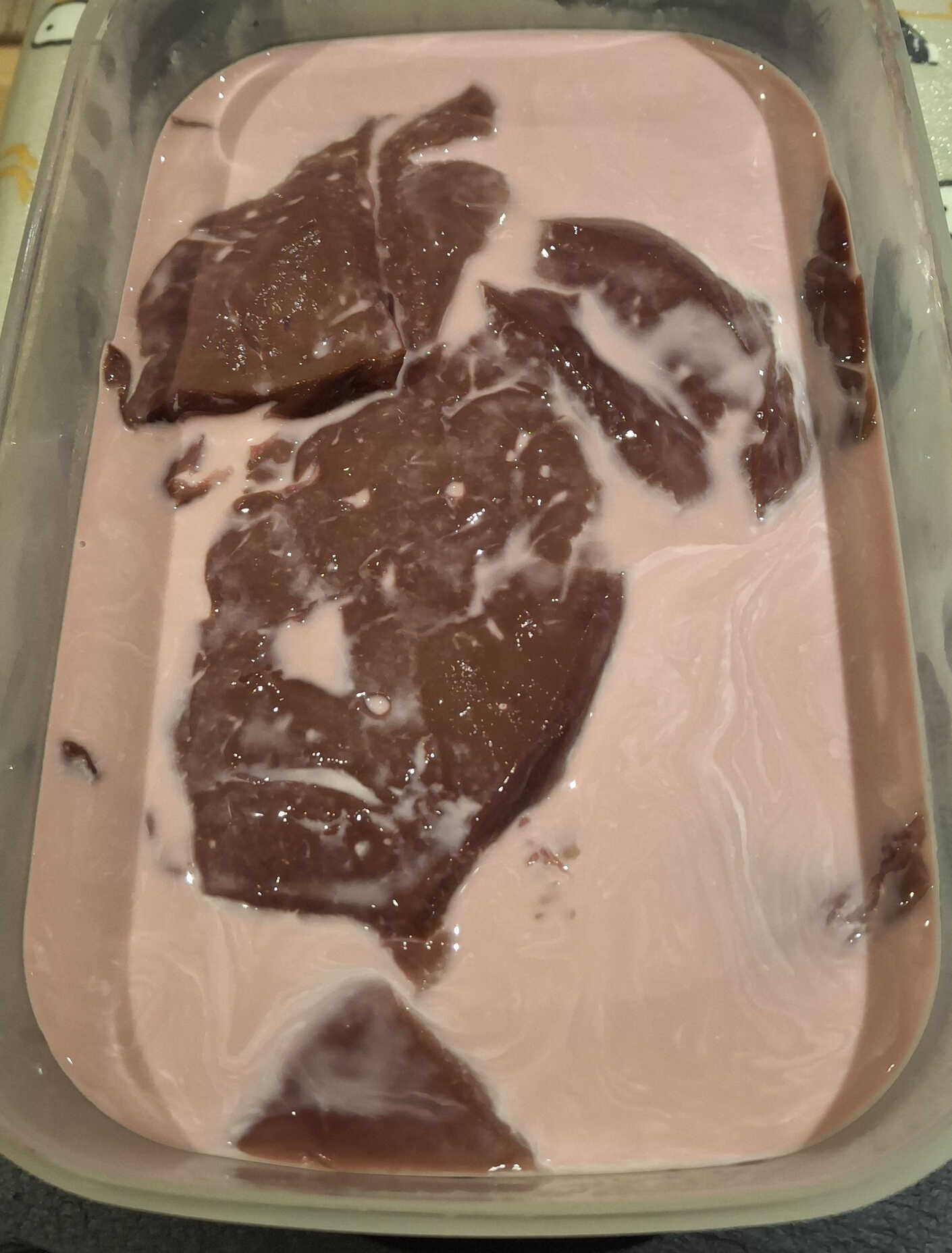
Some chefs swear by soaking the liver in milk, or salt-and-lemon water to extract some of the bitterness before cooking. Though this seems a bit old-fashioned it might be worth considering if you have liver from an older animal.
Serve a couple of slices of liver and a couple of slices of bacon per person.
Fried liver does not keep - so plan on eating it straight away.
And that was only because the Lords of the Manors ate all the animals' good bits.
Still, it's not completely repugnant when properly cooked. Which means lightly since it has a tendency to turn into shoe leather when cooked for a second too long. It also helps to choose the right liver.
The French seem to enjoy veal liver, which is obviously the most tender, but you won't find any white veal in Britain since we are crippled by our suicidal empathy for cows, ducks and migrants.
Otherwise you can use regular rosé calf's liver - still mild and delicate, lamb's liver (as we did) which is equally tender but more gamey, pig's liver which has a stronger coppery flavour, or ox liver which Teacher Paul suggests is ideal for feeding to the cat though it is sometimes used in longer braised dishes.
If you are lucky enough to get your liver whole you will need to peel away its silvery outer membrane and trim off any thick tubes or gristly lumps, or greenish bile before slicing.
Some chefs swear by soaking the liver in milk, or salt-and-lemon water to extract some of the bitterness before cooking. Though this seems a bit old-fashioned it might be worth considering if you have liver from an older animal.
Serve a couple of slices of liver and a couple of slices of bacon per person.
Fried liver does not keep - so plan on eating it straight away.
- bacon
- liver, sliced
- seasoned flour for coating
For the Shallot Sauce:- shallots, minced
- garlic, crushed
- butter
- Worcestershire Sauce
- balsamic vinegar optional
- demi-glace or rich stock
- thyme
To Serve:- chives
For Garnish:- 1 shallot, peeled, halved
Prepare the garnish by peeling a shallot and halving it lengthways.
Simmer in simmering, salted water until tender, then drop into cold or iced water to refresh.
Keep warm until required.
Start the sauce by mincing the shallots and sweating them down in a little butter until they begin to turn golden.
Add crushed or puréed garlic and sweat a little longer, then deglaze with a dash of Worcestershire sauce, and vinegar if you like.
Cover with a rich stock or demi-glace and set to simmer until it reduces and thickens slightly. Skim away any scum or foam which surfaces as you go.
Just before serving, season and throw in a handful of thyme leaves to add fresh herb flavour.
Slice the liver fairly thinly, and season. Add more seasoning and perhaps a sprinkling of mustard powder which is quite good to flour in a bowl or a plastic bag and coat the liver slices. Heat another knob of butter in the frying pan and fry the liver quickly on both sides before setting it aside. It should still be nice and pink in the middle.
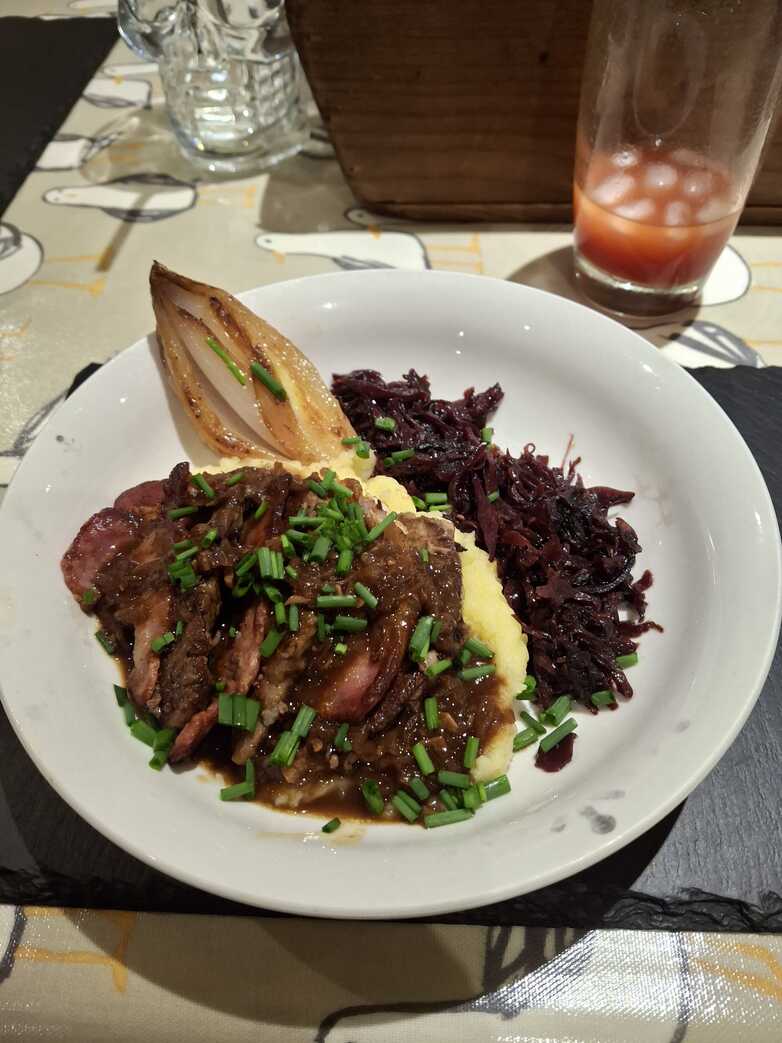
Arrange on a clean, hot plate to serve: mound some braised red cabbage, then stack the liver sliced if you like and bacon on top and dress with the shallot sauce.
Artfully position the charred shallot halves against the stack.
Simmer in simmering, salted water until tender, then drop into cold or iced water to refresh.
Teacher Paul observes, correctly in my opinion, that there is no need to use an expensive salt when dissolving it into water since it will then be chemically indistinguishable from rock salt.
Teacher Paul is wrong, in my humble opinion, in his belief that the shape or composition of the salt has no effect when it is sprinkled on the surfaces of food to act as seasoning or dessicant.
Dry off the shallots. Heat a lightly oiled frying pan until smoking and press the cut sides of the halve onto the pan until they achieve a delicate charring.Teacher Paul is wrong, in my humble opinion, in his belief that the shape or composition of the salt has no effect when it is sprinkled on the surfaces of food to act as seasoning or dessicant.
Keep warm until required.
Start the sauce by mincing the shallots and sweating them down in a little butter until they begin to turn golden.
Add crushed or puréed garlic and sweat a little longer, then deglaze with a dash of Worcestershire sauce, and vinegar if you like.
Cover with a rich stock or demi-glace and set to simmer until it reduces and thickens slightly. Skim away any scum or foam which surfaces as you go.
Just before serving, season and throw in a handful of thyme leaves to add fresh herb flavour.
Or you could use sage, which is a classic liver flavour combo.
Melt a little butter and oil in a frying pan and fry a few slices of bacon whole, or cut into sections or strips until crispy at the edges. Set aside to keep warm.Slice the liver fairly thinly, and season. Add more seasoning and perhaps a sprinkling of mustard powder which is quite good to flour in a bowl or a plastic bag and coat the liver slices. Heat another knob of butter in the frying pan and fry the liver quickly on both sides before setting it aside. It should still be nice and pink in the middle.
Arrange on a clean, hot plate to serve: mound some braised red cabbage, then stack the liver sliced if you like and bacon on top and dress with the shallot sauce.
Artfully position the charred shallot halves against the stack.
Frankly it's best served with mashed potato, which we didn't have, if served at all 🤣
I quite like to add a scattering of chives, myself. It's good to have something which alleviates the dish's otherwise unrelenting brownness.
I quite like to add a scattering of chives, myself. It's good to have something which alleviates the dish's otherwise unrelenting brownness.
Lamb's Liver Pâté
meat snack starter
There are basically two approaches to making liver pâté -
to mince the liver first with mostly other meats and then cook them slowly in a terrine immersed in a water bath in a low oven,
or to sweat the liver with vegetables on the stove top then purée everything together.
This takes the second.
You can use this method with whichever mammal's liver you like - lamb, beef, pig, but possibly not a bird's. And you could also add whatever alcohol and herb assortment you prefer. Brandy and thyme, or port and sage are classics.
I used bourbon thanks to a suggestion by Claudia Curici and parsley, basil, oregano, thyme and lavender (!).
to mince the liver first with mostly other meats and then cook them slowly in a terrine immersed in a water bath in a low oven,
or to sweat the liver with vegetables on the stove top then purée everything together.
This takes the second.
You can use this method with whichever mammal's liver you like - lamb, beef, pig, but possibly not a bird's. And you could also add whatever alcohol and herb assortment you prefer. Brandy and thyme, or port and sage are classics.
I used bourbon thanks to a suggestion by Claudia Curici and parsley, basil, oregano, thyme and lavender (!).
Easily fills two pots
Ingredients
- 400g lamb's liver, thickly sliced
- 2 red onions, chopped
- a few garlic cloves, crushed
- 4 slices bacon, chopped
- butter & olive oil
- couple teaspoons green peppercorns, roughly crushed
- grind of allspice and nutmeg
- a good handful of mixed herbs
- good splash of bourbon
- couple of tablespoons of double cream
- couple of tablespoons of crème fraîche
- salt
Roughly chop the red onions and sweat them in a generous amount of olive oil and butter until they soften.
Add the chopped bacon and cook through.
Add the crushed garlic and cook through.
Grind the allspice and add to the pan. Lightly crush the green peppercorns and add to the pan. Add a grating of nutmeg.
Add the liver slices to the pan and cook them through, flipping once, without over-cooking. They should still be pink in the centre.
Remove the liver, roughly chop and set aside.
Roughly chop the herbs and stir through the frying pan, then deglaze the pan with bourbon.
Add salt and adjust the seasoning, then scrape the pan into a food processor or blender and add the chopped liver including any leaked juices.
Add more butter and a little olive oil to the frying pan, then add the creams and heat until they bubble. Pour enough of this into the blender to lubricate the mixture and process everything into a fairly smooth paste.
Scoop into pots or crocks and cover with more melted butter before refrigerating.
Add the chopped bacon and cook through.
Add the crushed garlic and cook through.
Grind the allspice and add to the pan. Lightly crush the green peppercorns and add to the pan. Add a grating of nutmeg.
Add the liver slices to the pan and cook them through, flipping once, without over-cooking. They should still be pink in the centre.
Remove the liver, roughly chop and set aside.
Roughly chop the herbs and stir through the frying pan, then deglaze the pan with bourbon.
Add salt and adjust the seasoning, then scrape the pan into a food processor or blender and add the chopped liver including any leaked juices.
Add more butter and a little olive oil to the frying pan, then add the creams and heat until they bubble. Pour enough of this into the blender to lubricate the mixture and process everything into a fairly smooth paste.
Scoop into pots or crocks and cover with more melted butter before refrigerating.
Surprisingly good.
I reckon you can keep this in the fridge for a couple of weeks, but this is not advice for legal purposes, so you can't sue me if you get sick and die.
I reckon you can keep this in the fridge for a couple of weeks, but this is not advice for legal purposes, so you can't sue me if you get sick and die.
You could also add any herbs or spices you fancy (we had cinnamon and bay leaves), flavourings like mustard, or alcohol like port or wine.