Introduction to Bistro Cookery - A Rare Bit of Cheese
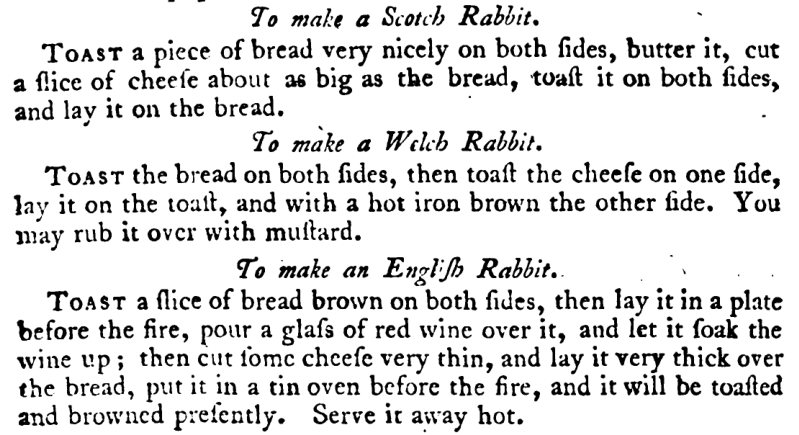

There are competing theories for the origin of the term Welsh Rarebit for mustardy cheese-on-toast.
The first is that it referred to an unusually tasty dish - like food or a woman. The second is that it was a corruption of Welsh Rabbit - an ironic reference to the poverty of the Welsh who were unable even to afford rabbit to eat and were perforce required to dine on cheese.
The fact that the earliest reference to this preparation is to rabbit [Nathan Bailey's English Dictionary - 1725] rather than rarebit [Francis Grose dictionary of the vulgar tongue - 1778] seems to settle the matter.
What is in no doubt is that the Welsh have always been great lovers of cheese. In fact, one of the oldest jokes in the English language originally printed in A C Merie Talys in 1526, concerns St. Peter's use of cheese to lure the vexsome Welsh from heaven to provide the angels some respite from their incessant jabber:
The jest (geste) is of course poking fun at the Welshmen's well-known love for their ancient and popular dish of caws pobi - meaning roast cheese in their inscrutable babble.
From the earliest Rabbit recipe being recorded as just cheese on toast with mustard, one theory for the development of today's more liquid Rarebit lies in the convenience for pub landlords, who would have served Welsh Rabbit as an early form of bar snack, in having a pot of bubbling liquid cheese to just pour over their toast, rather than having to resort to pressing the cheesy bread with a hot shovel - this being before the invention of the toaster oven.
The liquid used to dissolve this cheese would naturally have been beer, milk, or occasionally wine.
Mustard is still pretty much essential, but later Worcestershire Sauce and a pinch of cayenne pepper also became common ingredients.
Gary Rhodes' signature interpretation Smoked Haddock with Welsh Rarebit, however, eschews the beer and the cayenne. And even the toast!
This is the recipe we shall be recreating tonight, in the first lesson in our Bistro Cookery course proper, since Teacher Paul greatly enjoyed eating it at Rhodes' restaurant.
Though we will also include some toast. Which I feel is a vital element for soaking up all those lovely juices. As well as some spinach. Which may not be.
I also brought beer. Theakston's Old Peculier, since you ask.
Rhode's approach is also unusual in turning his rarebit into a thick, rubbery, panade à la farine (French for flour panade) instead of a pourable sauce.
He then rolls this into a sheet and keeps it chilled for days. I suppose you can see how this would be convenient in a restaurant setting. It also helps to inhibit the topping from immediately running off the fish as soon as it warms up.
This week's life lessons and PaulPointers™:
So if you believe that explains the popularity of pudding, then I think you may be suffering from low blood-sugar.
Paul also mentioned the current unpopularity of seed oils, not that we were using any seed oils this week.
So allow me to indulge in a short rant:
OK rant over. On to the cookery...
The first is that it referred to an unusually tasty dish - like food or a woman. The second is that it was a corruption of Welsh Rabbit - an ironic reference to the poverty of the Welsh who were unable even to afford rabbit to eat and were perforce required to dine on cheese.
The fact that the earliest reference to this preparation is to rabbit [Nathan Bailey's English Dictionary - 1725] rather than rarebit [Francis Grose dictionary of the vulgar tongue - 1778] seems to settle the matter.
What is in no doubt is that the Welsh have always been great lovers of cheese. In fact, one of the oldest jokes in the English language originally printed in A C Merie Talys in 1526, concerns St. Peter's use of cheese to lure the vexsome Welsh from heaven to provide the angels some respite from their incessant jabber:
I fynde wrytten amonge olde gestes, howe God mayde Saynt Peter porter of heuen, and that God of hys goodnes, sone after his passyon, suffered many men to come to the kyngdome of Heuen with small deseruynge;
at whiche tyme there was in heuen a great company of Welchemen, whyche with their crakynge and babelynge troubled all the other.
Wherfore God sayde to saynte Peter, that he was wery of them, and that he wolde fayne haue them out of heuen.
To whome saynte Peter sayd: Good Lorde, I warrente you, that shal be done.
Wherfore saynt Peter wente out of heuen gates and cryed wyth a loud voyce Cause bobe, that is as moche to saye as rosted chese, whiche thynge the Welchemen herynge, ranne out of Heuen a great pace.
And when Saynt Peter sawe them all out, he sodenly wente into Heuen, and locked the dore, and so sparred all the Welchemen out.
Ah, they don't tell 'em like they used to!Wherfore God sayde to saynte Peter, that he was wery of them, and that he wolde fayne haue them out of heuen.
To whome saynte Peter sayd: Good Lorde, I warrente you, that shal be done.
Wherfore saynt Peter wente out of heuen gates and cryed wyth a loud voyce Cause bobe, that is as moche to saye as rosted chese, whiche thynge the Welchemen herynge, ranne out of Heuen a great pace.
And when Saynt Peter sawe them all out, he sodenly wente into Heuen, and locked the dore, and so sparred all the Welchemen out.
The jest (geste) is of course poking fun at the Welshmen's well-known love for their ancient and popular dish of caws pobi - meaning roast cheese in their inscrutable babble.
From the earliest Rabbit recipe being recorded as just cheese on toast with mustard, one theory for the development of today's more liquid Rarebit lies in the convenience for pub landlords, who would have served Welsh Rabbit as an early form of bar snack, in having a pot of bubbling liquid cheese to just pour over their toast, rather than having to resort to pressing the cheesy bread with a hot shovel - this being before the invention of the toaster oven.
The liquid used to dissolve this cheese would naturally have been beer, milk, or occasionally wine.
Mustard is still pretty much essential, but later Worcestershire Sauce and a pinch of cayenne pepper also became common ingredients.
Gary Rhodes' signature interpretation Smoked Haddock with Welsh Rarebit, however, eschews the beer and the cayenne. And even the toast!
This is the recipe we shall be recreating tonight, in the first lesson in our Bistro Cookery course proper, since Teacher Paul greatly enjoyed eating it at Rhodes' restaurant.
Though we will also include some toast. Which I feel is a vital element for soaking up all those lovely juices. As well as some spinach. Which may not be.
I also brought beer. Theakston's Old Peculier, since you ask.
Rhode's approach is also unusual in turning his rarebit into a thick, rubbery, panade à la farine (French for flour panade) instead of a pourable sauce.
He then rolls this into a sheet and keeps it chilled for days. I suppose you can see how this would be convenient in a restaurant setting. It also helps to inhibit the topping from immediately running off the fish as soon as it warms up.
This week's life lessons and PaulPointers™:
- Teacher Paul talked about the Spanish inclination for rubbing their toast with split garlic cloves before covering them in grated tomatoes for breakfast, and rubbing salad bowls with a garlic clove to give them that delightful hint of French armpit hair.
- Speaking of hairs, we also discovered from Student Gita that the name Iqbal can be understood in Hindi as meaning One Hair. So don't be surprised if that's what you get in your curry if visit his restaurant.
- Teacher Paul observes that mustard and honey are emulsifying agents which help to maintain a vinaigrette's suspension of oil and water for much longer before it separates.
- Teacher Paul reminds us of the classic vinaigrette ratio of 3:1 oil:vinegar. Of course depending on personal taste and the salad you're dressing you can vary this ratio enormously - I rather like about 1:1 when substituting lemon or orange juice for the vinegar.
- Teacher Paul bemoans the inclination of mature spinach to be covered in grit and mud kicked up over them by any heavy rainfall. Be sure to give it a really good wash.
- Teacher Paul waxed lyrical about nutmeg. About how Elizabeth David's authentic recipe for Ragù Bolognese surprisingly features nutmeg. About how well spinach naturally pairs with nutmeg - added in his dish below. About how the narcotic effect of nutmeg was solely responsible for the popularity of rice or bread and butter puddings.
So if you believe that explains the popularity of pudding, then I think you may be suffering from low blood-sugar.
Paul also mentioned the current unpopularity of seed oils, not that we were using any seed oils this week.
So allow me to indulge in a short rant:
Americans are faddish hysterics fed by a spiraling doom-cycle of clickbait terror stories, so everything that you love or enjoy will at some time or another be accused of murdering you, babies, or the planet.
And right now it's the turn of seed oils.
The supposed horrors of seed oils are as follows:
Naturally extracted ingredients, eaten in moderation, are going to be generally preferable to gorging on artificially treated or synthesized franken-foods. But there's a trade off.
The better quality foodstuff is more expensive, requires more resources to produce, is limited in quantity and doesn't last as long. The whole world cannot cook with Tuscan extra-virgin, cold-pressed olive oil alone.
You just need to be sensible about this stuff.
And right now it's the turn of seed oils.
The supposed horrors of seed oils are as follows:
- Seed oils are full of residual poisonous chemicals from the extraction process.
- Yes, toxic solvents like hexane are used in the chemical extraction of oil from seeds, and the refining process may well use bleaching or deodorizing agents to extend the oil's shelf life. Trace amounts of these may remain in the processed oils. They are though, pretty heavily regulated and used in such vast quantities that grossly harmful effects ought to be readily apparent. The foods that will kill you are generally the ones that haven't been treated to make them safe.
- Seed oils are full of genetically modified Frankenstein biogenics
- Genetically modified crops are indeed used to produce the vast majority of seed oils. Now I'm no particular fan of GMOs, but the oil they produce is going to be identical to that produced by natural plants. It's their DNA which is modified, not the fatty acids they produce. If you don't like GMOs then campaign against them - but there's no reason to starve yourself.
- Seed oils are full of the wrong kind of fatty acids.
- No area of un-scientific study is more persistently wrong than nutritionism. Except maybe for climatism. According to these retards there are good cholesterols and bad cholesterols. Good Omega-3 fatty acids and bad Omega-6 fatty acids. The simple truth is that these dotards have no capacity whatsoever to model or predict complex, chaotic, integrated biological systems. In the last century Westerners have gone from generally healthy to generally obese under the dietary advice promoted by these self-serving cretins. Ignore them. Eat what you like in moderation.
- Ultra-processed foods (whatever they are) are full of seed oils. And that's bad, and somehow the fault of the seed oils.
-
There's a permanent class war between genteel wine-sipping white, middle class liberals who dine on bruschetta con fagioli schiacciati and the beer-guzzling oiks who gobble beans on toast.
These liberals have invented something called super-processed or ultra-processed foods to differentiate their diet from whatever the plebs eat.
But if you ask them for a definition they're never able to provide one. Do they mean cooked? Canned? Cured? What is the difference between a blue collar burger and white collar filet mignon? Parma ham and Spam?
They rabbit on about chemicals, but we are bags of chemicals. We're made of chemicals. Everything we consume is chemicals. Salt is a chemical. Do they not salt their foie gras? Food is made of e-numbers and additives - E330 is the citric acid that gives lemon juice its preservative effects. Do they not squeeze lemon over their gravadlax while sneering at the peasant's tin of processed tomatoes?
No String Cheese isn't food. Yes it tastes like snot. But you're not supposed to live on the stuff. And even if someone does - who are THEY to tell others what to eat?
It's class fear, hatred and resentment pure and simple. - Seed oils make you infertile, or kill babies, or make your heart explode or something. Studies show.
-
You can commission a study to show anything. The Scottish Government paid the University of Sheffield to model the effects of Minimum Unit Pricing for alcohol.
When they didn't like the predictions they just paid them more money to improve them. Now I'm paying £30 for my daily bottle of vodka. Bastards.
Naturally extracted ingredients, eaten in moderation, are going to be generally preferable to gorging on artificially treated or synthesized franken-foods. But there's a trade off.
The better quality foodstuff is more expensive, requires more resources to produce, is limited in quantity and doesn't last as long. The whole world cannot cook with Tuscan extra-virgin, cold-pressed olive oil alone.
You just need to be sensible about this stuff.
OK rant over. On to the cookery...
menu
Rare Bits
Smoked Haddock with Welsh Rarebit
Smoked Haddock with Welsh Rarebit
The main event.
Tomatoes and Spinach Wilted with Nutmeg
Popular additions to the standard Welsh Rarebit.
Dressed Frisée
A bit of sharp side salad - so you can pretend the dish is healthy.
Poached Smoked Haddock with Welsh Rarebit, Nutmeg Spinach, Plum Tomatoes & Frisée Vinaigrette
class main cheese fish
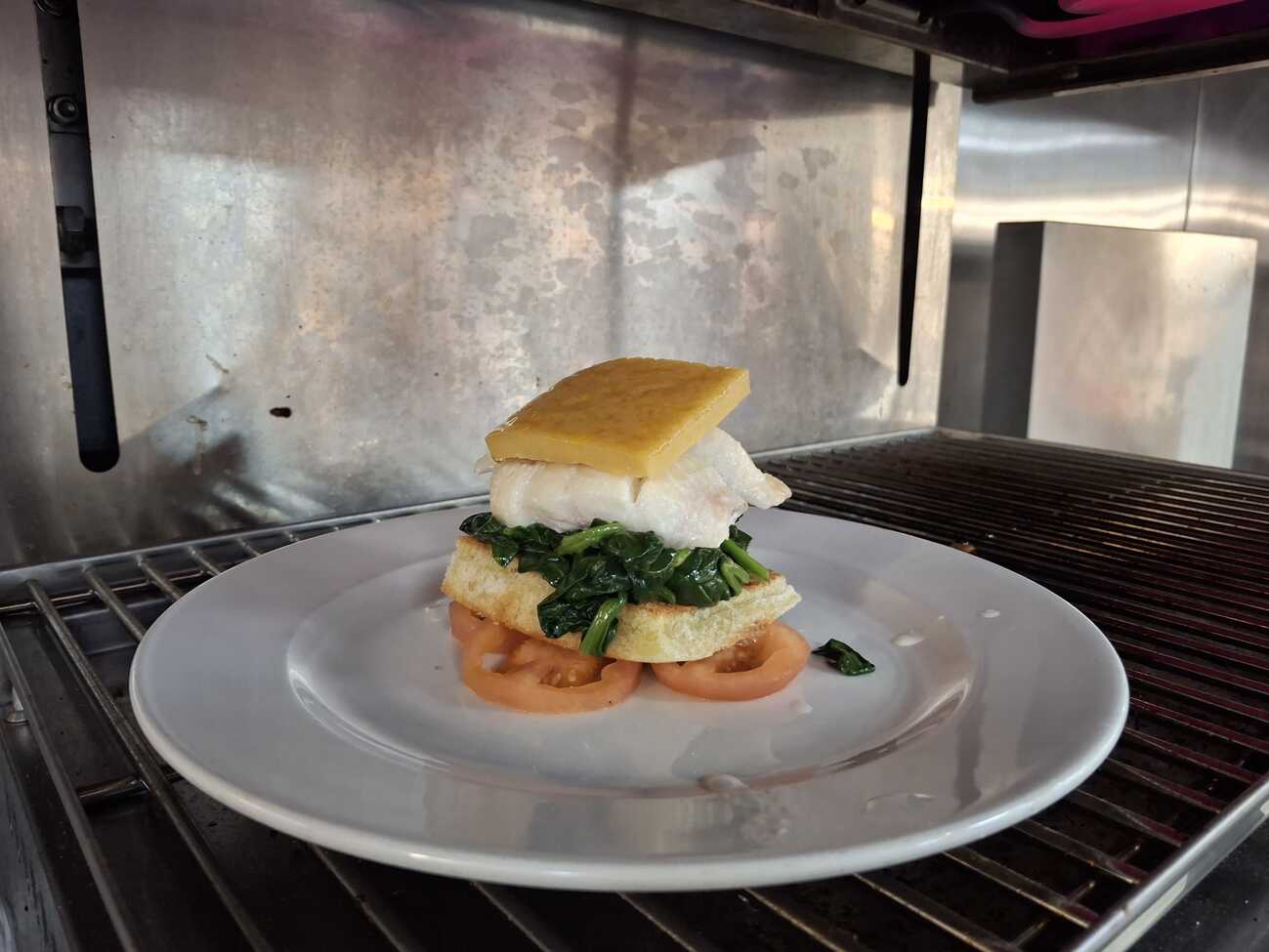
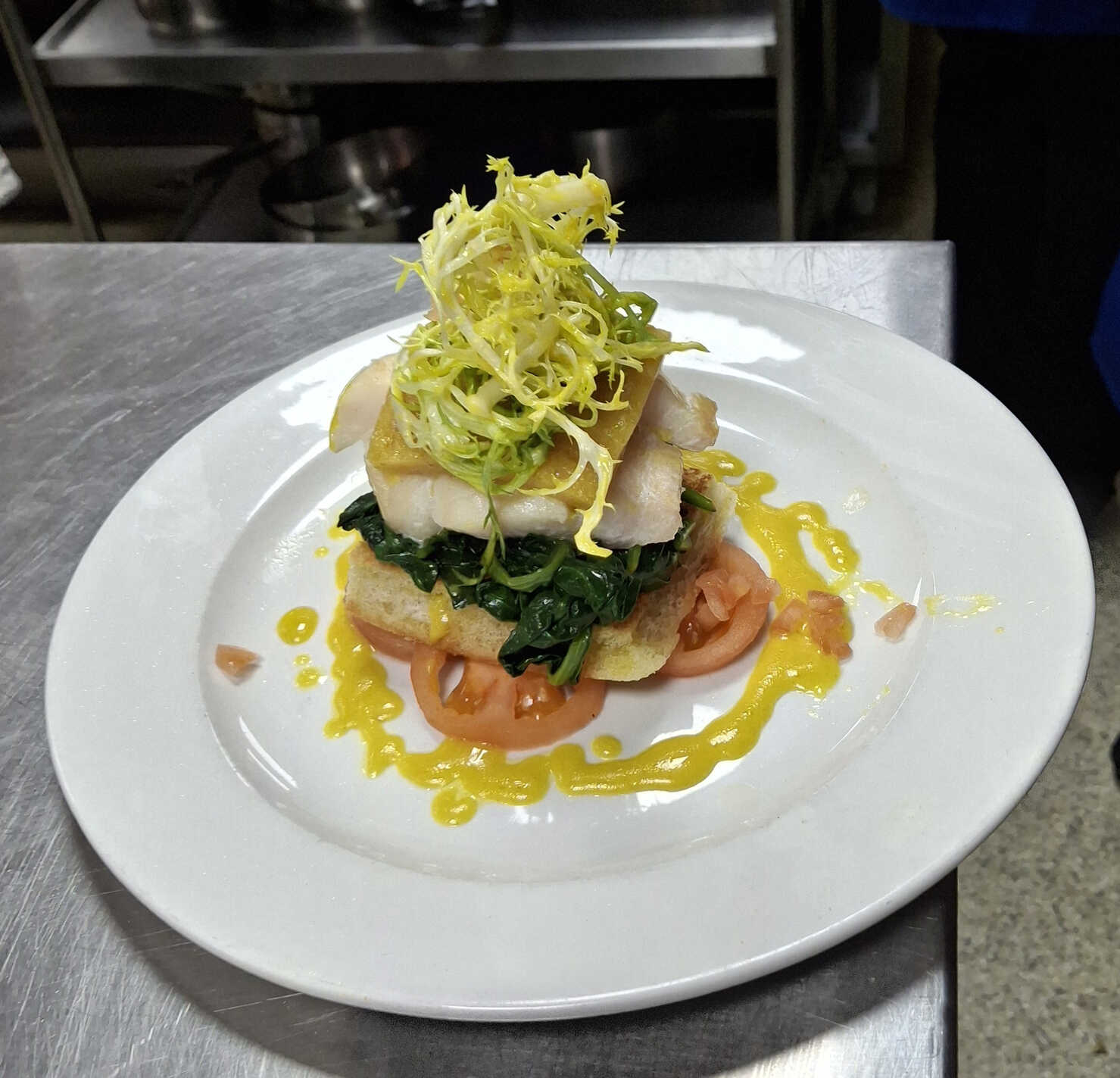
Teacher Paul's rarebit technique follows Gary Rhodes somewhat in creating a thick, goopy flour panade which sets like jelly, rather than a runny sauce.
But he begins with making a traditional flour-and-butter roux.
But he begins with making a traditional flour-and-butter roux.
Makes enough Rarebit for 4
Ingredients
- 1 fillet undyed smoked haddock per person
For the Welsh Rarebit:- 2 egg yolks
- 150ml double cream
- 1 teaspoon prepared English mustard
- 100g grated uncoloured cheddar
- salt & pepper
- a few dashes of Tabasco or a few pinches of cayenne pepper
- Worcestershire sauce
- 25g butter
- 25g flour
- splash of ale optional
For the Spinach:- spinach, washed, dried
- pepper
- knob of butter
- grating of nutmeg
Salad Dressing:- olive oil
- white wine vinegar
- prepared English mustard
- salt & pepper
For the Garnishes:- frisée lettuce, washed, dried
- 1-2 tomatoes per person
Prepare:
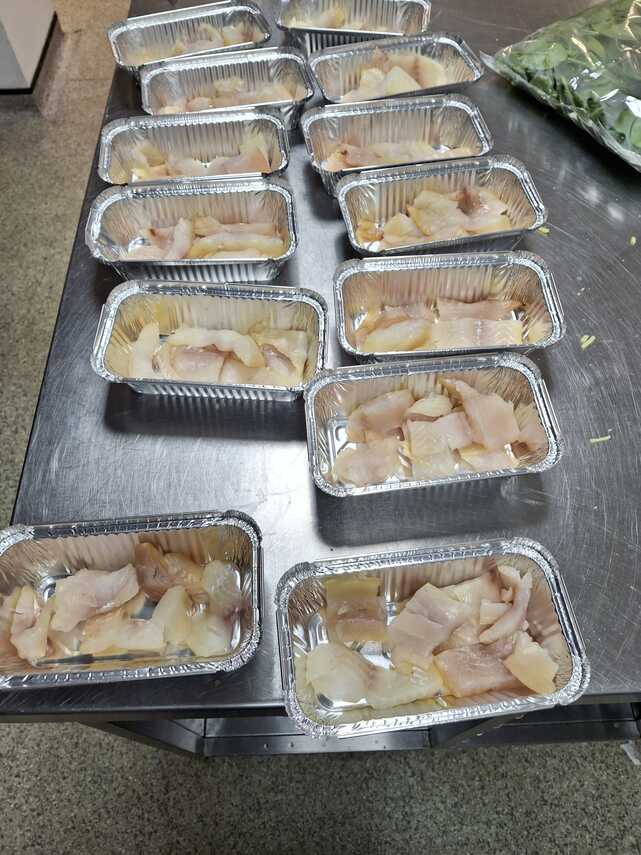
Portion the smoked haddock
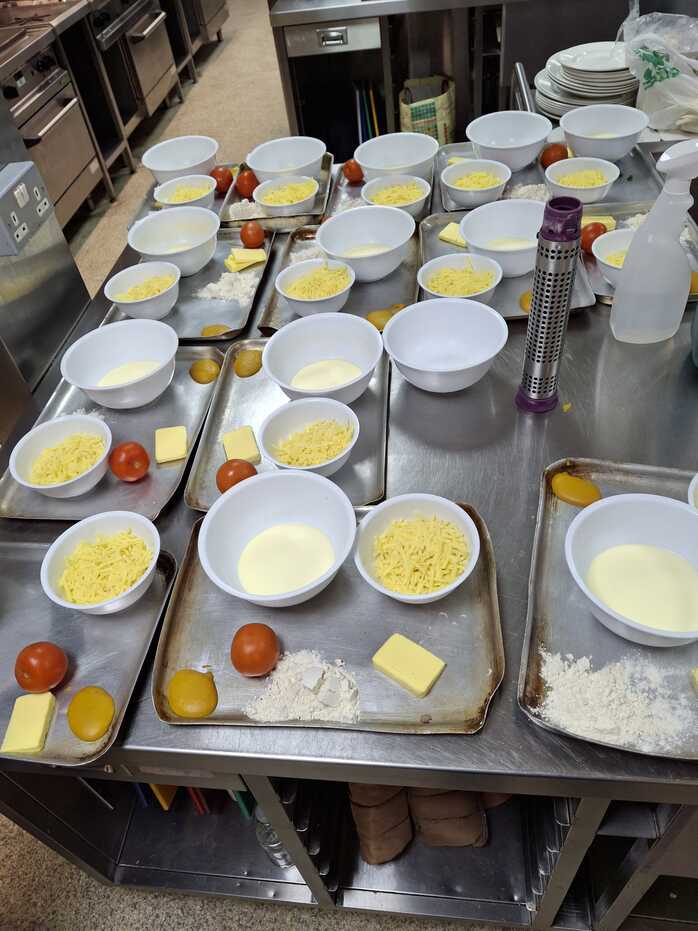
Grate cheese for rarebit
Measure out the mustard, ale/cream, Worcestershire sauce
Prepare the spinach - thoroughly wash & drain it.
Wash and dry the frisée lettuce.
Grate fresh nutmeg
Prepare poaching liquid - season the milk or milk & water with pepper and, if you like, a grating of nutmeg. The fish will be salty enough already.
Slice the bread for the rarebit base.
Make Welsh Rarebit Mixture:
Melt butter in small pan.
Add flour and cook for a minute to make a roux.
Add ale/cream gradually to form a smooth white sauce. Warm gently until thickened, keeping the heat moderate to prevent splitting.
Add cheese and stir to melt in gently.
Add mustard & Worcestershire sauce, and season lightly.
Keep warm or chill until needed.
Poach the Smoked Haddock:
Heat poaching liquid gently.
Add haddock skin-side down.
Poach at a gentle simmer. The fish should remain delicate and translucent and be only just cooked through.
Drain on tray.
Keep warm under foil. Or you can just leave them in the poaching liquid until required.
Make up the Dressing:
Whisk together olive oil and vinegar in proportions of roughly 3:1. Season generously with salt and pepper and beat in a spoonful of prepared English mustard.
Prepare the Tomatoes:
Cut a cross in the top of the tomatoes, and slice around the core.
Drop the tomatoes into a pot of boiling water for anything up to a minute until the skin begins to separate and immediately drop into cold water to prevent overcooking.
Slice the tomatoes equatorially from the top down, and arrange the slices in an overlapping circle in the centre of the serving plate. Season with salt & pepper.
Wilt the Spinach:
Heat butter in saucepan
Add spinach and wilt gently
Add grated nutmeg
Taste and season with salt & pepper
Drain excess liquid if needed
Assemble:
Cut out a section of the chilled rarebit layer with a hot knife to the size of your haddock fillet and lay it on top like a hat.
Toss the frisée lightly in the dressing and pile on top.
Drizzle extra dressing over and around, adding a few concassé tomatoes or snipped chives.
Wipe the edges of the plate clean of any dribbles and serve.
Portion the smoked haddock
Grate cheese for rarebit
Measure out the mustard, ale/cream, Worcestershire sauce
Prepare the spinach - thoroughly wash & drain it.
Wash and dry the frisée lettuce.
Grate fresh nutmeg
Prepare poaching liquid - season the milk or milk & water with pepper and, if you like, a grating of nutmeg. The fish will be salty enough already.
Slice the bread for the rarebit base.
Make Welsh Rarebit Mixture:
Melt butter in small pan.
Add flour and cook for a minute to make a roux.
Add ale/cream gradually to form a smooth white sauce. Warm gently until thickened, keeping the heat moderate to prevent splitting.
Add cheese and stir to melt in gently.
Add mustard & Worcestershire sauce, and season lightly.
Keep warm or chill until needed.
We chilled ours - cover a tray with clingfilm, spread the mixture over the tray to about 3mm depth, then cover completely with clingfilm and put in the fridge.
Although using clingfilm is convenient, it can be difficult to peel off when you need to use the rarebit. You might prefer to use greaseproof paper instead.
Although using clingfilm is convenient, it can be difficult to peel off when you need to use the rarebit. You might prefer to use greaseproof paper instead.
Poach the Smoked Haddock:
Heat poaching liquid gently.
Add haddock skin-side down.
Poach at a gentle simmer. The fish should remain delicate and translucent and be only just cooked through.
We just baked ours for 8-10 minutes in a 165°C (fan) oven.
Lift out with slotted spoon.Drain on tray.
Keep warm under foil. Or you can just leave them in the poaching liquid until required.
Make up the Dressing:
Whisk together olive oil and vinegar in proportions of roughly 3:1. Season generously with salt and pepper and beat in a spoonful of prepared English mustard.
The mustard will help hold the vinaigrette in suspension for longer.
Prepare the Tomatoes:
Cut a cross in the top of the tomatoes, and slice around the core.
Drop the tomatoes into a pot of boiling water for anything up to a minute until the skin begins to separate and immediately drop into cold water to prevent overcooking.
Slice the tomatoes equatorially from the top down, and arrange the slices in an overlapping circle in the centre of the serving plate. Season with salt & pepper.
You can take alternative approaches to using the tomatoes - halve them and fry them cut-side-down in a little oil to soften and warm them, without overcooking or collapsing them.
Or halve them, place them cut-side-up on an oven tray, season with salt and pepper, drizzle with a little olive oil and bake them at 180-200°C/Gas Mark 4-6 for 20 minutes until softened, but still holding their shape.
Arrange the halves decoratively around the serving plate.
Or halve them, place them cut-side-up on an oven tray, season with salt and pepper, drizzle with a little olive oil and bake them at 180-200°C/Gas Mark 4-6 for 20 minutes until softened, but still holding their shape.
Arrange the halves decoratively around the serving plate.
Wilt the Spinach:
Heat butter in saucepan
Add spinach and wilt gently
Add grated nutmeg
Taste and season with salt & pepper
Drain excess liquid if needed
Do not overcook - you want the spinach leaves to collapse a little but to retain their shape and not to darken excessively. They should still be a fairly bright green when plating.
You will need to squeeze out the spinach once it cools enough to handle.
You will need to squeeze out the spinach once it cools enough to handle.
Assemble:
Cut out a section of the chilled rarebit layer with a hot knife to the size of your haddock fillet and lay it on top like a hat.
Since our haddock had already been mysteriously broken into pieces, we just piled the bits onto the spinach toast and laid the rarebit slice on top.
Toast the bread lightly.
We removed the crust, rubbed the slice with a halved garlic clove, and fried the bread on both sides in a little olive oil to colour.
Place the bread on the plated tomatoes, cover with wilted spinach, top with the rarebit-covered haddock fillet and then slide the plate under a medium-hot salamander and grill until the rarebit is bubbling and golden.Toss the frisée lightly in the dressing and pile on top.
Drizzle extra dressing over and around, adding a few concassé tomatoes or snipped chives.
Wipe the edges of the plate clean of any dribbles and serve.
A very satisfying dish - the flavours of the spinach and endive are both contrasting and complementary.
My flour panade never really set properly. I think I should have used more flour, or cooked the mixture down for longer.
I would probably add more mustard to the rarebit mixture next time - although it did originally taste very strongly, the final flavour gets lost in the mix.
My flour panade never really set properly. I think I should have used more flour, or cooked the mixture down for longer.
I would probably add more mustard to the rarebit mixture next time - although it did originally taste very strongly, the final flavour gets lost in the mix.
Smoked Haddock with Welsh Rarebit
main cheese fish
Gary Rhodes' original and signature dish. Included here for reference.
It takes an unusual approach to making the flour panade by first blending the flour with the milk and cheese without cooking it out in a roux. The flattened rarebit itself will freeze or keep in the fridge for 10 days. You can also assemble the haddock fillets with their rarebit hat and keep them for days in the fridge too - covered tightly with clingfilm (to prevent the smoky flavour polluting everything else in the fridge).
It takes an unusual approach to making the flour panade by first blending the flour with the milk and cheese without cooking it out in a roux. The flattened rarebit itself will freeze or keep in the fridge for 10 days. You can also assemble the haddock fillets with their rarebit hat and keep them for days in the fridge too - covered tightly with clingfilm (to prevent the smoky flavour polluting everything else in the fridge).
Serves 4. Or maybe 20.
Ingredients
For 4 Servings:- 4 x 100g portion of skinned, trimmed natural smoked haddock fillet
- 6 plum tomatoes
- 175g Rarebit Mix
- Chopped chives
For the Rarebit (makes 16-20 servings):- 700g mature cheddar cheese, finely grated
- 150ml milk
- 50g plain flour
- 50g fresh white breadcrumbs
- 1 tbsp Colman's English mustard powder
- 1 tbsp Worcestershire sauce
- 2 eggs
- 2 egg yolks
For the Balsamic House Dressing (makes 500ml):- 200ml extra virgin olive oil 1st press
- 200ml groundnut oil
- 1 tsp salt
- ¼ tsp ground pepper
- Juice of 1 lemon
- 50ml white wine vinegar
- 50ml sherry vinegar
- Balsamic vinegar (8-year-old) few drops, to taste
- Salt
- Pinch of sugar
To Garnish:- Finely chopped chives to garnish
Make the Rarebit
In a heavy bottomed pan, very gently melt the cheese with the milk, make sure the cheese does not get too hot or the mix will split.
Once fully melted, add the flour, breadcrumbs, English mustard powder, stir in well and cook out in the pan until the cheese comes away from the sides and forms a ball. Remove from the pan and leave the mix in a bowl to cool.
Once cool, place the mix in a food processor and add the eggs and yolks plus the Worcestershire sauce, salt, ground white pepper and blitz until smooth. Do not overwork.
Prepare the Tomatoes and Dressing:
Mix all ingredient of the balsamic house dressing together.
Blanch the tomatoes in boiling water to make them easy to peel. This can take between 10 and 60 seconds depending on their ripeness.
Slice lengthways, and dress neatly in an overlapping circle of 6 slices per individual plate.
Sprinkle with a little salt and pepper and put in the fridge. Prepare the Haddock:
To Serve:
Preheat the oven to 180°C/Gas Mark 4, set the grill to medium.
Make sure the tomato plates are not served fridge cold either have a few out before service or just before serving - simply place under the lights for a minute.
Place the haddock fillet topped with the Welsh rarebit under a salamander to colour. Then place in a buttered pan and cook through in the oven for about 6-7 minutes.
Drizzle over the glazed cheese top with a little olive oil.
Dress the tomatoes with the dressing, sprinkle with chopped chives before placing the haddock portion on top.
In a heavy bottomed pan, very gently melt the cheese with the milk, make sure the cheese does not get too hot or the mix will split.
Once fully melted, add the flour, breadcrumbs, English mustard powder, stir in well and cook out in the pan until the cheese comes away from the sides and forms a ball. Remove from the pan and leave the mix in a bowl to cool.
Once cool, place the mix in a food processor and add the eggs and yolks plus the Worcestershire sauce, salt, ground white pepper and blitz until smooth. Do not overwork.
Alternatively you can beat the mixture vigorously with a wooden spoon if you don't have a food processor.
Once cool place between sheets of either greaseproof parchment or cling film and roll out to about 3mm deep. Place flat in the fridge to set before cutting with a hot knife, exact portion sizes to fit the haddock portions.
The mixture will now be very pliable and easy to handle.
When topped, lay the haddock portions neatly in a tray and cling film tightly - do not stack as they will sweat.Prepare the Tomatoes and Dressing:
Mix all ingredient of the balsamic house dressing together.
Blanch the tomatoes in boiling water to make them easy to peel. This can take between 10 and 60 seconds depending on their ripeness.
Slice lengthways, and dress neatly in an overlapping circle of 6 slices per individual plate.
Sprinkle with a little salt and pepper and put in the fridge. Prepare the Haddock:
To Serve:
Preheat the oven to 180°C/Gas Mark 4, set the grill to medium.
Make sure the tomato plates are not served fridge cold either have a few out before service or just before serving - simply place under the lights for a minute.
Place the haddock fillet topped with the Welsh rarebit under a salamander to colour. Then place in a buttered pan and cook through in the oven for about 6-7 minutes.
Drizzle over the glazed cheese top with a little olive oil.
Dress the tomatoes with the dressing, sprinkle with chopped chives before placing the haddock portion on top.
Seems a massive quantity of rarebit to make up, but then I guess he was serving it in a restaurant.
Adjust for making at home!
Adjust for making at home!
I found my roux splitting and leaking butter, which doesn't happen to me very often. Perhaps I had too much butter, or the pan was too hot to begin with?
You can cure this by adding a little more flour to soak up the extra fat, but it did re-incorporate at the end anyway when I beat in the egg yolks.