Introduction to Bistro Cookery - Trout Bout
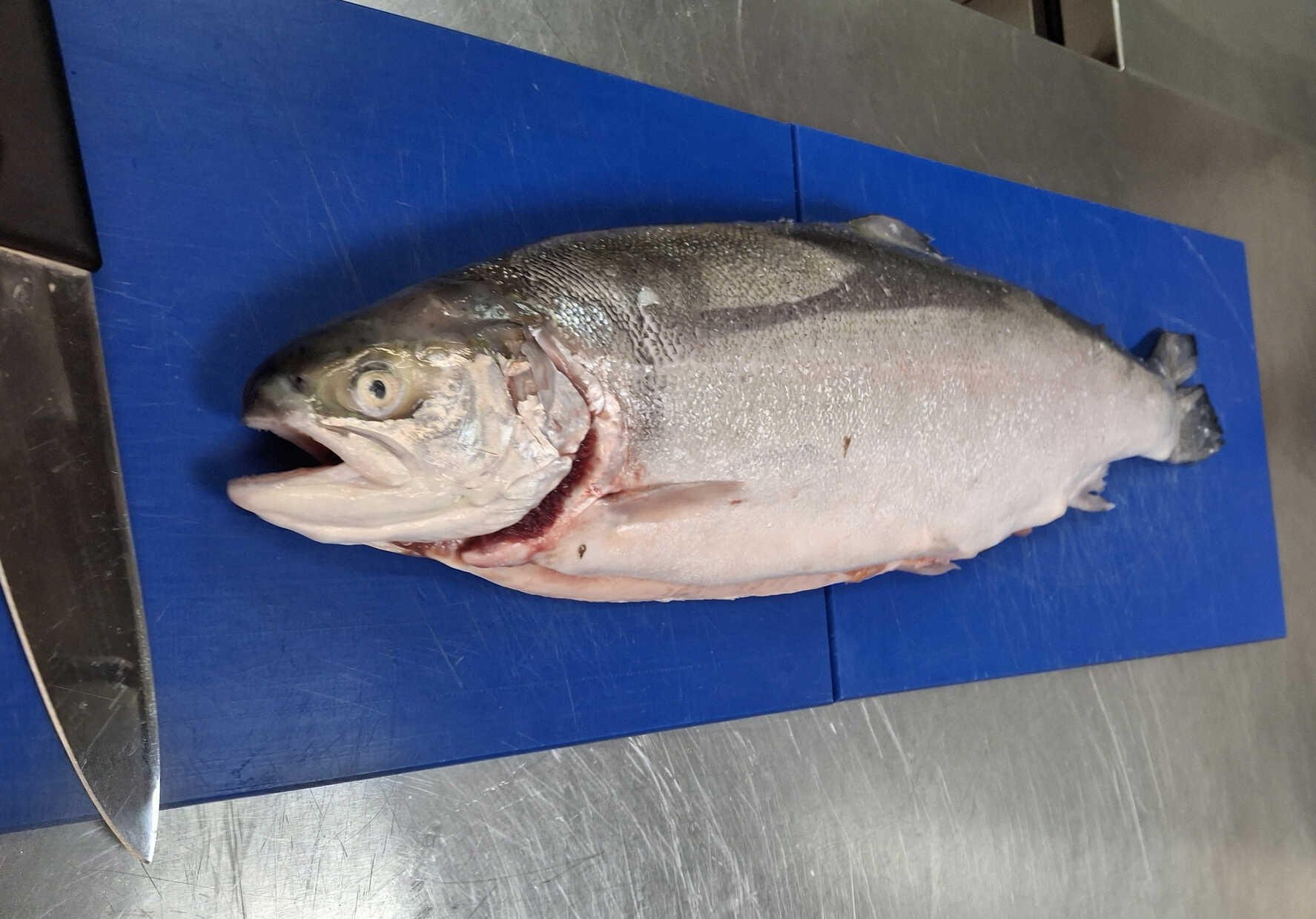
My what a big mouth you have!
Teacher Paul procured another GIANT fish for the class to work with in this very last class of our course - this time a trout for the making of Trout Almondine. (Other names are also available.)
Salmon (last lesson's fish) and trout are closely related fish - both are members of the Salmonidae family. Salmon migrate from salt to fresh water, whereas trout spend their lives in freshwater rivers and lakes. Mostly.
I assume, from it's surprising size and intense colour, that this was a farmed fish.
It seems the school is currently having some difficulty in acquiring more normal-sized trout.
The orange colour of salmon and trout bodies is caused by a carotenoid called astaxanthin from their consumption of shrimp and small crabs as part of their native diet. The unnaturally fluorescent orange of farmed salmon and trout flesh is produced by feeding the fish synthetic colour supplements.
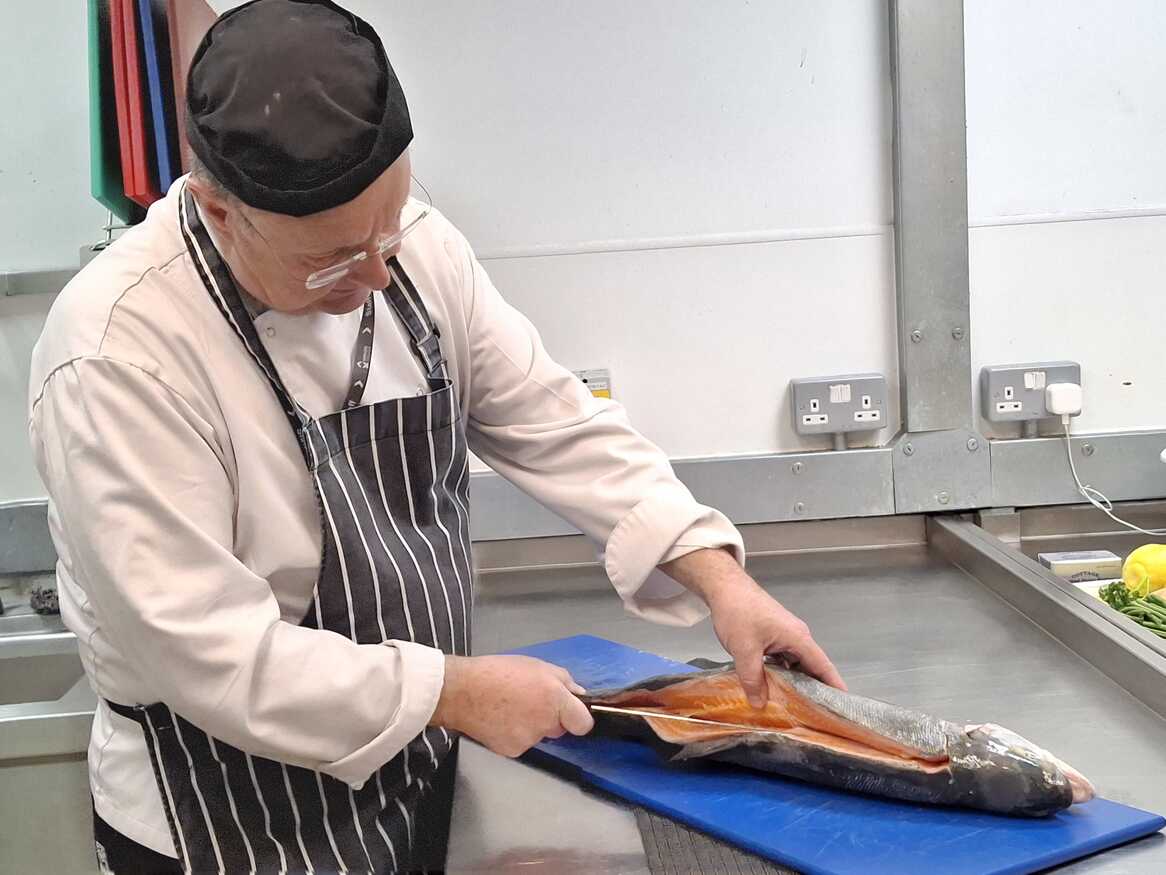
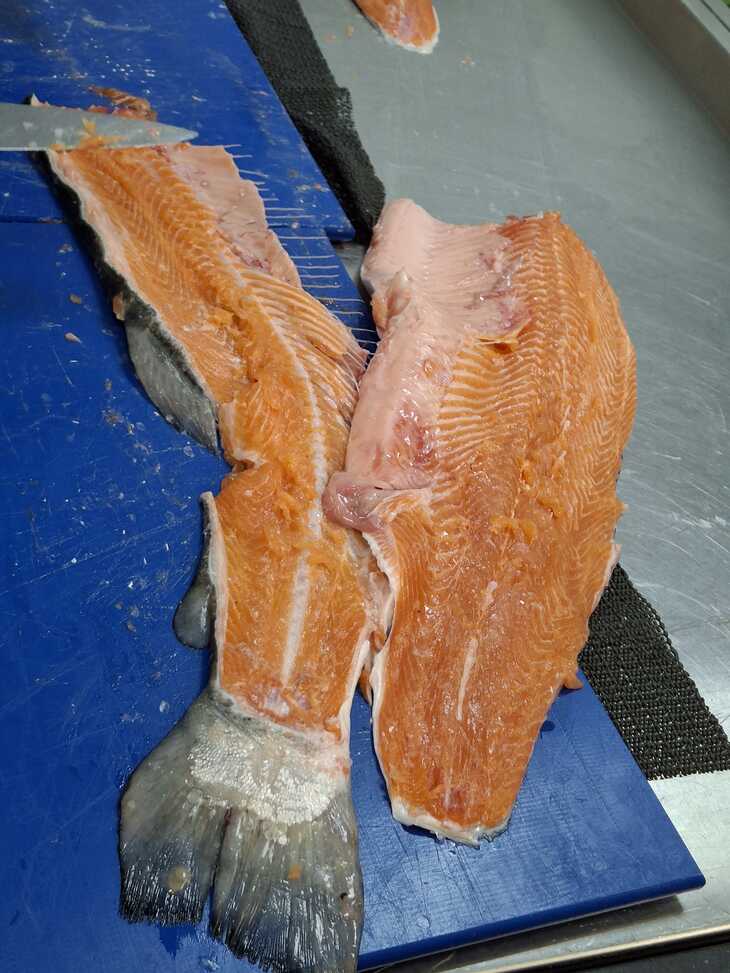
Teacher Paul demonstrated how to fillet a trout or salmon in the more common way along the backbone. Which essentially means cutting in from the top of the fish, and then slicing from head to tail or tail to head to release the whole side.
Turn the fish over and repeat.
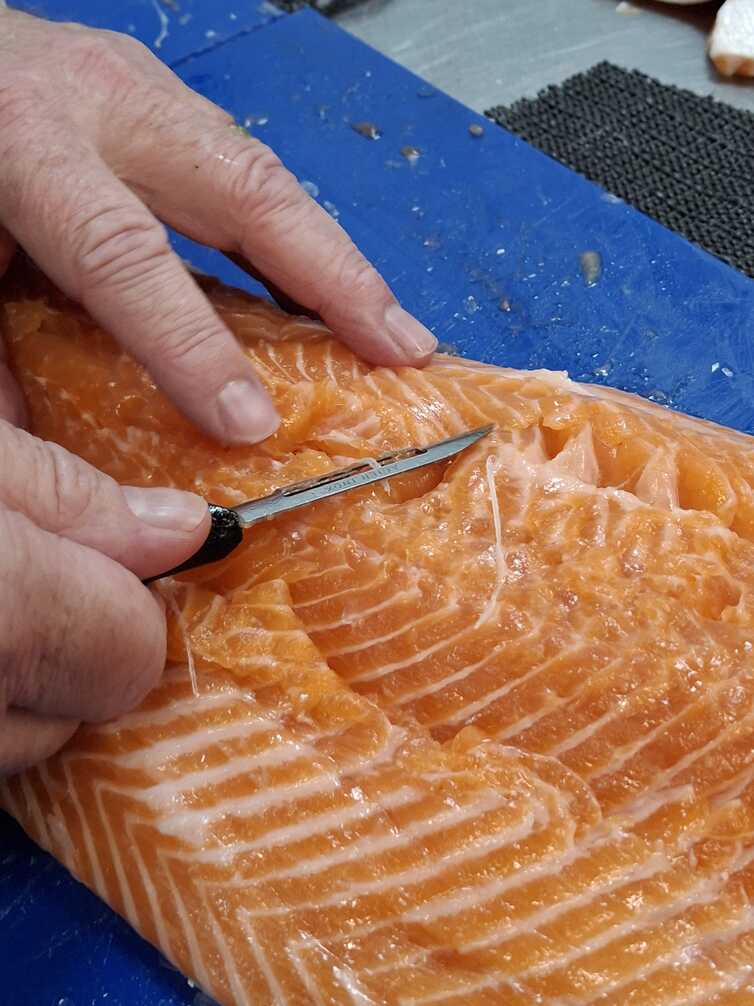
Now de-bone the fillets - first raise the pin bones by running the back of your knife along the fillet, then grab and remove them using kitchen pliers, fish tweezers, or by twisting them out using one of those old-fashioned potato peelers.
That just leaves the fish's skeleton with its head attached. Do not waste it - it's full of fish!
Despite the controversy over the authenticity of almond trout it is still considered by most non-food-snobs to be a classic, and remains a staple of Parisian bistro menus.
Though I made a more classic version, Teacher Paul opted to follow a radical recipe from the Hairy Bikers. Your mileage may vary.
They do though suggest adding capers - apologies Teacher Paul!
The final PaulPointers™ for this course:
The only tricky part is balancing the seasoning of the whole dish, since the rice will now be pretty salty.
Teacher Paul procured another GIANT fish for the class to work with in this very last class of our course - this time a trout for the making of Trout Almondine. (Other names are also available.)
Salmon (last lesson's fish) and trout are closely related fish - both are members of the Salmonidae family. Salmon migrate from salt to fresh water, whereas trout spend their lives in freshwater rivers and lakes. Mostly.
I assume, from it's surprising size and intense colour, that this was a farmed fish.
It seems the school is currently having some difficulty in acquiring more normal-sized trout.
The orange colour of salmon and trout bodies is caused by a carotenoid called astaxanthin from their consumption of shrimp and small crabs as part of their native diet. The unnaturally fluorescent orange of farmed salmon and trout flesh is produced by feeding the fish synthetic colour supplements.
Teacher Paul demonstrated how to fillet a trout or salmon in the more common way along the backbone. Which essentially means cutting in from the top of the fish, and then slicing from head to tail or tail to head to release the whole side.
Turn the fish over and repeat.
Now de-bone the fillets - first raise the pin bones by running the back of your knife along the fillet, then grab and remove them using kitchen pliers, fish tweezers, or by twisting them out using one of those old-fashioned potato peelers.
That just leaves the fish's skeleton with its head attached. Do not waste it - it's full of fish!
- You can deep-fry and eat them!
- You can strip off all the flesh from the bones and mix it into mashed potato, pasta or rice, make fish patties, add to soups, make dumplings, make hash.
- Or you can roast the skeleton, then strip it and do much pretty the same things with the meat, including grinding into a spread, dressing salads or making sandwiches.
- Or you can make fish stock or broth with the skeleton, before or after roasting. But. First remove the gills and eyeballs.
Though you can eat the eyeballs separately - deep-fried, grilled, or boiled, the gills are extremely bitter and must be discarded.
Never with butter, never with almonds; that is not cooking, it is packaging
Despite the controversy over the authenticity of almond trout it is still considered by most non-food-snobs to be a classic, and remains a staple of Parisian bistro menus.
Though I made a more classic version, Teacher Paul opted to follow a radical recipe from the Hairy Bikers. Your mileage may vary.
They do though suggest adding capers - apologies Teacher Paul!
The final PaulPointers™ for this course:
- Teacher Paul warns that trout are aggressively carnivorous (like most birds, though I'm not sure why that was relevant) - so watch out for their teeth!
- Teacher Paul once again explains the importance of properly cooking Bacteria Burgers. Bacteria, you see, lives on the outside of the cow.
So when you cook a fine steak it presents no risk to leave the inside practically raw.
However, when you mince it all up, mixing the bacteria-laden outside with the pure, clean insides, you now need to thoroughly cook the whole thing to avoid food poisoning.
The same may apply to fish burgers. Who knows? - Teacher Paul revisited his complaints about the propensity for parsley and spinach to pick up mud from their growing field. This means they absolutely must be washed thoroughly.
He recommends first chopping parsley just before using it, then rinsing it thoroughly afterwards to avoid turning it to green mush.
Though this might work when you have massive quantities, personally I still find it easer to wash the whole stalks of parsley, shake them dry against kitchen paper, and then mince it. - Teacher Paul demonstrated the process of par-cooking, cooling then refreshing or rethermalizing our potato and green beans to ease the complexity of timing preparations for serving.
Just pre-cook, chill, and set aside.
The re-heating for service then takes only seconds. - Teacher Paul mistakenly referred to this a Réchauffé - which is in fact the culinary term for warming up leftovers, or re-purposing them in a new cooked dish, such as shepherd's pie.
The only tricky part is balancing the seasoning of the whole dish, since the rice will now be pretty salty.
menu
A Bout of Trout
Almond Trout
Almond Trout
A definite Bistro Classic. Finally!
Green Beans
Haricots Verts are a traditional accompaniment.
New Potatoes
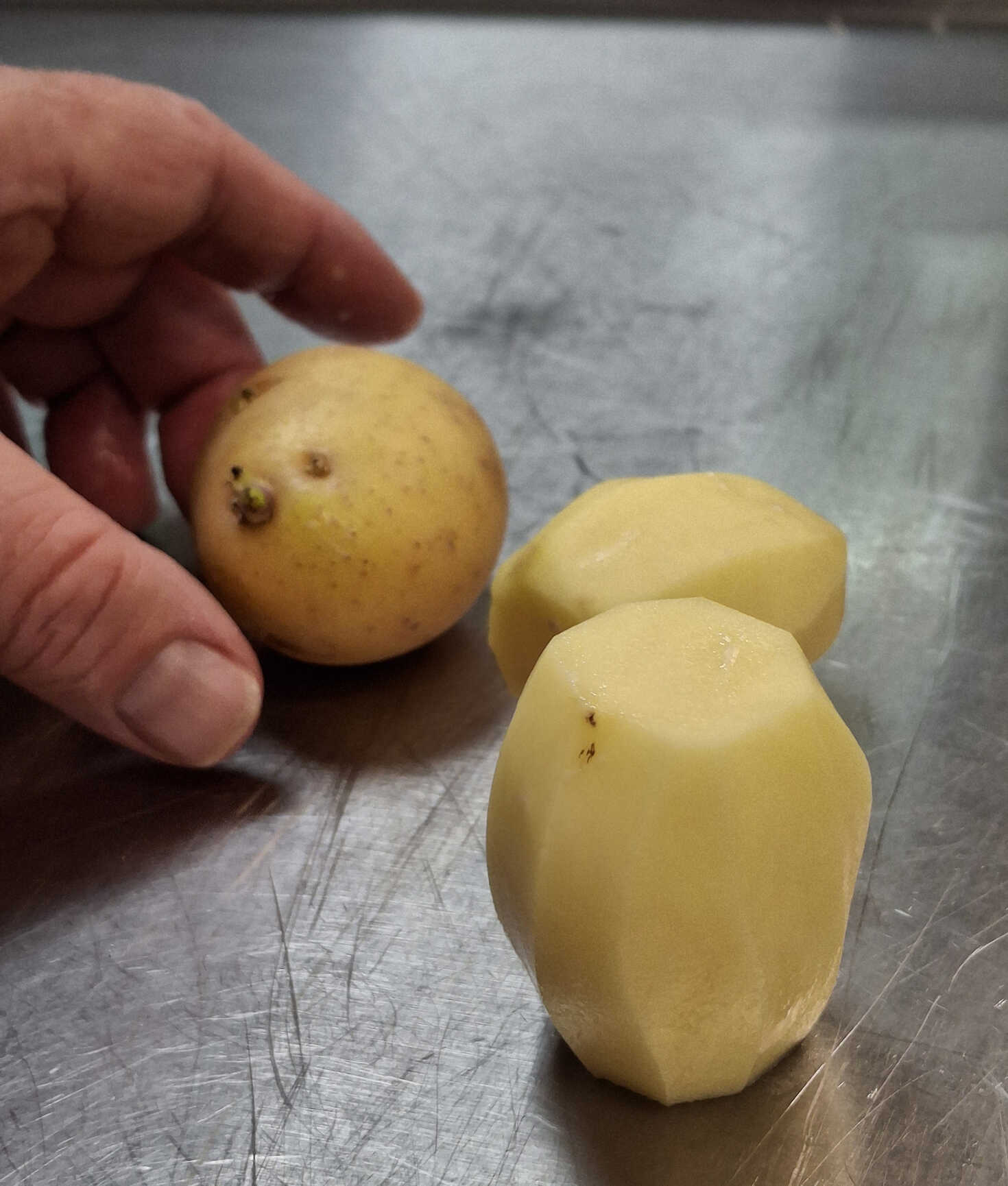
Turned, for your pleasure.
Classic Almond Trout
Truite aux Amandes
Truite aux Amandes
class main fish
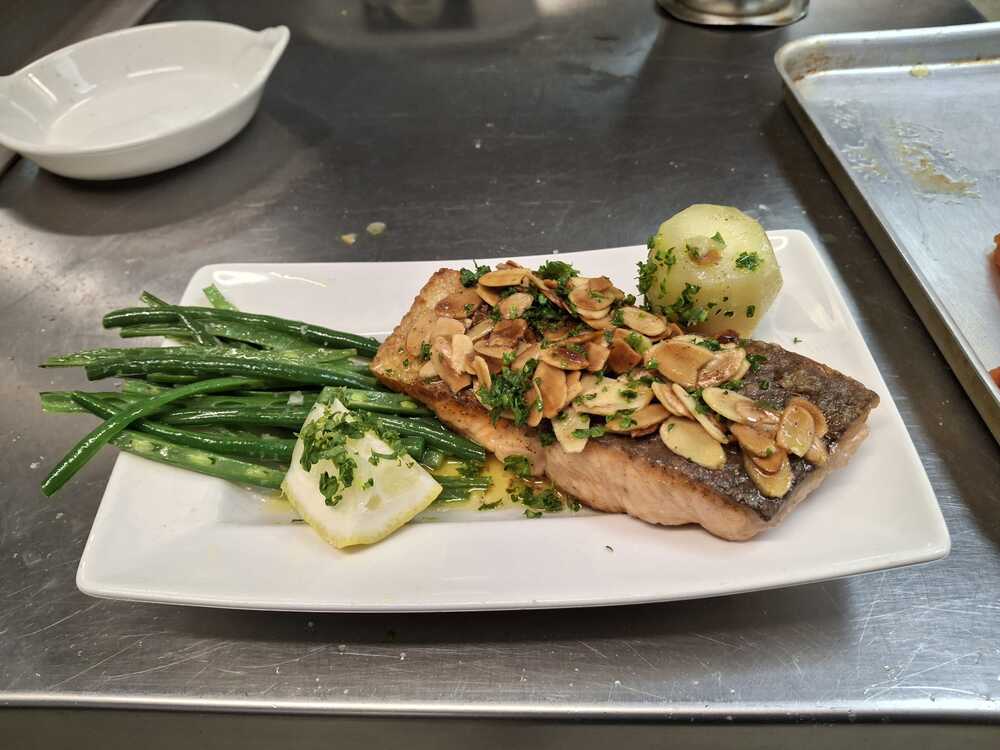
Almond Trout A.K.A Trout Almondine A.K.A. Trout Amandine A.K.A Truite aux Amandes depending on how Frenchified you want the name to sound,
is a Bistro classic.
Despite what you might have heard.
It's prepared by first coating the fish (whole or filleted) in flour, then pan-frying - a style known as à la meunière or in the style of the miller's wife (the meunière).
This is most typically exemplified in Sole Meunière.
Other variations add the interest of currants and capers to the sauce, this time made with chopped whole almonds rather than flaked, vaguely echoing Jean-Georges Vongerichten's signature caper-raisin sauce.
Traditionally served with green beans and steamed fingerling or new potatoes. Though you could try mash and a green salad. Or a lemony couscous?
Despite what you might have heard.
It's prepared by first coating the fish (whole or filleted) in flour, then pan-frying - a style known as à la meunière or in the style of the miller's wife (the meunière).
This is most typically exemplified in Sole Meunière.
Other variations add the interest of currants and capers to the sauce, this time made with chopped whole almonds rather than flaked, vaguely echoing Jean-Georges Vongerichten's signature caper-raisin sauce.
Traditionally served with green beans and steamed fingerling or new potatoes. Though you could try mash and a green salad. Or a lemony couscous?
Serves 2
Ingredients
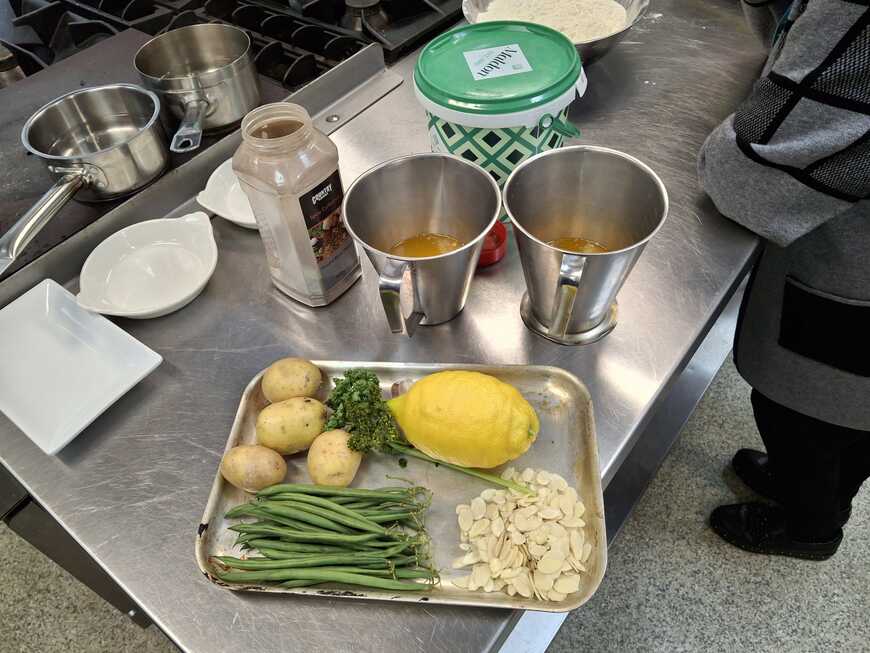
- 2 fresh trouts clean and scaled
- 4 tablespoon of plain flour
- 1 tablespoon of oil
- 40 grams European style salted butter
Meuniere butter:- 1 lemon
- 80 grams of salted butter
- 4 tablespoons of toasted almonds
For the garnish:- 1 lemon peeled and sliced
- 2 tablespoon of chopped parsley
Start by cleaning trouts. When clean pat them fry and store them on a tray in the fridge for later use.
Continue with the food preparation: weigh the butter, chop the parsley, juice 1 of the lemon and peel the other one.
When done pour the flour in a tray or a plate, take the trouts out of the fridge and coat them lightly with some of the flour.
Place a large pan of fish pan on the stove on medium to high heat and add a tablespoon of oil and the 40 grams of butter.
When the butter start to foam add the trout in the pan (the trout belly should be facing toward the top of the pan).
Leave the trout to cook in the butter on one side first for 4 minutes then turn it over to the other side and cook it for a further 4 minutes. (While the trout are cooking make sure you drizzle them butter regularly with a spoon.)
After 8 minutes turn the heat off and leave the trout in the pan to rest while you make the brown butter and toast the almonds.
For the almonds you have 2 options: you can either toast them dry in a clean pan on their own or cook them with the butter when making the brown butter.
To make the brown butter place the 80 grams of butter in a small saucepan on medium heat until it begins to foam. The color will progress from lemony-yellow to golden-tan to, finally, a toasty-brown. Once you smell that nutty aroma, the butter is ready. You can turn the heat of and serve.
Serving the fish:
When the brown butter is ready place the trouts on a serving dish (the head on the left side and the fish belly facing toward you Why, particularly?). Cover them with the freshly squeeze lemon juice, pour the brown butter over and finish off with the parsley followed by a few sprinkles of almonds.
Serve with a side of mash or boiled potatoes, steam green beans, cauliflower, courgettes.
Pair with a dry white from burgundy (Chablis) or the Loire valley (Muscadet).
Bon appetit.
Continue with the food preparation: weigh the butter, chop the parsley, juice 1 of the lemon and peel the other one.
When done pour the flour in a tray or a plate, take the trouts out of the fridge and coat them lightly with some of the flour.
Place a large pan of fish pan on the stove on medium to high heat and add a tablespoon of oil and the 40 grams of butter.
When the butter start to foam add the trout in the pan (the trout belly should be facing toward the top of the pan).
Leave the trout to cook in the butter on one side first for 4 minutes then turn it over to the other side and cook it for a further 4 minutes. (While the trout are cooking make sure you drizzle them butter regularly with a spoon.)
After 8 minutes turn the heat off and leave the trout in the pan to rest while you make the brown butter and toast the almonds.
For the almonds you have 2 options: you can either toast them dry in a clean pan on their own or cook them with the butter when making the brown butter.
To make the brown butter place the 80 grams of butter in a small saucepan on medium heat until it begins to foam. The color will progress from lemony-yellow to golden-tan to, finally, a toasty-brown. Once you smell that nutty aroma, the butter is ready. You can turn the heat of and serve.
Serving the fish:
When the brown butter is ready place the trouts on a serving dish (the head on the left side and the fish belly facing toward you Why, particularly?). Cover them with the freshly squeeze lemon juice, pour the brown butter over and finish off with the parsley followed by a few sprinkles of almonds.
Serve with a side of mash or boiled potatoes, steam green beans, cauliflower, courgettes.
Pair with a dry white from burgundy (Chablis) or the Loire valley (Muscadet).
Bon appetit.
Can attest that the fish did taste lovely!
The Hairy Biker's Trout Almondine
class main fish
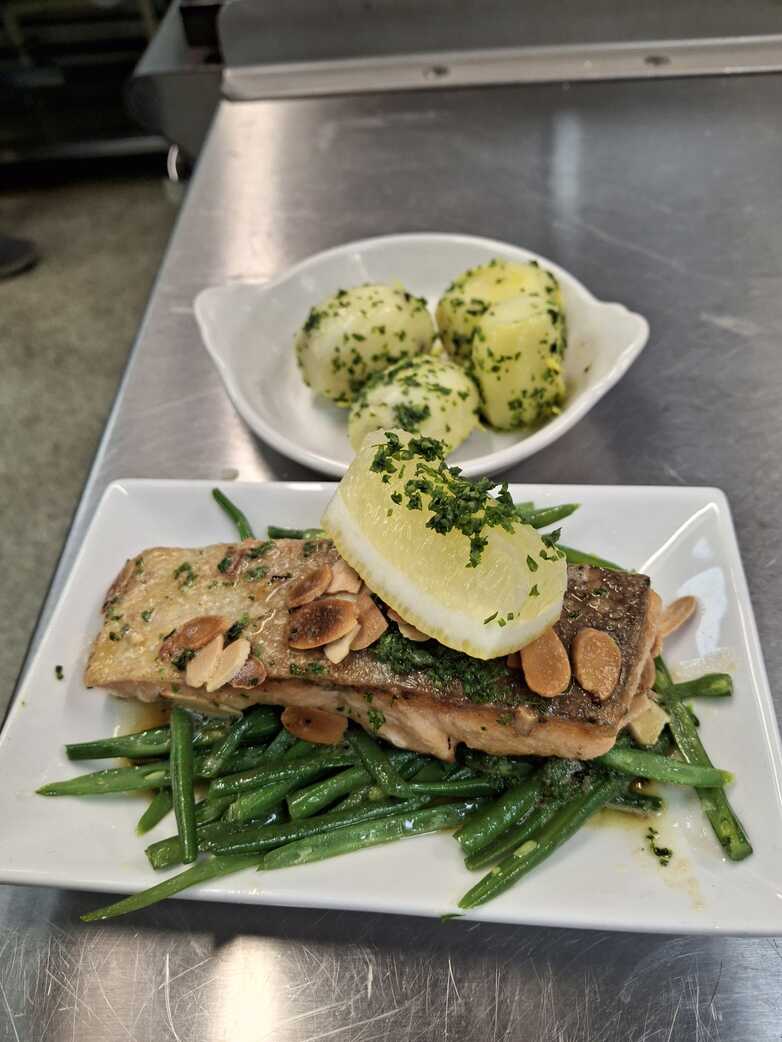
This Hairy Biker's version of Almond Trout takes liberties with the meunière coating.
They add ground almonds to it.
Teacher Paul instead tried adding almond flakes to the flour. I would say it was less successful.
Teacher Paul instead tried adding almond flakes to the flour. I would say it was less successful.
Serves 2
Ingredients
- 2 large trout fillets, sea trout or arctic char, pin-boned
- 200ml/7fl oz whole milk
- 2 tbsp ground almonds
- 2 tbsp flour, seasoned with salt and pepper
- 1 tbsp olive oil
- 50g/1¾oz butter
- 2 tbsp flaked almonds
- 2 tbsp finely chopped parsley
- 1 tbsp chopped capers
- 1 lemon, juice and zest
Dry the fish fillets with kitchen paper and set aside.
Take two bowls, in one add the milk, in the other add the seasoned flour and ground almonds.
Dip this fish fillets in the milk and then press into the almond flour mixture until completely coated.
Heat a frying pan and add the olive oil and half the butter. Place the fish into the hot pan skin side up and fry for 2 minutes until the surface is golden-brown and crisp. Turn the fish over and cook on the skin side for 5 minutes, or until cooked through. Put the fish on a warm plate and set aside.
Add the remaining butter to the frying pan, allow to bubble and then add the flaked almonds and cook for a few minutes until toasted. Add the parsley, capers, lemon zest and juice. Warm for about 30 seconds.
Place the fish fillets on a serving plate and sprinkle over the flaked almond mixture. Serve with new potatoes and green beans.
Take two bowls, in one add the milk, in the other add the seasoned flour and ground almonds.
Dip this fish fillets in the milk and then press into the almond flour mixture until completely coated.
Heat a frying pan and add the olive oil and half the butter. Place the fish into the hot pan skin side up and fry for 2 minutes until the surface is golden-brown and crisp. Turn the fish over and cook on the skin side for 5 minutes, or until cooked through. Put the fish on a warm plate and set aside.
Add the remaining butter to the frying pan, allow to bubble and then add the flaked almonds and cook for a few minutes until toasted. Add the parsley, capers, lemon zest and juice. Warm for about 30 seconds.
Place the fish fillets on a serving plate and sprinkle over the flaked almond mixture. Serve with new potatoes and green beans.
The capers would probably have been a nice addition.
Green Beans
Haricots Verts
Haricots Verts
class veg side
Teacher Paul likes to slice his beans in half lengthways for better mouthfeel.
I tend to agree with his assessment.
Ingredients
- green beans
Chop the beans as you prefer - split them lengthways if you like.
Drop into boiling water, bring back to a simmer, and cook for about 30 seconds.
Drop them into iced or running water to quickly chill them, then set them aside until needed.
Reheat them for serving by frying or dropping them briefly into boiling water again.
Drop into boiling water, bring back to a simmer, and cook for about 30 seconds.
Drop them into iced or running water to quickly chill them, then set them aside until needed.
Reheat them for serving by frying or dropping them briefly into boiling water again.
Add garnishes like butter, garlic, almonds (again), pine nuts, parsley, parmesan, lemon zest, lemon juice etc.
Turned Potatoes
class side veg staple
Like regular potatoes. But more turny 🙂
Ingredients
- potatoes
Turn the potatoes.
Reheat in boiling water, glaze with butter, dip in finely chopped parsley to dress.
This means peeling (preferably with a paring knife) them all into regularly-sized, roughly barrel shapes. Traditionally 7-sided - the odd number of sides supposedly promoting even cooking.
Par-cook the potatoes, refresh in running or iced water.Reheat in boiling water, glaze with butter, dip in finely chopped parsley to dress.