Artisan Bread - The Bread Bomb
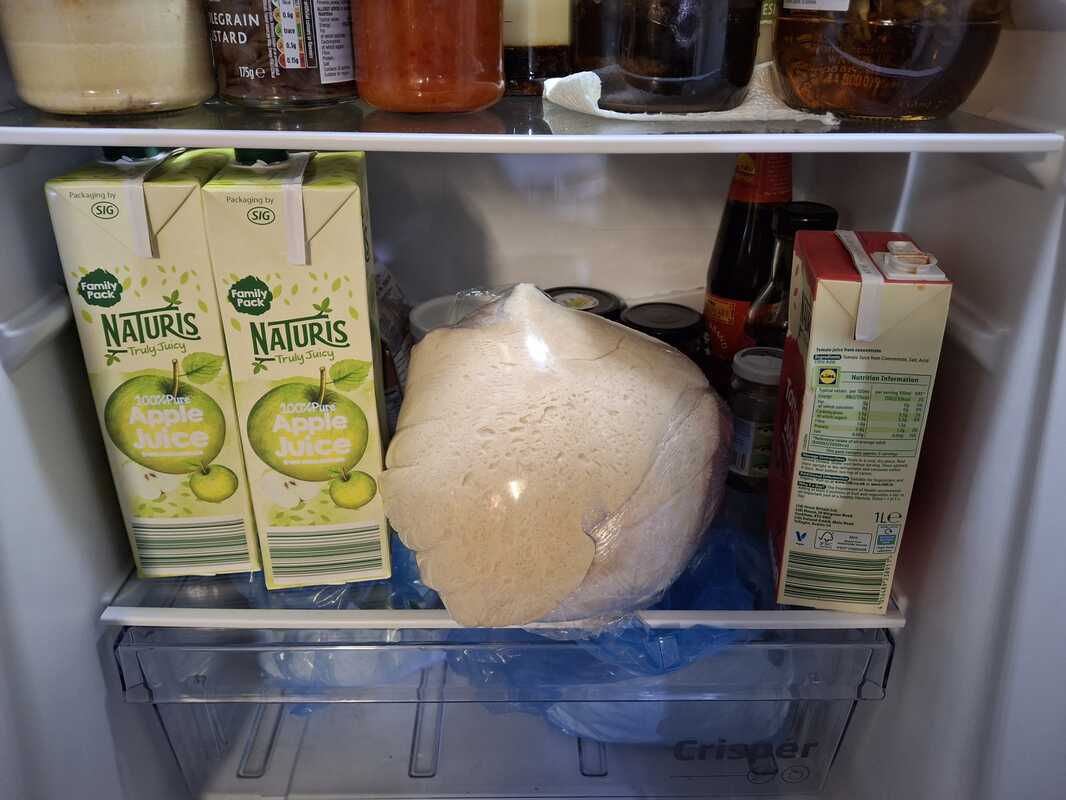
In which we learn that a mass of fermenting dough, tightly sealed in clingfilm, is liable to explode!
It's the start of a brand new course on how to make Artisan Breads, for which we are blessed with an Bulging-Cadillac double act!
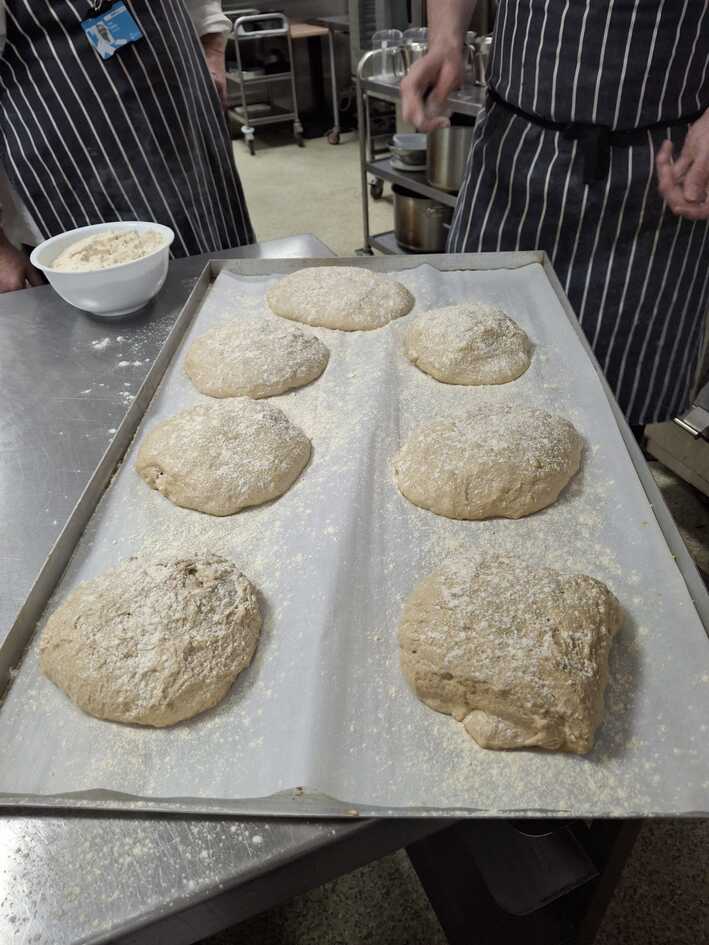
They walked us through the process of creating our first rustic loaves, for which we mixed and kneaded the dough, wrapped it up tightly in plastic, and took it home for its overnight cold proving and subsequent baking.
My bread had issues though:
So what is this bread stuff anyway?
Gluten is what gives bread its chewiness and elasticity, and holds in the bubbles that develop when the yeast exhales carbon dioxide.
It is the network or matrix that forms when the proteins in flour hydrate, unfold and start to cross-link together.
These proteins are primarily Glutenin and Gliadin, which are both classes or aggregates of dozens of different individual types of protein. Found particularly in all kinds wheat flour, also barley, rye and some oats.
Strong flour contains a particularly large proportion of such proteins (12-14%) such as that produced from grinding hard wheat varieties, which is ideal for bread-making.
Durum wheat is not the general Italian phrase for hard wheat, as you might think, but is a specific hard wheat variety, and despite containing large quantities of glutens, they are of a particularly inelastic type unsuitable for baking high-volume soft loaves. Albeit perfect for making pasta and couscous.
It is my understanding based on this single cookery class that there are two approaches to developing this gluten matrix in bread dough:
Wheat grains consist of a dark outer layer of bran - consisting of fibre, B vitamins and protein.
Inside this is the endosperm which constitutes 85% of the kernel. This is largely starch and some protein.
Finally the tiny germ is the part which, under the right conditions, will sprout and grow into a new wheat plant and is made of fatty acids, protein, minerals, and vitamins B and E.
The germ is kind of like the yolk of an egg, and the endosperm is the white. I suppose that would make the bran the eggshell - if you could eat eggshells.
When the grain is watered, germinates, and is then dried or roasted it becomes malt which is full of flavour, enzymes and sugars like maltose.
All of these can be ground up to produce flours, and depending on how much of which parts of the kernel and what variety of plant, the flour will have different qualities.
Pure white flour is made from only the endosperm, increasingly brown flours include some bran and germ, and wholemeal flour is made from grinding up the whole grain. (Duh!)
Just to make baking simple, every country has its own complicated way of classifying their wheat flours.
Well, except for Britain which has three flours: Strong, Plain, and Self-Raising.
Oh and whole-wheat, but that hardly counts.
You pays your money, you takes your choice.
The French use a T-system, which was originally designed as a way of classifying flour for taxation, and is increasingly useless for determining what the flour is actually good for.
It technically measures the amount of ash which is left when the flour is burnt, as a proportion of the original weight - giving an indication of the amount of bran or germ contained.
5g of the flour is heated to 900°C for 80 minutes, then the remaining ash is weighed and a grade range assigned.
The Italians on the other hand grade the fineness of their flour with a Type designation, and the strength of the flour with a W-value.
Since you can't really grind fibre very finely the type also gives a good gauge of how much bran and germ is included in the flour.
I've always assumed they just grind up the whole grains, then sieve the result into the different types using different meshes. But I suspect that's just me.
Anyway, here is how their grades shake out:
So what is this yeast stuff anyway?
Yeast is a uni-cellular fungus which typically reproduces by budding or fission. This is distinct from moulds which are multicellular fungi that grow in long stringy colonies and reproduce by emitting spores.
Baker's yeasts eat the sugars carbohydrates in dough and excretes alcohol and carbon dioxide. The small amount of alcohol evaporates during baking, and the carbon dioxide turns the dough into a bubbly foam giving bread its springy leavened qualities.
Because of its cellular simplicity it's possible to dry out yeast which then enters a dormant state without dying, ready to spring back into life when re-hydrated.
Dried yeast does come in different forms though; instant, active and fast-acting.
It's the start of a brand new course on how to make Artisan Breads, for which we are blessed with an Bulging-Cadillac double act!
They walked us through the process of creating our first rustic loaves, for which we mixed and kneaded the dough, wrapped it up tightly in plastic, and took it home for its overnight cold proving and subsequent baking.
My bread had issues though:
- My dough exploded!
- Do NOT completely seal your dough in layers of clingfilm!
- My dough was impossible to remove the (floured) baking paper.
- Just decant to a bowl, and cover lightly with oiled cling film.
- My loaves were impossible to remove from the (fresh) (floured) baking paper.
- Use more Flour!
- The crust on my baked loaves was rather too thick and hard.
- Something to do with the way I punched down and re-kneaded the proved loaves. Explanation to come in later classes. Allegedly. Though a thicker tougher crust is also encouraged by continuing steaming after the first third of the baking time.
So what is this bread stuff anyway?
Gluten is what gives bread its chewiness and elasticity, and holds in the bubbles that develop when the yeast exhales carbon dioxide.
It is the network or matrix that forms when the proteins in flour hydrate, unfold and start to cross-link together.
These proteins are primarily Glutenin and Gliadin, which are both classes or aggregates of dozens of different individual types of protein. Found particularly in all kinds wheat flour, also barley, rye and some oats.
Strong flour contains a particularly large proportion of such proteins (12-14%) such as that produced from grinding hard wheat varieties, which is ideal for bread-making.
Durum wheat is not the general Italian phrase for hard wheat, as you might think, but is a specific hard wheat variety, and despite containing large quantities of glutens, they are of a particularly inelastic type unsuitable for baking high-volume soft loaves. Albeit perfect for making pasta and couscous.
It is my understanding based on this single cookery class that there are two approaches to developing this gluten matrix in bread dough:
- The no-knead method which requires little to no kneading, but a wetter, yeast-heavier dough than normal, and a long, slow proving in a cool or cold place.
During this process the gluten proteins naturally relax and chain together by themselves.
This is the method recommended by Teacher Aaron for producing artisan or rustic loaves with crisp crusts, open crumb and complex flavours. - The traditional method which involves kneading and stretching the dough to encourage the necessary process of long protein chains unrolling and bonding together.
This uses a slightly drier, less yeasty dough. A short, warm proving of only an hour or two is all that is then required to allow the dough to aerate and rise.
Absolutely typical for producing commercial loaves or Wonder bread clones.
Wheat grains consist of a dark outer layer of bran - consisting of fibre, B vitamins and protein.
Inside this is the endosperm which constitutes 85% of the kernel. This is largely starch and some protein.
Finally the tiny germ is the part which, under the right conditions, will sprout and grow into a new wheat plant and is made of fatty acids, protein, minerals, and vitamins B and E.
The germ is kind of like the yolk of an egg, and the endosperm is the white. I suppose that would make the bran the eggshell - if you could eat eggshells.
When the grain is watered, germinates, and is then dried or roasted it becomes malt which is full of flavour, enzymes and sugars like maltose.
All of these can be ground up to produce flours, and depending on how much of which parts of the kernel and what variety of plant, the flour will have different qualities.
Pure white flour is made from only the endosperm, increasingly brown flours include some bran and germ, and wholemeal flour is made from grinding up the whole grain. (Duh!)
Just to make baking simple, every country has its own complicated way of classifying their wheat flours.
Well, except for Britain which has three flours: Strong, Plain, and Self-Raising.
Oh and whole-wheat, but that hardly counts.
You pays your money, you takes your choice.
The French use a T-system, which was originally designed as a way of classifying flour for taxation, and is increasingly useless for determining what the flour is actually good for.
It technically measures the amount of ash which is left when the flour is burnt, as a proportion of the original weight - giving an indication of the amount of bran or germ contained.
5g of the flour is heated to 900°C for 80 minutes, then the remaining ash is weighed and a grade range assigned.
- T45 means that less than 0.50% of the original flour remains as ash. This will be the finest, refined, endosperm-only white flour.
- T55 means 0.50-0.60% ash. Which is the standard all-purpose French flour.
- T65 means 0.62-0.65% ash. Good for rustic or artisan breads, and sourdough.
- T80 means 0.75-0.90% ash. For country-style breads.
- T110 means 1.00-1.20% ash. Getting pretty dark and chewy now.
- T150 means upwards of 1.50% ash - basically farine intégrale or wholemeal flour.
The Italians on the other hand grade the fineness of their flour with a Type designation, and the strength of the flour with a W-value.
Since you can't really grind fibre very finely the type also gives a good gauge of how much bran and germ is included in the flour.
I've always assumed they just grind up the whole grains, then sieve the result into the different types using different meshes. But I suspect that's just me.
Anyway, here is how their grades shake out:
- Typo '00': A super-fine grind, with the colour and texture of baby powder. Very popular for making smooth pastas, and also pizza when it comes in a strong version.
- Typo '0': Slightly less refined, more of a general purpose flour. Possibly steel-ground.
- Typo '1': Getting coarser. Probably stone-ground. Used for bread.
- Typo '2': Coarser still, a little darker now. Also for bread. Possibly rustic pizza shapes.
- Tipo Integrale: Basically coarse ground whole-wheat flour, for speciality breads or piadina flatbread.
- Low W (90-180): A weak flour with low gluten content of 8-9%.
- Medium W (200-300): Containing 9-12% gluten. So could include good pizza or focaccia flours.
- High W (300+): Strong flour with over 12% gluten, suitable for most bread baking.
- W 350 and over: Some kind of super-flour with 15-16% gluten. Who knows what you do with this? Build houses? Possibly bake panettone.
So what is this yeast stuff anyway?
Yeast is a uni-cellular fungus which typically reproduces by budding or fission. This is distinct from moulds which are multicellular fungi that grow in long stringy colonies and reproduce by emitting spores.
Baker's yeasts eat the sugars carbohydrates in dough and excretes alcohol and carbon dioxide. The small amount of alcohol evaporates during baking, and the carbon dioxide turns the dough into a bubbly foam giving bread its springy leavened qualities.
Because of its cellular simplicity it's possible to dry out yeast which then enters a dormant state without dying, ready to spring back into life when re-hydrated.
Dried yeast does come in different forms though; instant, active and fast-acting.
- Active yeast requires activating or blooming in warm water, possibly with added sugar, before using.
- Active yeast has a definite shelf-life - so check it's still alive before using.
- Substitute for fresh yeast in recipes with about half its weight of active dry yeast.
- Instant yeast can just be added directly to the dough or flour.
- Instant yeast is a lot more stable, pretty much living forever.
- Substitute for fresh yeast with about one third the weight of instant dry yeast.
- Fast-acting yeast is a sub-category of instant yeast, which acts quickly (Duh!) but is unsuitable for long or slow proving.
- Do not seal in your fermenting dough! Better to put it in an open-topped bucket.
- Salt inhibits yeast growth, so make sure that it is well distributed through the flour before adding the yeast.
- Slow-prove for up to 72 hours, but no longer.
- Over-proved dough will dry out the surface. It should no longer be used for making bread, though it might still serve for pizza. Apparently.
- Don't be in too much of a hurry to slice into the bread when it comes out of the oven. It needs to cool and settle down on a wire rack for 30 minutes or an hour first.
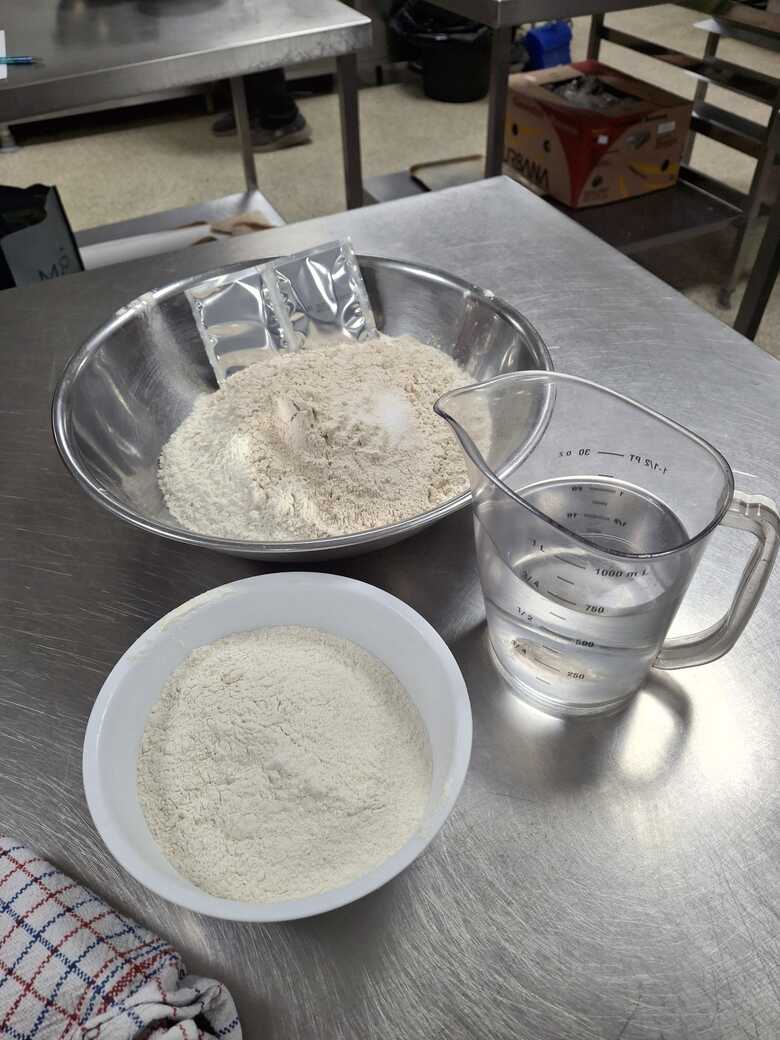
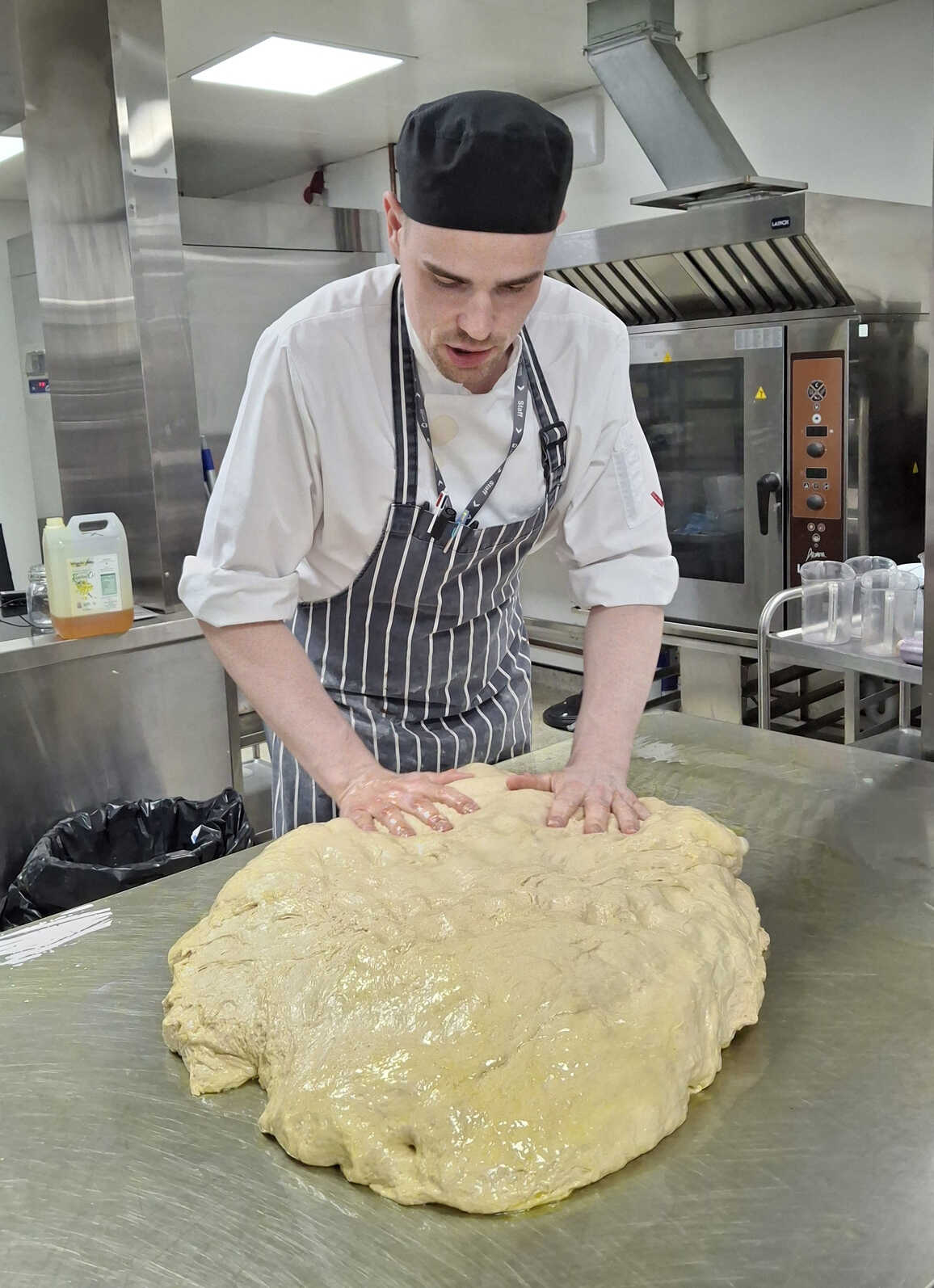
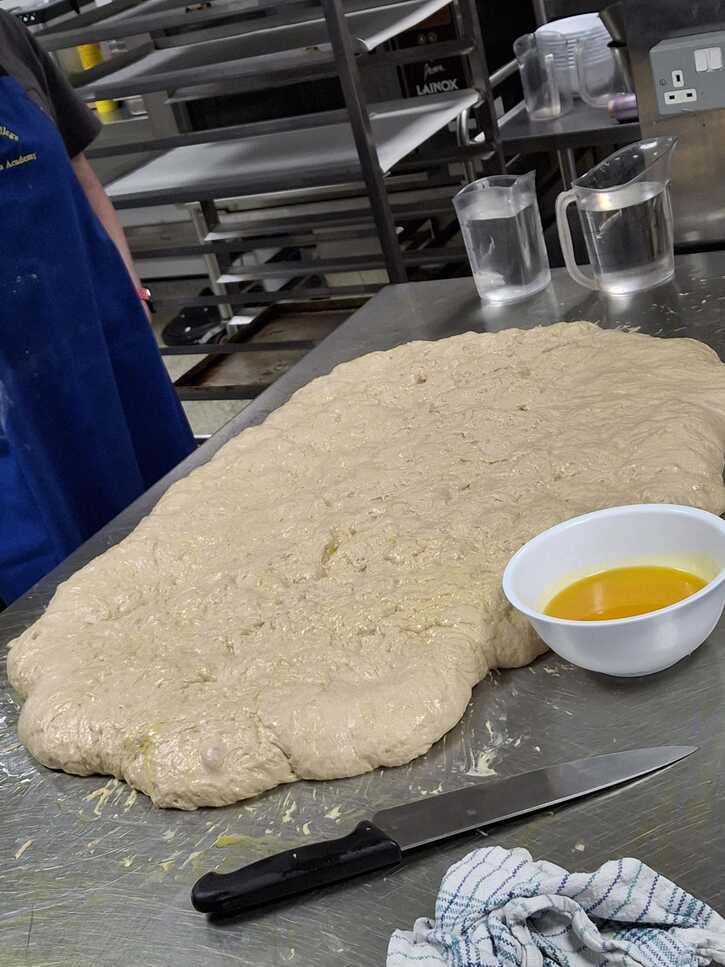
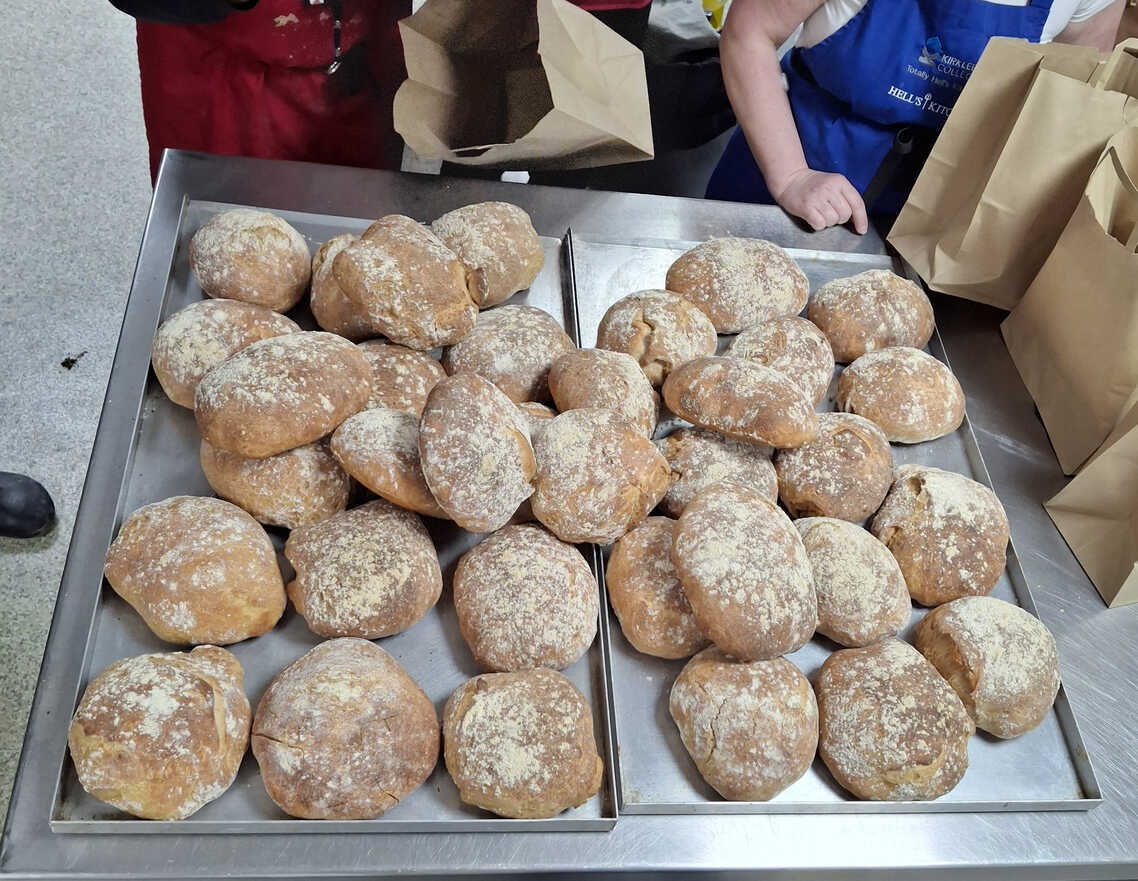
Now all I need to do is to think of things to do with all this bread I'll be baking!
Rustic Hybrid Bread
class veg bread
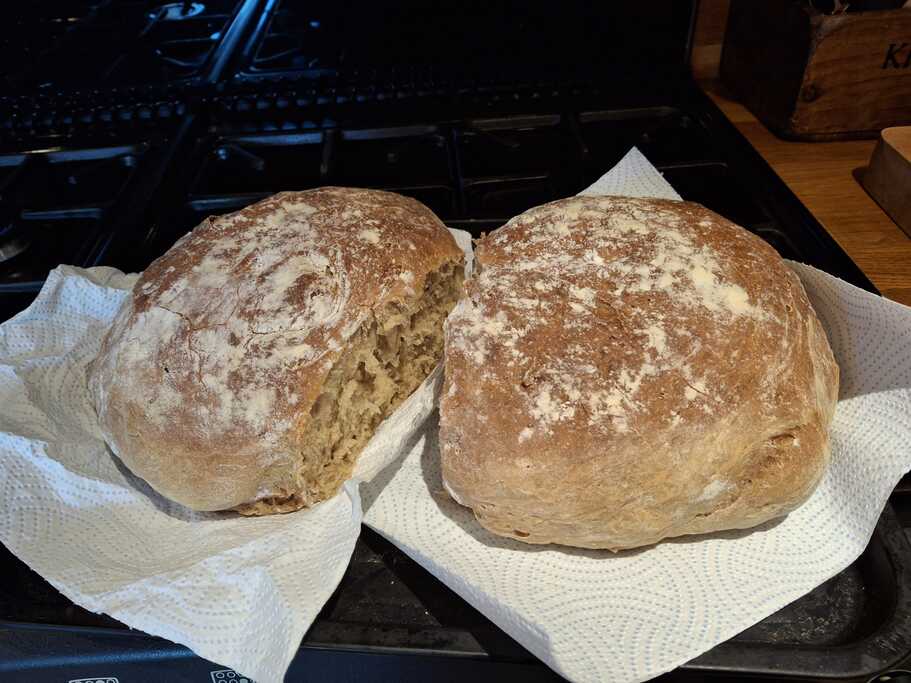
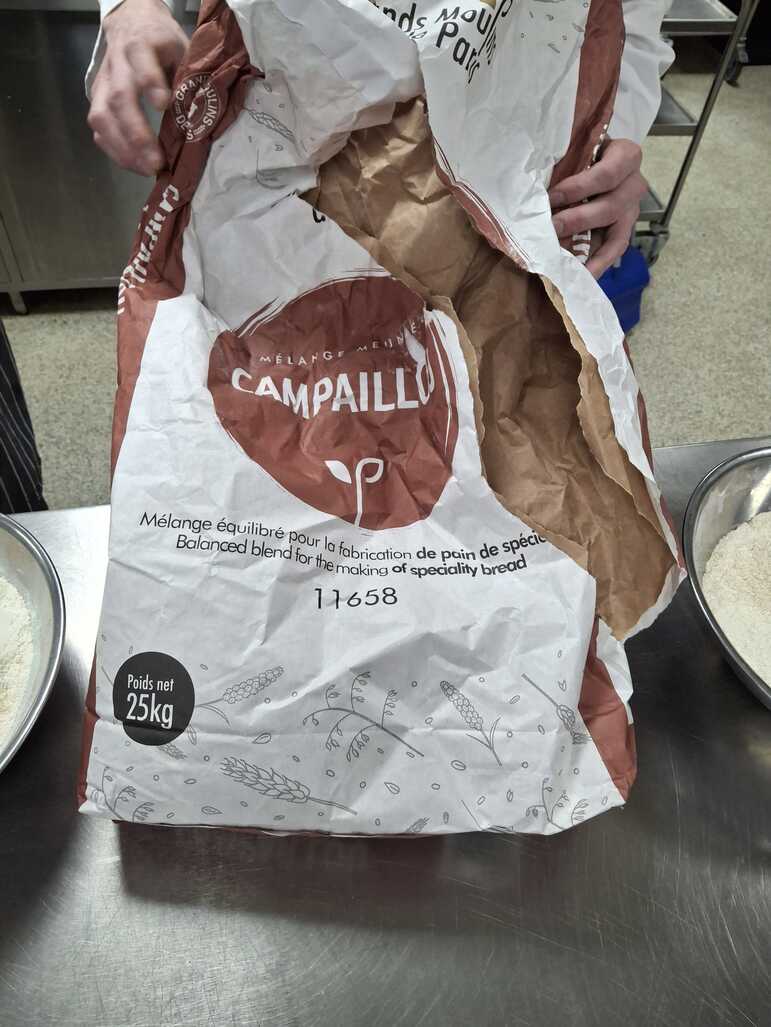
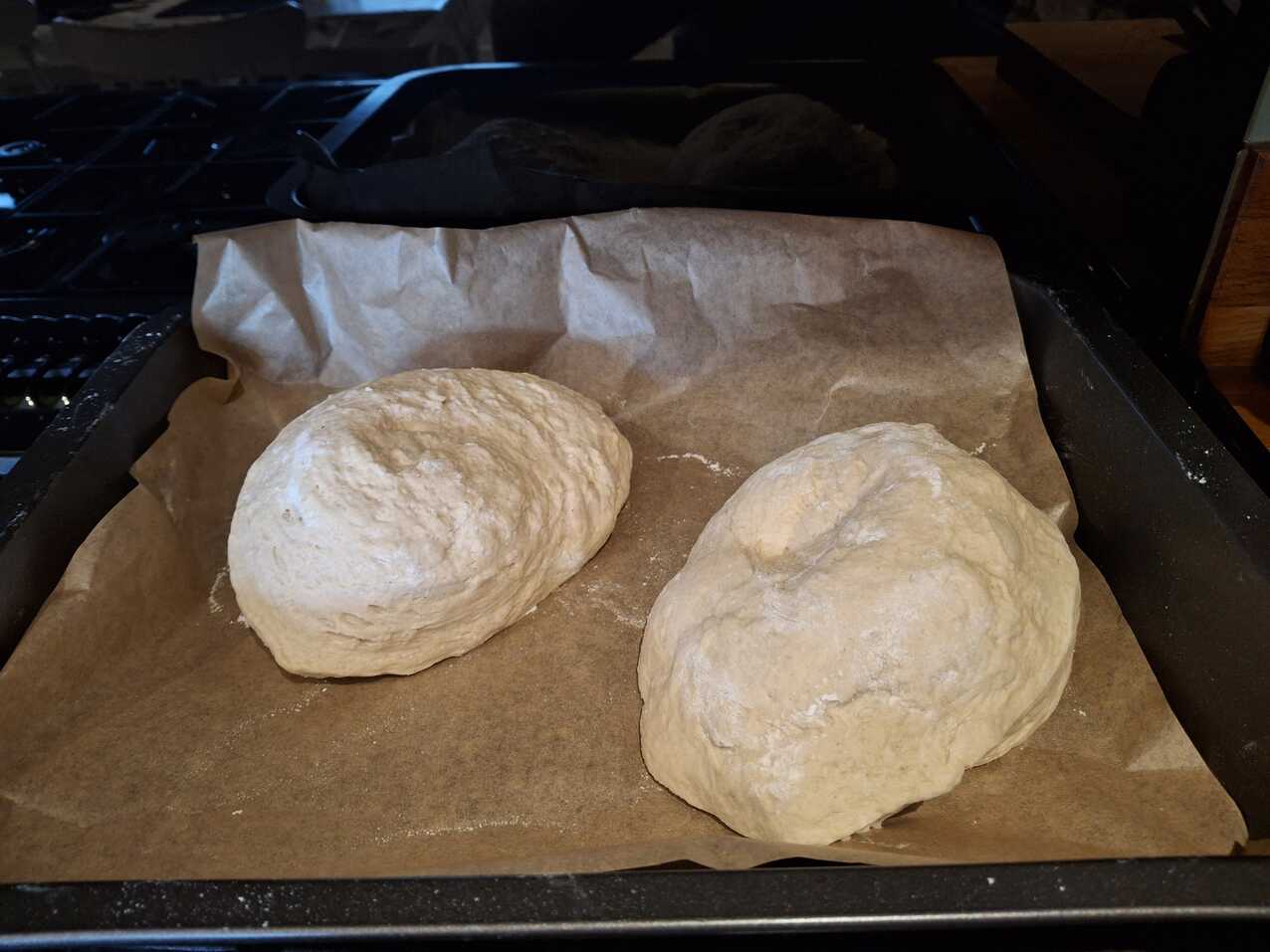
The recipe below was on the class handout, but to be honest we barely seemed to follow the method instructions.
And since the ingredients were already weighed out for us, I don't even know if they followed the recipe either!
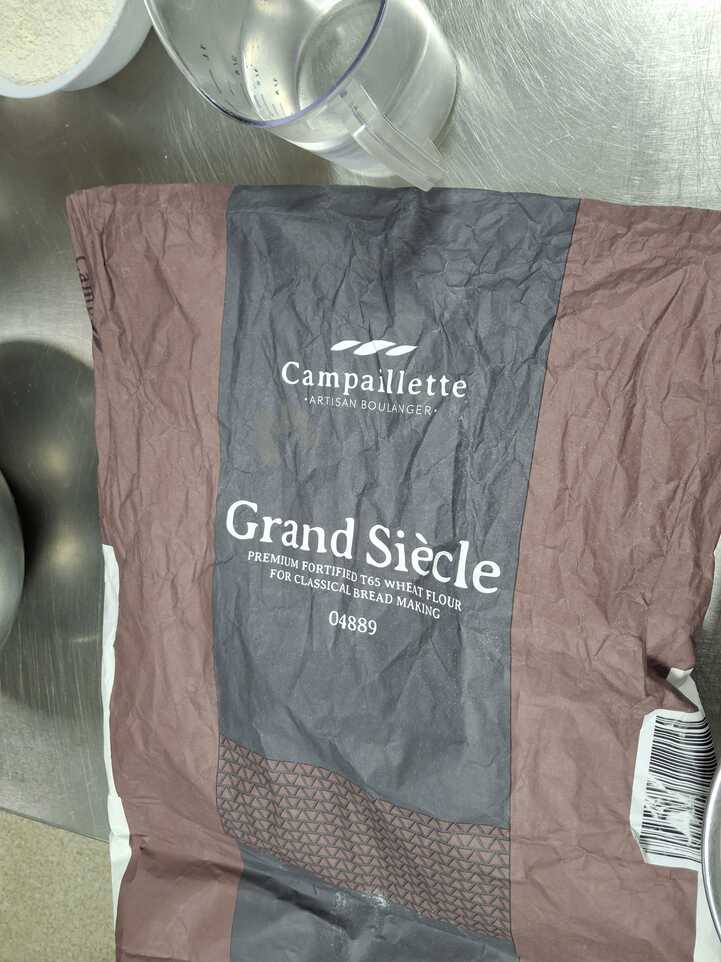
However, I do know that we used these two flours in our mixture:
And since the ingredients were already weighed out for us, I don't even know if they followed the recipe either!
However, I do know that we used these two flours in our mixture:
- Moul-Bie Campaillette Grand Siècle T65 Traditional French Baguette Flour: A strong (11-12.5%) baguette flour with a high bran content.
- Moul-Bie Campaillou French Bread Flour: A strong (12.5%) flour made with a combination of malted wheat and rye. These give it a golden appearance and a rich, malted flavour.
Makes 2 loaves
Ingredients
- 750g strong white bread flour
- 250g granary bread flour
- 30g fresh yeast
- 20g salt (about 3½ tsps)
- 680ml cold water
Activate the Yeast:
Crumble the fresh yeast into a jug.
Add 200ml of the warm water wait, WHAT warm water? and stir to dissolve.
Leave for 5 minutes until slightly frothy.
Mix the Dough:
In a large bowl, combine the white and granary flour.
Add the salt to one side of the bowl.
Pour in the yeast mixture, olive oil (if using) WHAT olive oil??, and most of the remaining water.
Mix until a smooth, slightly sticky dough forms. Add more water if needed.
Knead:
Turn out onto a lightly floured surface.
Knead for 10-12 minutes until it is smooth, elastic, and springs back when pressed.
First Prove:
Place the dough in a lightly oiled bowl.
Cover with a damp tea towel or cling film.
Leave in a arm place for 1-1½ hours, until doubled in size.
Shape:
Knock back the dough gently.
Divide into 2 equal pieces.
Shape into rounds or oval style loaves.
Place on a lined baking tray or floured peel.
Second prove:
Cover loosely and prove for 30-45 minutes, until risen and slightly springy.
Preheat the oven to 220°C (200°C fan).
Place an empty roasting tray at the bottom of the oven.
Bake:
Dust the loaves with flour.
Score each loaf with a sharp blade.
Put loaves in the oven.
Bake for 25-30 minutes (unless you have an industrial bakery HA! - in which case it will take only 6-8 minutes cooking and 5 minutes drying) until the loaves:
Crumble the fresh yeast into a jug.
Add 200ml of the warm water wait, WHAT warm water? and stir to dissolve.
Leave for 5 minutes until slightly frothy.
We did none of this - I suspect we may have been using instant yeast, which does not require hydrating and activating.
Mix the Dough:
In a large bowl, combine the white and granary flour.
Add the salt to one side of the bowl.
Pour in the yeast mixture, olive oil (if using) WHAT olive oil??, and most of the remaining water.
Mix until a smooth, slightly sticky dough forms. Add more water if needed.
What we did is mix the salt through the flours, then stirred through the yeast, then added the (cold) water.
Knead:
Turn out onto a lightly floured surface.
Knead for 10-12 minutes until it is smooth, elastic, and springs back when pressed.
We followed a no-knead approach with our loaves and only mixed the dough sufficiently to bring the mass together.
We then folded the dough:
We then folded the dough:
- Press the dough flat.
- Fold both sides up and over each other like a letter.
- Fold top and bottom over each other similarly and press flat again.
First Prove:
Place the dough in a lightly oiled bowl.
Cover with a damp tea towel or cling film.
Leave in a arm place for 1-1½ hours, until doubled in size.
We put our dough in the fridge for 24 hour to slow-prove.
Do not make the mistake of wrapping it tightly in cling film, lest it explosively recreate a scene from The Blob in your fridge 😉
Do not make the mistake of wrapping it tightly in cling film, lest it explosively recreate a scene from The Blob in your fridge 😉
Shape:
Knock back the dough gently.
Divide into 2 equal pieces.
Shape into rounds or oval style loaves.
Place on a lined baking tray or floured peel.
We took the dough from the fridge, repeated the folding process from above. Twice.
Then cut the dough in half and set both loaves to prove as instructed.
Then cut the dough in half and set both loaves to prove as instructed.
Second prove:
Cover loosely and prove for 30-45 minutes, until risen and slightly springy.
Preheat the oven to 220°C (200°C fan).
Place an empty roasting tray at the bottom of the oven.
Bake:
Dust the loaves with flour.
Score each loaf with a sharp blade.
Put loaves in the oven.
We were advised to be sure that the sheet on which they are laid is thoroughly preheated.
Use an upturned oven tray if you do not have flat sheets.
We did not score our loaves.
Pour a mug of water into the hot tray to create steam and close the door quickly.We did not score our loaves.
Bake for 25-30 minutes (unless you have an industrial bakery HA! - in which case it will take only 6-8 minutes cooking and 5 minutes drying) until the loaves:
- Turn a deep golden brown.
- Develop a firm crust.
- Sound hollow when tapped underneath.
My bread had issues. See above!
Sushi Bread
class fish starter
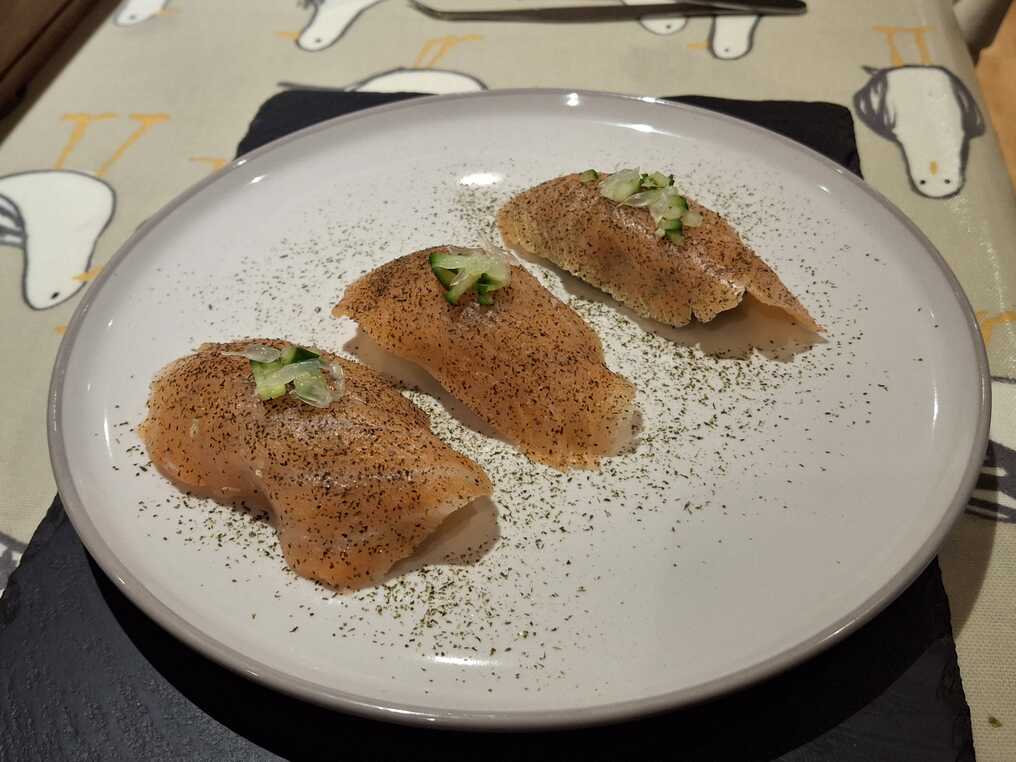
Since we now have a houseful of bread, and some smoked salmon. Let's try making sushi with breadcrumbs!
Now obviously the beauty of sushi rice is its stickiness. Well, that and its flavour. But we don't have that.
So we need to try and generate some adherence, which I thought the lime juice might provide.
But it doesn't.
So on to the next idea - mixing Boursin into the breadcrumbs!
Now obviously the beauty of sushi rice is its stickiness. Well, that and its flavour. But we don't have that.
So we need to try and generate some adherence, which I thought the lime juice might provide.
But it doesn't.
So on to the next idea - mixing Boursin into the breadcrumbs!
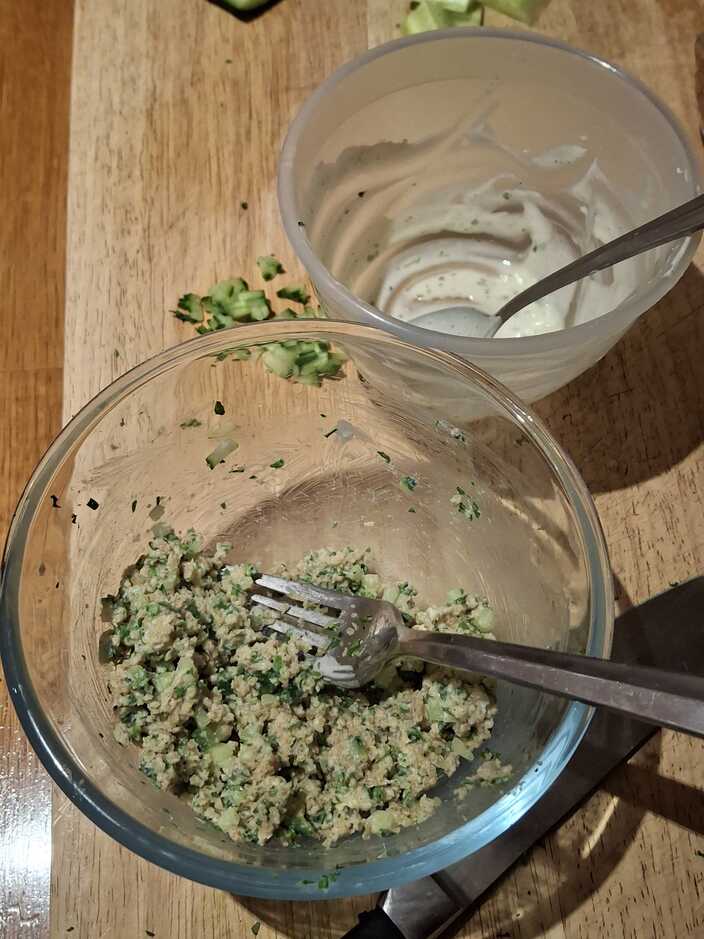
UPDATE: You can get the breadcrumbs to bind together well if you make a paste of Boursin, a little lime juice, and a little honey, then cut that into the seasoned breadcrumb, cucumber and rocket mixture.
Add just enough paste to get the crumbs to cohere, and don't bother with the Boursin smear on the fish any more.
The result is excellent!
Add just enough paste to get the crumbs to cohere, and don't bother with the Boursin smear on the fish any more.
The result is excellent!
Ingredients
- bread
- smoked salmon or raw salmon
- lime juice
- drizzle of honey
- rocket, finely minced
- cucumber, cut into tiny dice
- garlic and herb Boursin
Topping:- nori seaweed, ground
- lime vesicles
Cut a small piece of nori sushi seaweed up into bits and grind it to a fine powder in an electric spice grinder.
You won't be able to make any impact on it with a pestle and mortar.
Set aside in a small sieve.
Trim your smoked salmon into suitably sized and shaped sushi pieces. Or you could try raw salmon. Or any other fish, I guess.
Rub a smear of Boursin along the underside of the fish as if it was wasabi Other Garlic & Herb Soft Cheeses are also available.
Remove the bread's crusts and pulse a few times in a food processor without overdoing it. You want the crumbs about the size of grains of rice, funnily enough. Or slightly larger.
Take a section of lime, cut out sections between the membranes, then tease out some individual vesicles (aka juice sacs or kernels) for decoration.
Take a segment of cucumber. Cut it lengthways into quarters and cut off the watery, seedy cores. Then slice them in all three dimensions to make tiny cubes, about the size of fenugreek seeds.
Finely mince the rocket.
Now season the crumbs with a little salt and pepper and mix everything together with a drizzle of honey bread can be surprisingly bitter! and enough lime juice to bind it.
Dust lightly with powdered seaweed, decorate with lime vesicles and a few spare cucumber dice if you like and serve.
I'm not entirely sure about the ground seaweed. That might taste better with raw salmon. Liquorice or matcha might have worked more effectively with the smoked?
Trim your smoked salmon into suitably sized and shaped sushi pieces. Or you could try raw salmon. Or any other fish, I guess.
Rub a smear of Boursin along the underside of the fish as if it was wasabi Other Garlic & Herb Soft Cheeses are also available.
Remove the bread's crusts and pulse a few times in a food processor without overdoing it. You want the crumbs about the size of grains of rice, funnily enough. Or slightly larger.
Take a section of lime, cut out sections between the membranes, then tease out some individual vesicles (aka juice sacs or kernels) for decoration.
Particularly if you have access to any finger limes, which have beautiful caviar-like vesicles.
Take a segment of cucumber. Cut it lengthways into quarters and cut off the watery, seedy cores. Then slice them in all three dimensions to make tiny cubes, about the size of fenugreek seeds.
Finely mince the rocket.
Now season the crumbs with a little salt and pepper and mix everything together with a drizzle of honey bread can be surprisingly bitter! and enough lime juice to bind it.
Ha! Good luck with that.
Press it into the palm of one hand gently! with your thumb to make a flattened sausage, and top with a slice of smoked salmon.
But see the update above.
Dust lightly with powdered seaweed, decorate with lime vesicles and a few spare cucumber dice if you like and serve.
Delicious.
But serve with a spoon 😂
But serve with a spoon 😂