Artisan Bread - Baps Out!
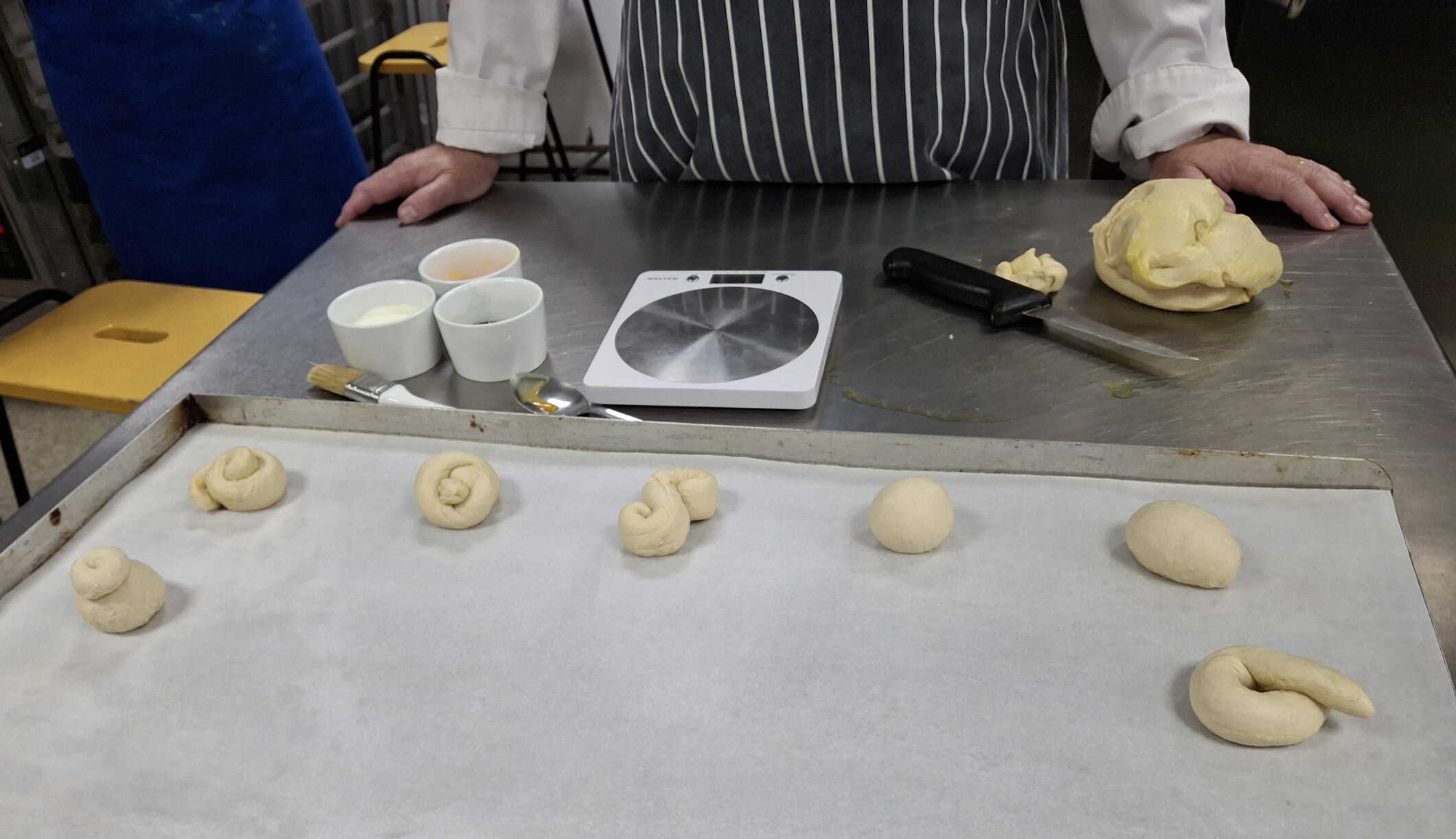
Today we will be making baps or rolls.
We will use a generic bread dough recipe, adapted from Mary Berry, but we're going to split the dough into 50g portions and make interesting fun shapes out of them.
We even did the same thing with half white / half seeded whole grain flour for heartier baps.
It's a game the whole family can play!
We also experimented with some different washes for coating and glazing the rolls.
When dough is placed in a hot oven, it puffs up in the first few minutes. This is called oven spring. If the dough's skin dries too quickly it may restrict this rise. Two ways to permit the maximum rise are washes and scoring.
Washing with a glaze:
A wash is applied to the dough before baking and helps to keep the skin of the dough pliable in the early bake. It may also smooth or colour the crust as well as add flavour. Some washes also provide the glue if you want to add seeds or toppings to the crust. Once the final proof is complete, the finish of the crust is determined. Glazes affect the look, taste and crunch of the crust, and some are fundamental to the end product, such as washing a Challah with egg and topping with sesame seeds.
The standard egg washes are 3 parts egg to 1 part liquid, so you'll need to add roughly 1 tablespoon of liquid to a large egg. The less liquid you use, and the thinner you paint it on, the darker and shinier the crust will be. Paradoxically!
Milk or cream alone will result in a softer crust with little colour.
Here's what the Internet has to say about the various bread washes:
Teacher Paul talked us through some exciting bun shapes you can make with around 50g of dough. The names are my own 😉:
Paul's BapPointers™
We will use a generic bread dough recipe, adapted from Mary Berry, but we're going to split the dough into 50g portions and make interesting fun shapes out of them.
We even did the same thing with half white / half seeded whole grain flour for heartier baps.
It's a game the whole family can play!
We also experimented with some different washes for coating and glazing the rolls.
When dough is placed in a hot oven, it puffs up in the first few minutes. This is called oven spring. If the dough's skin dries too quickly it may restrict this rise. Two ways to permit the maximum rise are washes and scoring.
Washing with a glaze:
A wash is applied to the dough before baking and helps to keep the skin of the dough pliable in the early bake. It may also smooth or colour the crust as well as add flavour. Some washes also provide the glue if you want to add seeds or toppings to the crust. Once the final proof is complete, the finish of the crust is determined. Glazes affect the look, taste and crunch of the crust, and some are fundamental to the end product, such as washing a Challah with egg and topping with sesame seeds.
The standard egg washes are 3 parts egg to 1 part liquid, so you'll need to add roughly 1 tablespoon of liquid to a large egg. The less liquid you use, and the thinner you paint it on, the darker and shinier the crust will be. Paradoxically!
Milk or cream alone will result in a softer crust with little colour.
Here's what the Internet has to say about the various bread washes:
- Whole Egg Wash (egg + water): Produces a deep golden color and a glossy, professional-looking shine. It is the standard for enriched breads like challah, brioche, and dinner rolls where a balanced, bakery-quality finish is desired.
- Egg Yolk Wash (yolk + cream/milk): Creates the richest, deepest brown color with a maximum, lacquered shine. The high fat content in the yolk and cream results in a dramatic, almost varnish-like finish ideal for pastries and holiday breads. For a truly rich glossy varnish then repeatedly apply several coats to the bread as it bakes.
- Egg White Wash (white + water): Provides a light shine with minimal browning.
This is best for lean breads like baguettes or sourdough where you want surface gloss without altering the natural crust color.
Be sure to thoroughly beat the white - since any stringy elements will bake into unpleasant thick rubbery blobs on the crust.
Salt can help loosen egg whites: For a no-yolk egg white-only wash add a pinch of salt. Even when mixed with water, this will make the wash easier to spread on savory breads and rolls. - Milk or Cream Wash: Yields a soft golden-brown color with a matte to semi-gloss finish. Milk's lactose sugars caramelize for a subtle sweetness and tender crust, making it ideal for soft rolls, biscuits, and scones.
- Water or Steam: Results in a crispy, crackly, and thin crust with no added richness or shine. Water delays crust formation, allowing for better oven spring, which is essential for artisan loaves and baguettes. Create the steam by pouring water into a hot tin in the oven when the loaf begins to bake, if you don't have a steam oven.
- Butter Wash: Creates a soft, tender, matte crust with a rich, buttery flavor. Typically brushed on after baking, it is the secret to impossibly soft dinner rolls and modern variations of focaccia. You can even add a touch of honey!
- Olive Oil Wash: Imparts a light golden color and a smooth chewy crust with crispy edges. It is traditional for Mediterranean flatbreads like ciabatta and focaccia.
- Flour: A dusting of plain flour produces rustic and chewy crust.
- Cornstarch: Pasted on as a cooked cornstarch slurry it results in a shiny, hard crust.
- Egg White and Sugar: A frothed egg whites and sugar coating on sweet buns before baking gives a glossy non-stick crust.
- Sugar Syrup: A 50:50 sugar and water mix brushed on after baking for a shiny glaze for sweet buns.
- Marmalade: Brush your Hot Cross buns with marmalade after baking for a sticky zesty shine. Dilute with a little lemon for extra tartness.
Teacher Paul talked us through some exciting bun shapes you can make with around 50g of dough. The names are my own 😉:
- the spiral: Roll the dough into a sausage, then coil it up into a spiral. You can use beaten egg wash to glue the end in place.
- the double spiral: Roll the dough into a (longer) sausage, then roll opposite spirals from both ends so it looks like a complicated S shape.
- the knot: Roll the dough into a (fairly thin) sausage and tie it into a knot.
- the ball: Just roll it into a ball! It takes a bit of practice to get the ball smooth and round - you start of with firm downward pressure rolling the dough under the palm of one hand, then gradually ease off the pressure while rolling it around the whole palm using your fingers like a cage.
- the snowman: Roll two balls, one much smaller, place the smaller ball on top like a snowman's head! and push your finger down through both of them to press them together and leave a slight dimple.
- the plait: Roll out three similar thin sausages, you will probably want to start with more than 50g of dough for this one stick them together at one end, then plait your way along the three strands, folding and sticking the final ends together with a bit of egg wash.
- the poo: Roll into a thick sausage, then just fold one end over the other so it looks a bit like a dog's poo. Yum!
Paul's BapPointers™
- Adding some milk to bread dough softens the crumb making it softer and sweeter, but also promotes a darker crust, from caramelising the contained sugars - Teacher Paul recommends using only 40% or at most 50% milk.
- To bake soft rolls without them developing a crispy crust - just bake them for a shorter time.
- Teacher Paul suggests that you should knead the dough for around 8 minutes - which you should be able to gauge by the sweat you work up.
Mary Berry-Style Soft Bread Rolls
class bread
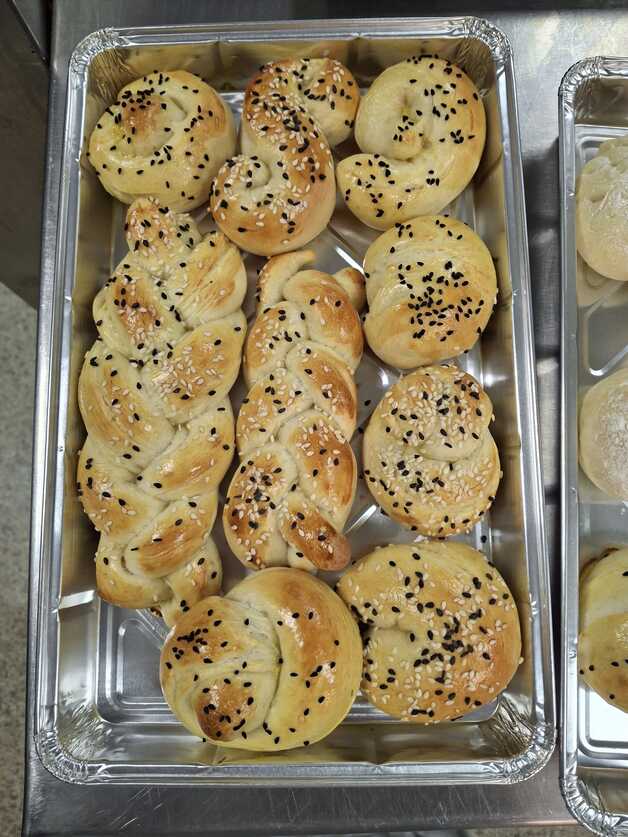
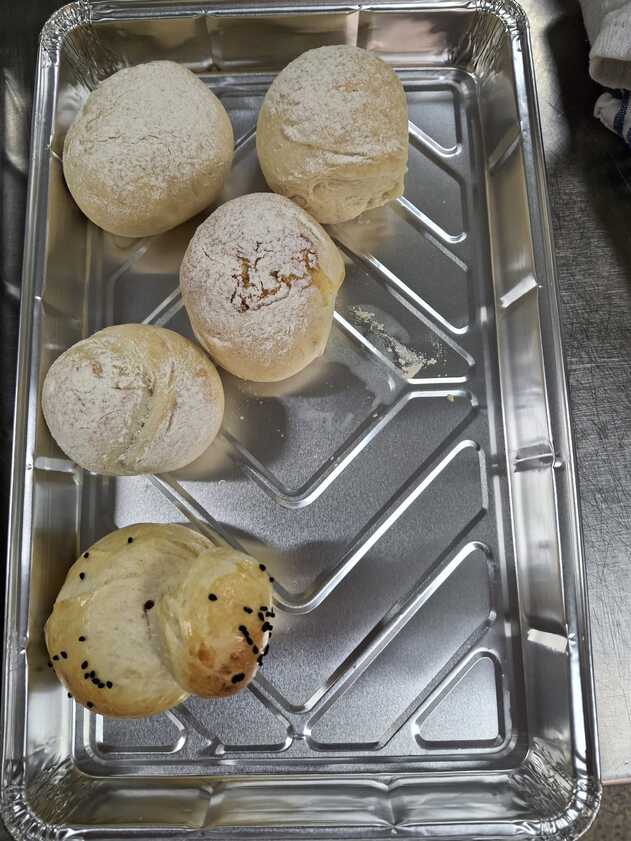
The class recipe was billed as Mary Berry-Style White Bread, as from this fan's site.
But the method was identical to the fan's actual Mary Berry soft rolls recipe, so that's the one I've written up below.
Although Mary Berry-by-proxy clearly disagrees, Paul recommended using a blend of 100ml milk and 200ml warm water for extra softness. Oddly enough the soft roll recipe uses almost twice as much butter as the bread, so maybe if we'd just added more butter?...
I either dusted my rolls with flour, or applied an egg yolk wash as discussed above.
The latter I also sprinkled with mixed black and yellow sesame seeds, or onion seeds.
Here are some common problems addressed by Ekani Ella:
Why is my white bread not rising properly?
White bread fails to rise when the water is too hot and kills the yeast, or too cold to activate it. Using warm water that feels like bath temperature and giving the dough enough time in a warm, draft-free place helps it rise fully.
How do I stop my white bread from becoming dense?
A dense loaf is usually caused by under-kneading or rushing the rising time. Knead until the dough becomes smooth and elastic, and allow it to double in size during both rises to ensure a light, airy crumb.
Why does my homemade bread turn out dry?
Bread becomes dry when too much flour is added or when it's over-baked. Keep the dough slightly soft rather than stiff, and remove the loaf from the oven once it sounds hollow when tapped on the base.
How can I get a soft crust on white bread?
For a softer crust, brush the warm loaf with melted butter right after baking. Wrapping the bread in a clean tea towel while it cools also helps keep the crust tender.
Although Mary Berry-by-proxy clearly disagrees, Paul recommended using a blend of 100ml milk and 200ml warm water for extra softness. Oddly enough the soft roll recipe uses almost twice as much butter as the bread, so maybe if we'd just added more butter?...
I either dusted my rolls with flour, or applied an egg yolk wash as discussed above.
The latter I also sprinkled with mixed black and yellow sesame seeds, or onion seeds.
Here are some common problems addressed by Ekani Ella:
Why is my white bread not rising properly?
White bread fails to rise when the water is too hot and kills the yeast, or too cold to activate it. Using warm water that feels like bath temperature and giving the dough enough time in a warm, draft-free place helps it rise fully.
How do I stop my white bread from becoming dense?
A dense loaf is usually caused by under-kneading or rushing the rising time. Knead until the dough becomes smooth and elastic, and allow it to double in size during both rises to ensure a light, airy crumb.
Why does my homemade bread turn out dry?
Bread becomes dry when too much flour is added or when it's over-baked. Keep the dough slightly soft rather than stiff, and remove the loaf from the oven once it sounds hollow when tapped on the base.
How can I get a soft crust on white bread?
For a softer crust, brush the warm loaf with melted butter right after baking. Wrapping the bread in a clean tea towel while it cools also helps keep the crust tender.
Makes about 16 Rolls
Ingredients
- 500g strong white bread flour
- 1½ tsp salt
- 1 tbsp sugar
- 7g fast-action yeast
- 300ml warm water (not hot) or up to 50% milk
- 40g butter, softened we used only 26g
Optional:- 1 egg for glazing
Step 1: Combine the dry ingredients
Add flour, sugar, salt, and yeast to a large mixing bowl. Keep salt and yeast separate at first to avoid slowing yeast activity.
Step 2: Add liquids and butter
Pour in the warm water and add the softened butter. Mix until a soft dough begins to form.
Step 3: Knead the dough
Turn the dough onto a lightly floured surface. Knead for 8-10 minutes until smooth, stretchy, and elastic. The dough should feel soft but not sticky.
Step 4: First rise
Place the dough into an oiled bowl, cover with a tea towel, and leave to rise for 1-1.5 hours or until doubled in size.
Step 5: Shape the rolls
Punch down the dough gently and divide into 10-12 equal balls. Or however many you get at 50g each. Shape each piece into a smooth roll by tucking the edges underneath.
Step 6: Second rise
Arrange the rolls on a parchment-lined tray, leaving space between them. Cover and let rise again for 30-40 minutes until puffy and almost doubled.
Step 7: Add egg wash (optional)
Brush the tops with beaten egg for a glossy finish or milk for a soft sheen.
Step 8: Bake the rolls
Bake at 200°C for 12-15 minutes, or until golden brown and hollow-sounding when tapped underneath.
Step 9: Cool before serving
Transfer to a wire rack to cool slightly, ensuring the rolls stay soft and fluffy.
Add flour, sugar, salt, and yeast to a large mixing bowl. Keep salt and yeast separate at first to avoid slowing yeast activity.
Step 2: Add liquids and butter
Pour in the warm water and add the softened butter. Mix until a soft dough begins to form.
Step 3: Knead the dough
Turn the dough onto a lightly floured surface. Knead for 8-10 minutes until smooth, stretchy, and elastic. The dough should feel soft but not sticky.
Step 4: First rise
Place the dough into an oiled bowl, cover with a tea towel, and leave to rise for 1-1.5 hours or until doubled in size.
Step 5: Shape the rolls
Punch down the dough gently and divide into 10-12 equal balls. Or however many you get at 50g each. Shape each piece into a smooth roll by tucking the edges underneath.
Or turn into whatever shape takes your fancy.
Step 6: Second rise
Arrange the rolls on a parchment-lined tray, leaving space between them. Cover and let rise again for 30-40 minutes until puffy and almost doubled.
Step 7: Add egg wash (optional)
Brush the tops with beaten egg for a glossy finish or milk for a soft sheen.
Other washes, dressings or dustings, are available!
Step 8: Bake the rolls
Bake at 200°C for 12-15 minutes, or until golden brown and hollow-sounding when tapped underneath.
If making a whole loaf you would allow 25-30 minutes.
Step 9: Cool before serving
Transfer to a wire rack to cool slightly, ensuring the rolls stay soft and fluffy.
I rather liked the rolls I dusted with flour from a sieve and avoided over-baking so they remained white and super-soft.
But they were all excellent!
But they were all excellent!