Artisan Bread - Sunset
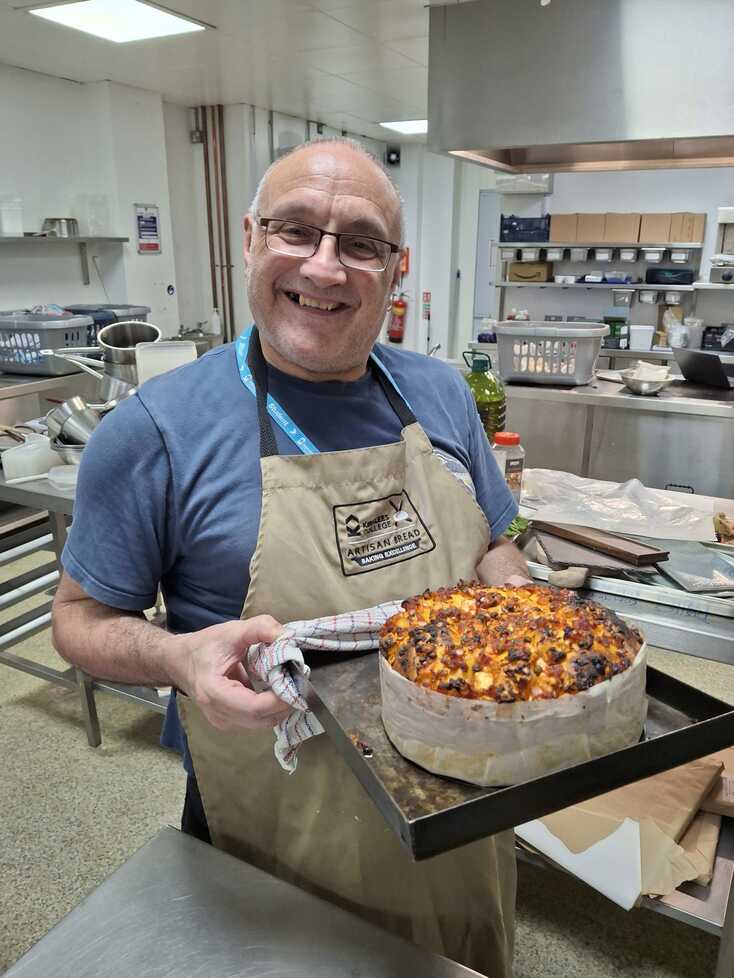
Finally - the last class of our course.
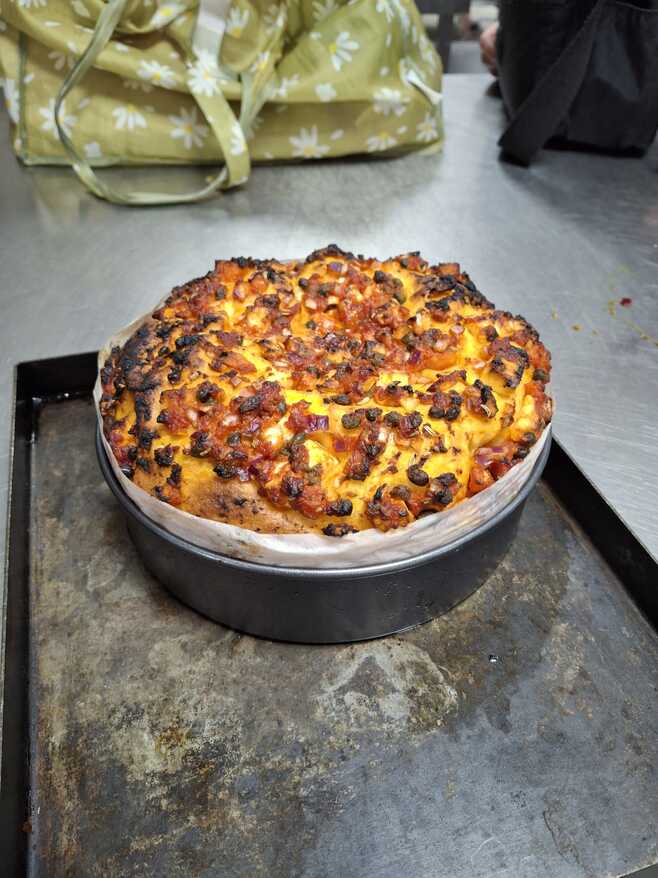
And appropriately enough we will be making Mediterranean Sunset Bread.
We got to choose what we'd like to make today, but apparently croissants were too complicated, brioche too time-consuming, baguettes too difficult, ciabatta too sticky, and bagels too Jewish JOKING! so this is where we ended up.
I find no sign of this particular bread in the literature, but Teacher Paul has often regaled us with the story of its discovery when he was running his restaurant back in the 20s or 30s...
He spotted loaves of this tomato-topped bread in the back of the baker's delivery van, asked about it, and thought I could make that. And reader, so he could.
It should be a bit like a bread-y focaccia with a rich tomato, olive and basil topping pressed into the surface dimples.
Or it would have been, if we'd had any basil.
TopPaulTips™:
And appropriately enough we will be making Mediterranean Sunset Bread.
We got to choose what we'd like to make today, but apparently croissants were too complicated, brioche too time-consuming, baguettes too difficult, ciabatta too sticky, and bagels too Jewish JOKING! so this is where we ended up.
I find no sign of this particular bread in the literature, but Teacher Paul has often regaled us with the story of its discovery when he was running his restaurant back in the 20s or 30s...
He spotted loaves of this tomato-topped bread in the back of the baker's delivery van, asked about it, and thought I could make that. And reader, so he could.
It should be a bit like a bread-y focaccia with a rich tomato, olive and basil topping pressed into the surface dimples.
Or it would have been, if we'd had any basil.
TopPaulTips™:
- Apropos nothing, but Paul again recommended potatoes mashed with beurre noisette for a deliciously nutty finish.
Mediterranean Sunset Bread
class bread
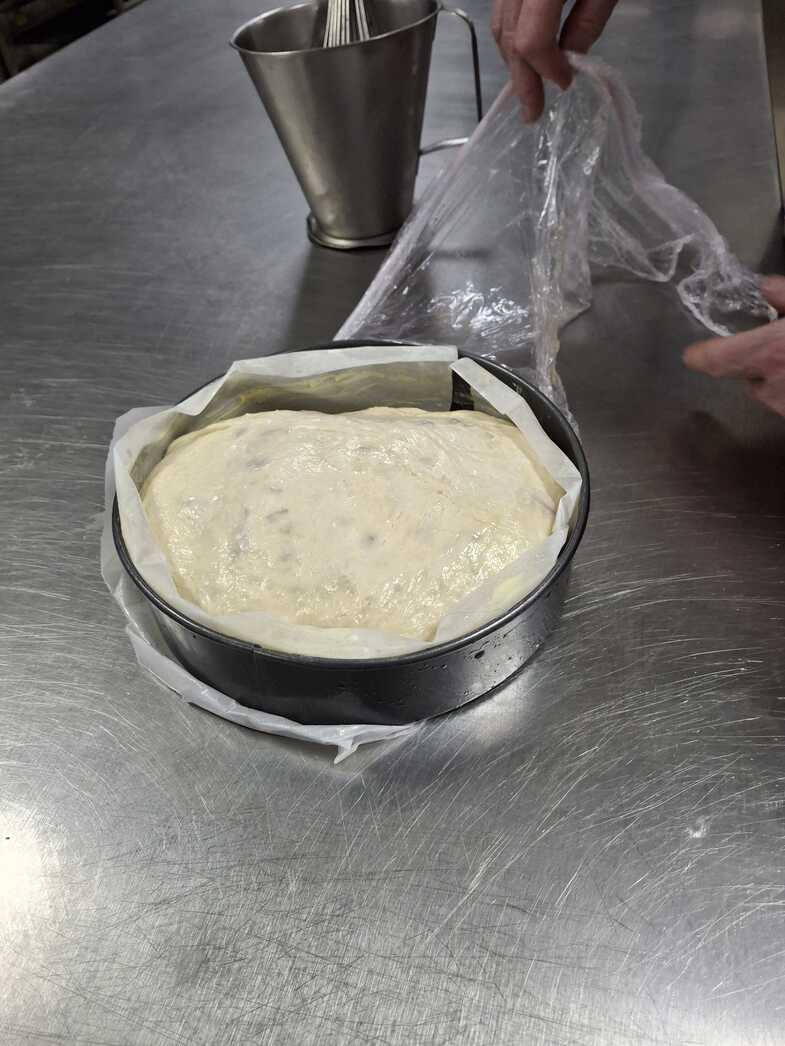
Despite treating this as if it was a focaccia, we made the dough following King Arthur's recipe for a
Classic White Sandwich Bread.
King Arthur has this message for his Knights of the Round Loaf:
King Arthur has this message for his Knights of the Round Loaf:
We call for a fairly wide range of water here due to two variables: how bakers measure their flour, and climate/season.
Flour is drier and will absorb more liquid in winter, and/or in a dry climate; in summer or in a humid climate, it's moister and will absorb less.
So generally speaking, you'll use more liquid in your bread in winter, less in summer.
In addition, some bakers measure their flour by dipping the cup into the bag or canister, tapping the flour to pack it down, and leveling it off.
The way we measure flour here at King Arthur is to stir/aerate the flour, sprinkle it gently into the measuring cup, and level it off.
If you're of the scoop/tap/level school, which measures a "heavier" cup of flour, you'll need to use more liquid.
At any rate, for this recipe, start with a smaller amount of water and move up, if necessary;
it's easier to add water than to take it out! Your goal is a dough that starts out a bit sticky, but as you knead becomes soft (but not sticky) and smooth, not "gnarly."
Makes 1 Large Loaf
Ingredients
- 1¼ cups (284g) to 1 1/2 cups (340g) lukewarm water
- 1 heaping tablespoon (32g) honey
- 2¼ teaspoons instant yeast
- 1¾ teaspoons (11g) table salt
- 2 tablespoons (28g) butter, softened
- 4 cups (480g) King Arthur Unbleached All-Purpose Flour
- ⅓ cup (37g) King Arthur Baker's Special Dry Milk or nonfat dry milk
Sunset Toppings:- olive oil
- tomato purée
- garlic purée
- red onions, chopped
- tomatoes (preferably sun-dried), chopped
- fresh basil leaves if you can find any
- feta cheese or mozzarella, or any cheese really
- fennel seeds
- dried chilli flakes (to taste)
- olives would have been nice
- capers
- salami, ham, chorizo or prosciutto might be alright
- salt & pepper
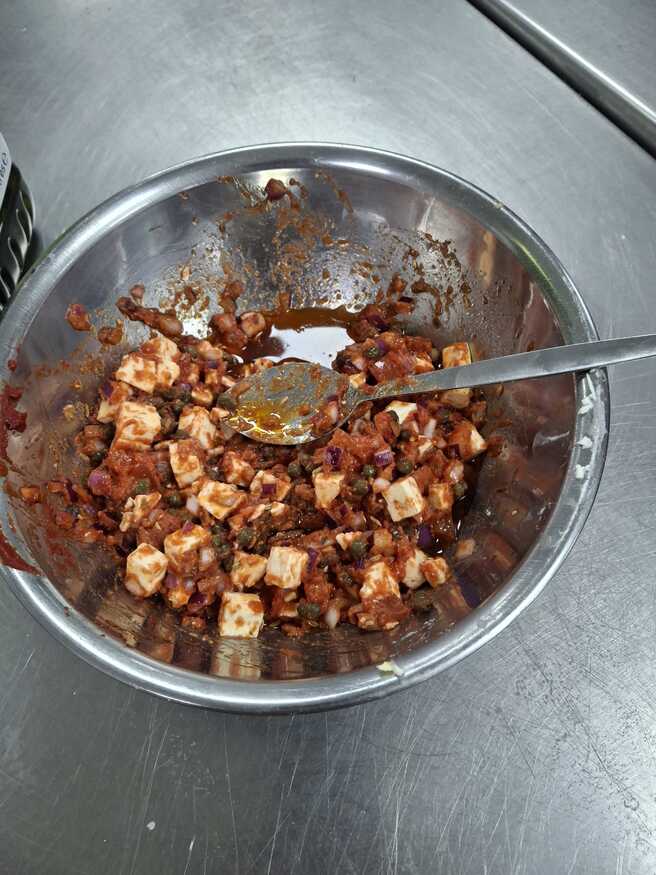
Chop and mix up your toppings of choice or whatever you can get your hands on, season, and set aside.
You'll want a decent amount of tomato purée and I'd suggest leaving the feta quite chunky.
One of the issues I had with the finished bread is that the toppings are all surface level well, duh! and it might be nice to push some bigger chunks of cheese and olive right down into the middle of the bread.
Weigh your flour; or measure it by gently spooning it into a cup, then sweeping off any excess. Mix all of the ingredients in the order listed, and mix and knead - by hand, or using a stand mixer - to make a smooth dough. It won't be particularly soft nor stiff; it should be smooth and feel bouncy and elastic under your hands.
Place the dough in a lightly greased bowl, or large (8-cup) measuring cup. Cover it, and let it rise for 60 to 90 minutes, till it's become quite puffy, though not necessarily doubled in size.
Gently deflate the dough, and shape it into a fat 9" log. Place it in a lightly greased 9" x 5" or 10" x 5" loaf pan.
Cover the pan, and let the dough rise for 60 to 90 minutes, till it's crowned 1" to 1½" over the rim of the pan. Towards the end of the rising time, preheat the oven to 350°F.
Bake the bread for 20 minutes. Tent it lightly with aluminum foil, and bake for an additional 15 to 20 minutes, till it's golden brown. An instant-read thermometer inserted into the center will read 195°F to 200°F (90-93°C).
Remove the bread from the oven, and turn it out onto a rack to cool. Or remove it from the springform tin.
One of the issues I had with the finished bread is that the toppings are all surface level well, duh! and it might be nice to push some bigger chunks of cheese and olive right down into the middle of the bread.
Weigh your flour; or measure it by gently spooning it into a cup, then sweeping off any excess. Mix all of the ingredients in the order listed, and mix and knead - by hand, or using a stand mixer - to make a smooth dough. It won't be particularly soft nor stiff; it should be smooth and feel bouncy and elastic under your hands.
Place the dough in a lightly greased bowl, or large (8-cup) measuring cup. Cover it, and let it rise for 60 to 90 minutes, till it's become quite puffy, though not necessarily doubled in size.
Gently deflate the dough, and shape it into a fat 9" log. Place it in a lightly greased 9" x 5" or 10" x 5" loaf pan.
We placed ours in a much wider springform tin.
Cover the pan, and let the dough rise for 60 to 90 minutes, till it's crowned 1" to 1½" over the rim of the pan. Towards the end of the rising time, preheat the oven to 350°F.
Of course, with our new wider & improved tin it won't crown at all!
Bake the bread for 20 minutes. Tent it lightly with aluminum foil, and bake for an additional 15 to 20 minutes, till it's golden brown. An instant-read thermometer inserted into the center will read 195°F to 200°F (90-93°C).
If you're adding the Sunset Topping, just thinly smear it over the surface of the loaf, then press it down here-and-there into the dough with your fingers.
Remove the bread from the oven, and turn it out onto a rack to cool. Or remove it from the springform tin.
If you like you can now pop it back into the oven for a few minutes to brown up the sides too.
When completely cool, wrap in plastic, and store at room temperature.
It's OK. Really needs the topping to penetrate deeper into the bread. Perhaps a layer could be folded in before the final proving?