Newer Entries
Miso Hungry
Shinkho Bridge at Nikko

In homage to my recent visit to Japan, this month I will be mostly eating Miso soup!

If I had one word of advice from this Japanese holiday it would be - don't visit in the summer. It's fucking hot.
And no, Hudson, it is not a dry heat.
It is, in fact, unbearably humid.
And being constantly dripping with sweat (I recommend a face-and-body terry cloth) really drives home how much worse it is being a fat bastard.
And hence the soups. Another desperate, and likely futile, attempt to lose some weight.

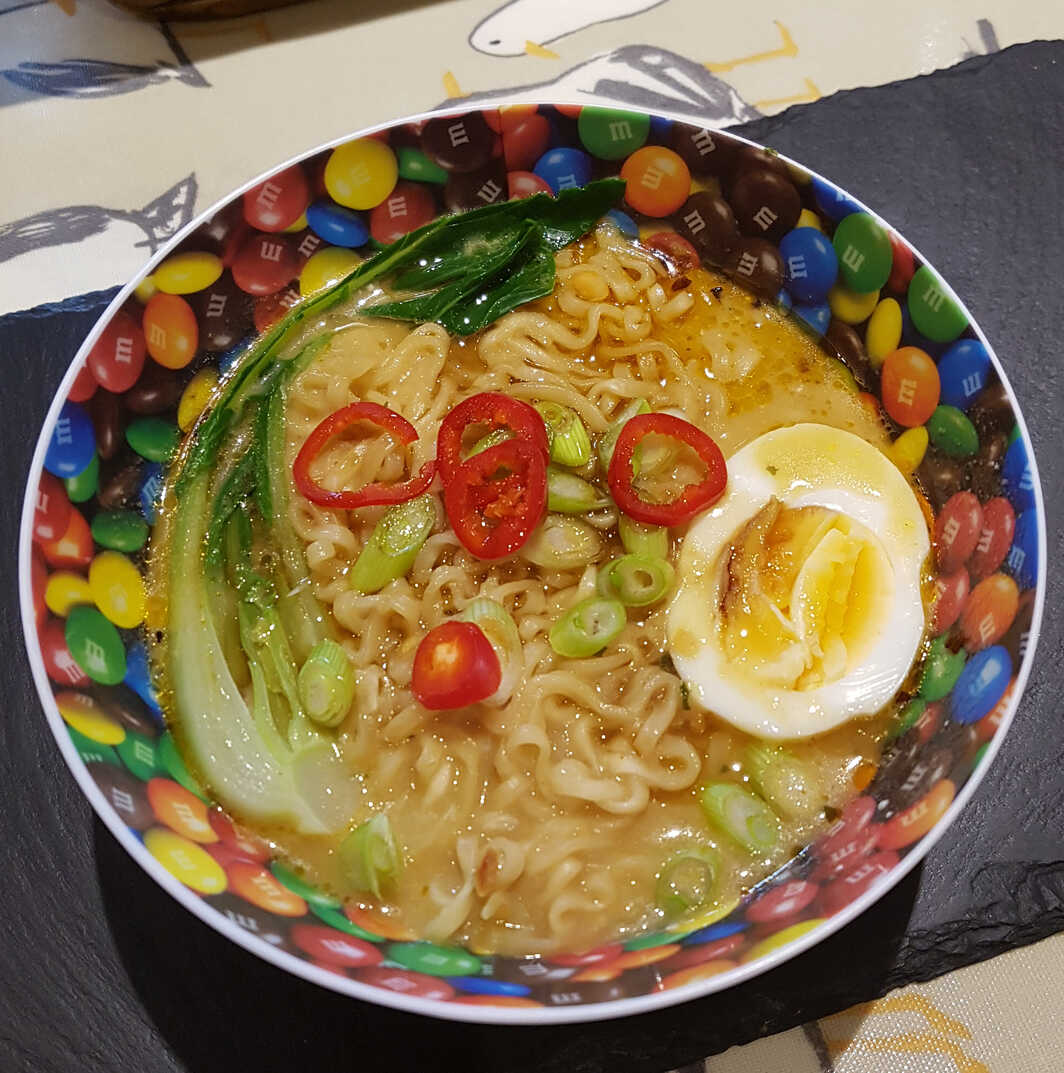
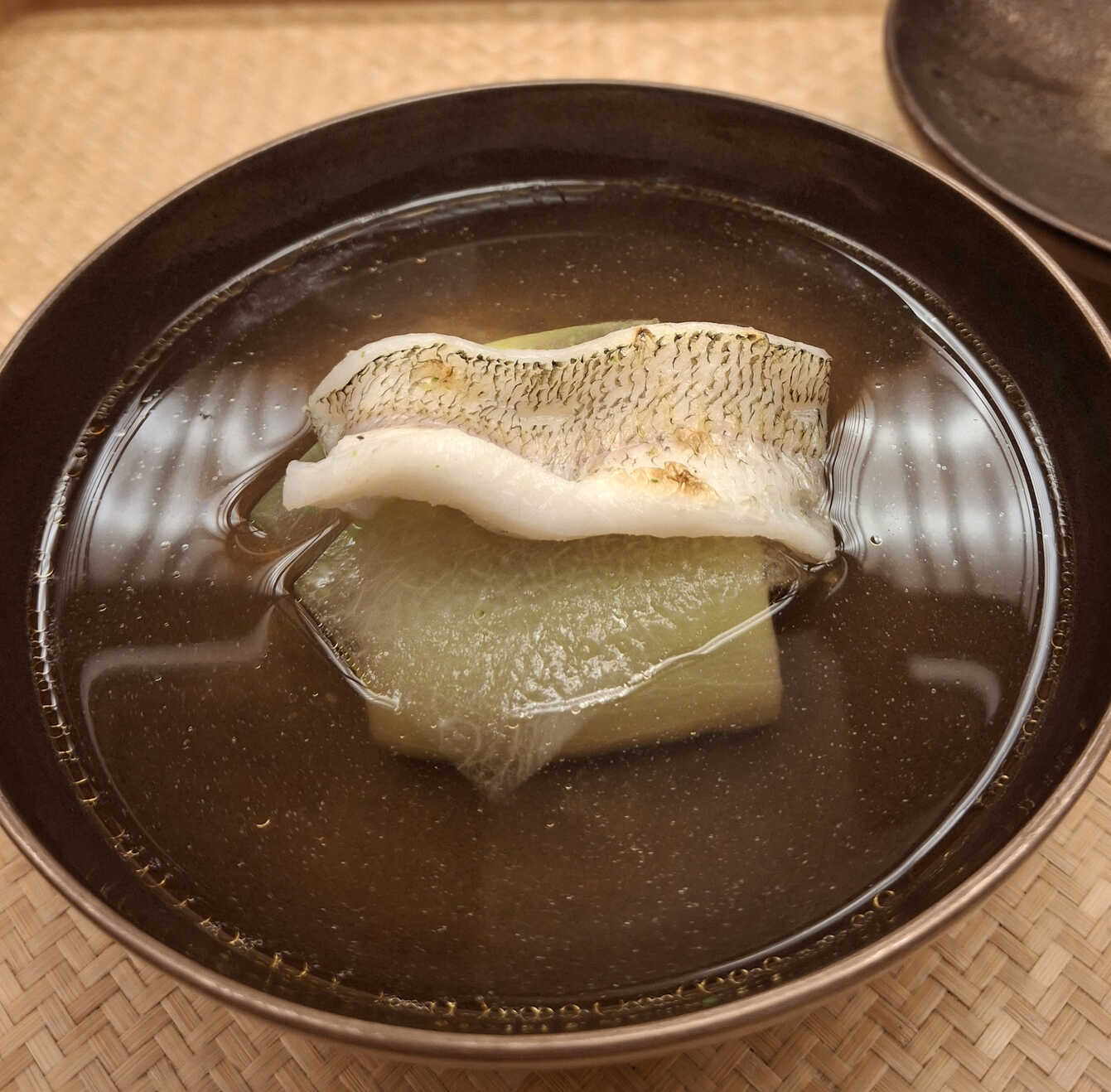
Apart from miso ramen, which is basically miso soup heaving with noodles, whilst in Japan I only really had miso soup as a small side dish or as one element in a long kaiseki meal; more a palate cleanser than a course.
It's not terribly exciting, I have to say, but it does pack quite a lot of flavour into an otherwise very thin soup.
And thin soup is definitely my target here.
Even if larger lumps do have a tendency to creep in as I get hungrier and hungrier 🙄

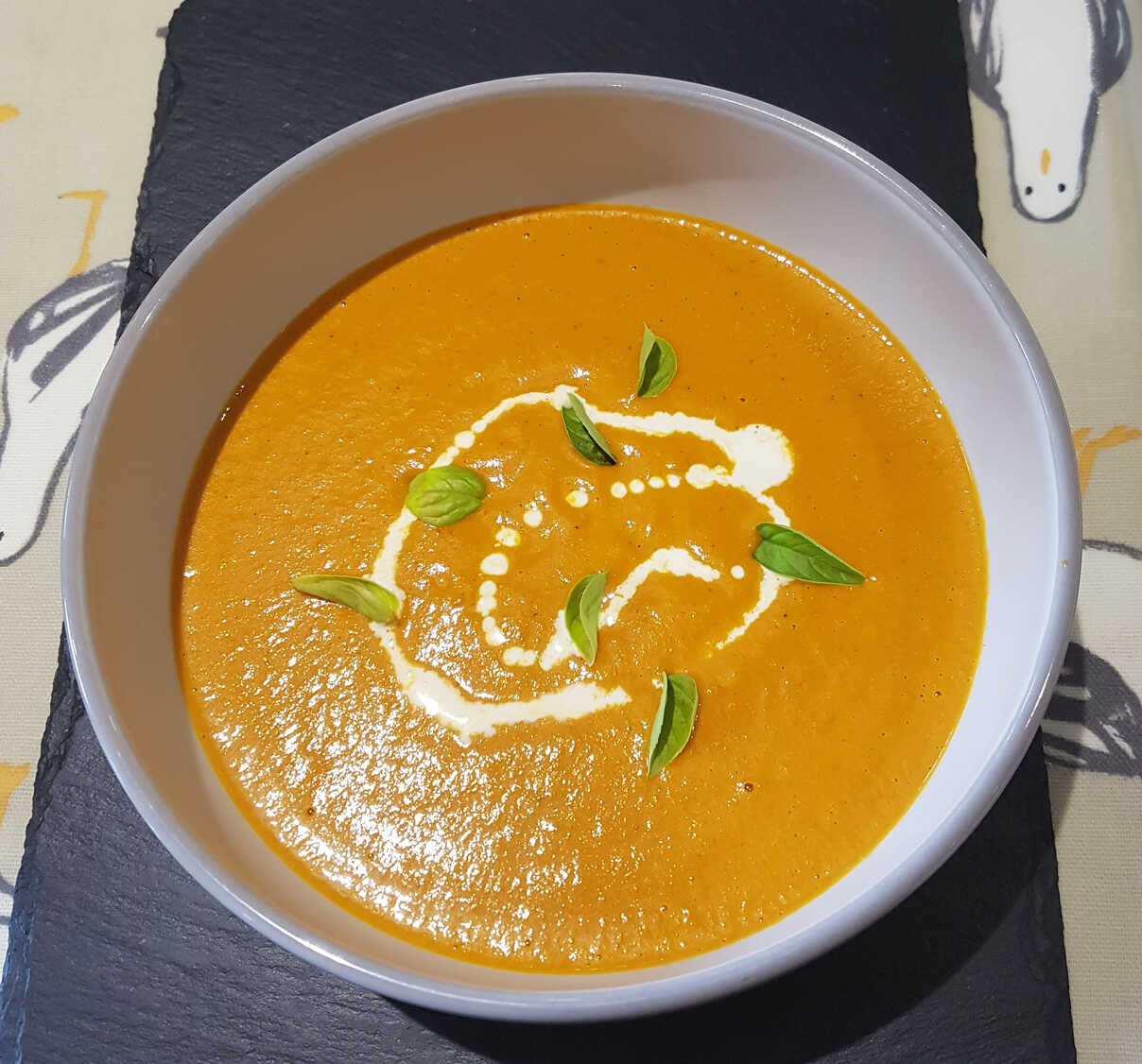
You can, of course, make a regular vegetable soup (squash, say), but use dashi as the stock and add miso flavourings. But here I'm really talking about a soup which is primarily miso, with added bits.
Here are some ideas for enhancing your miso soup, though you should really try to avoid turning it into a stew:
  • Adding cubed tofu and sliced spring onions is standard.
  • Simmer up rooty vegetables like potatoes, turnip (particularly Japanese), radish or daikon, burdock root, yam, taro (satoimo), squash.
  • Throw in kale ribs and kelp or any other kitchen garbage you have spare at the beginning of cooking, and discard the ribs at the end of cooking.
  • Cook in a bare handful or two of rice, ramen or soba noodles, left whole (for slurping) or cut into smaller pieces (minimal slurping).
    Though now this is getting uncomfortably close to being a bowl of ramen.
  • Briefly cook: Sliced celery, sliced zucchini, sliced carrots, fresh or frozen corn kernels, sliced nappa cabbage, sliced bok choy, etc…
  • Throw in a handful of seaweed at the end: Crumbled nori, wakame, arame, hijiki.
  • Include cubed chicken breasts, thinly sliced pork belly, or slices of char siu. Make sure to properly cook raw meat.
  • With the soup at a low simmer, pour in beaten egg in a circular pattern. Don’t stir the soup, and don’t let it come up to a boil.
  • Throw in a cup of sake for added punch.
  • Throw in a can of coconut milk for a richer soup.
  • Throw in chopped cilantro and lemongrass.
    What with the coconut milk, you're now in danger of making Thai tom kha.
  • Add shrimp, prawns, crab meat, clams are popular, or any kind of fish really, particularly smoked mackerel. Just bring these up to temperature.
  • Add bright green vegetables such as snow peas, spinach leaves, watercress leaves, asparagus sections, broccoli spears or string beans at the very end of cooking, after the soup comes to a boil, so that they retain their bright color.
    You can basically just put them in the bowl and pour the soup over.
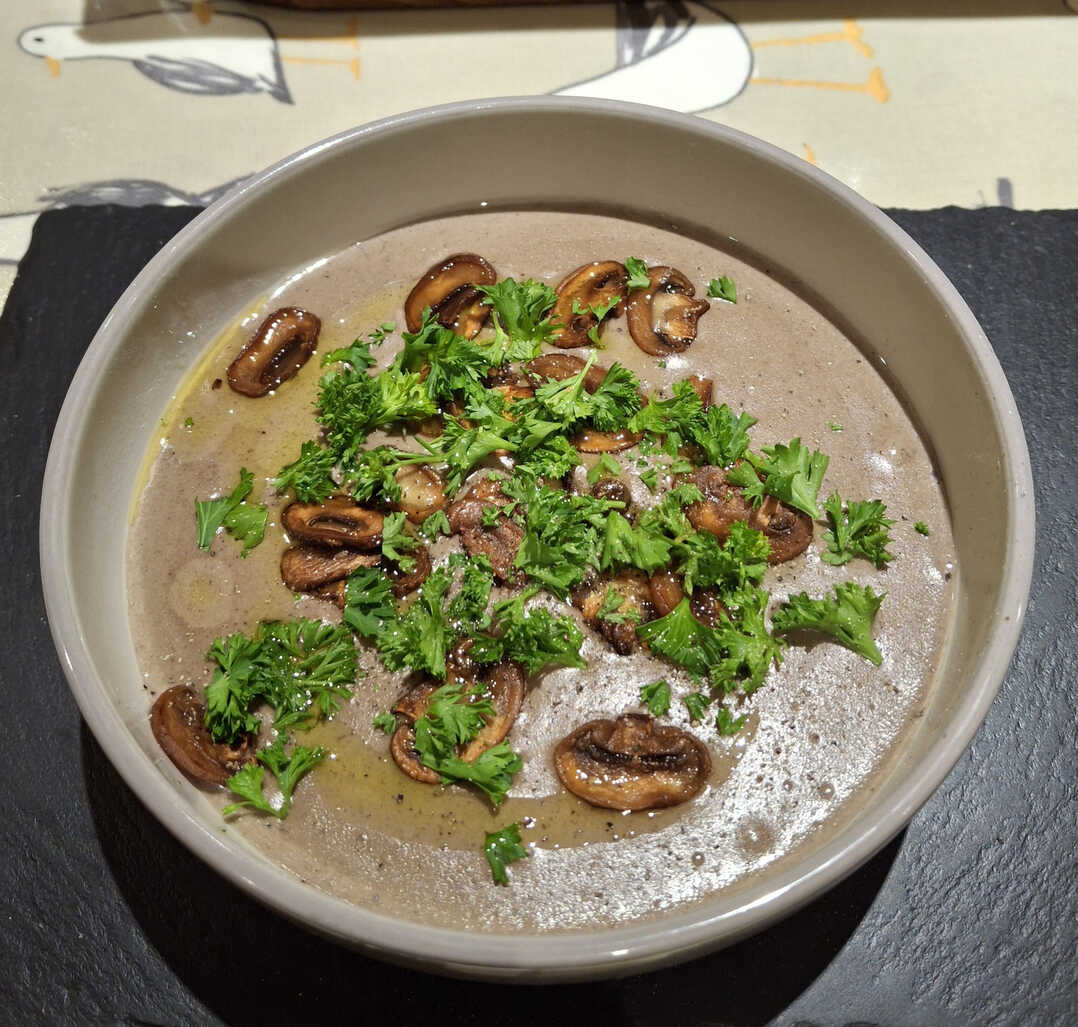
  • Add mushrooms, although they are best served in a dashi made from dried mushrooms.
  • Add an onsen egg, or a seasoned boiled egg cut in half. Best added freezing cold for a nice temperature contrast!
  • Season with a good squeeze of anchovy paste (in which case reduce the amount of miso).
  • Flavour with pickles like kyurizuke, chilli pastes like doubanjiang, crispy chilli oil, or a flavoured oil like sesame. And of course, kimchi!.
  • Sprinkle with shichimi togarashi; seven-flavoured chilli mix, for that Japanese authenticity.
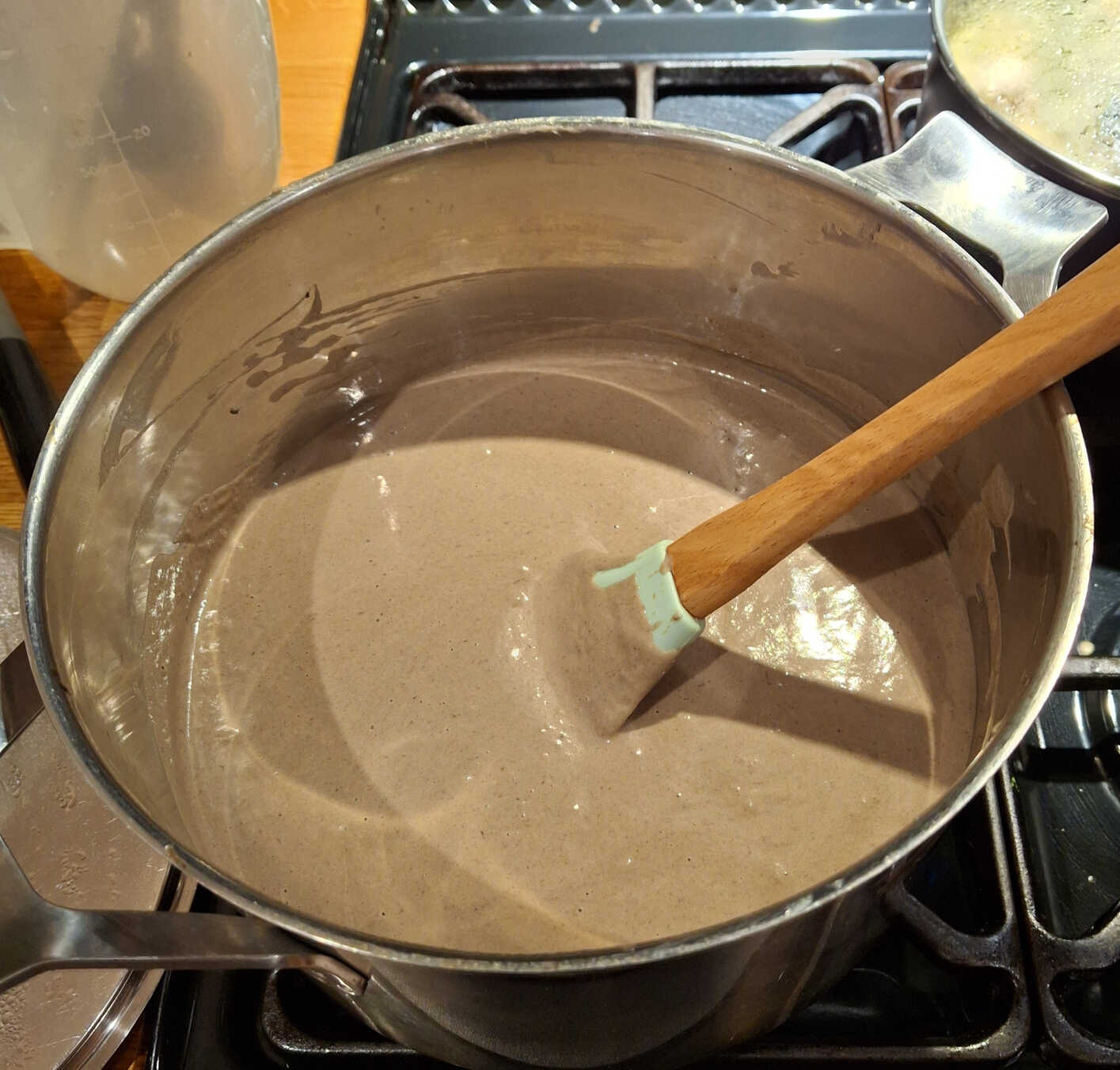
My Miso Period began with a regular Western cabbage soup though, which explains the persistent presence of cabbage as an ingredient in all my subsequent miso soups.
And I suppose it ended when I discovered that hoard of poisonous mushrooms....
You Say PotAYto and I Say Tortilla de Patatas...
Sunny Brighouse Marina

In which I present a Spanish Omelette recipe from Oleg, which arrives via my friend Flora.
Who slightly resented all the washing up involved.

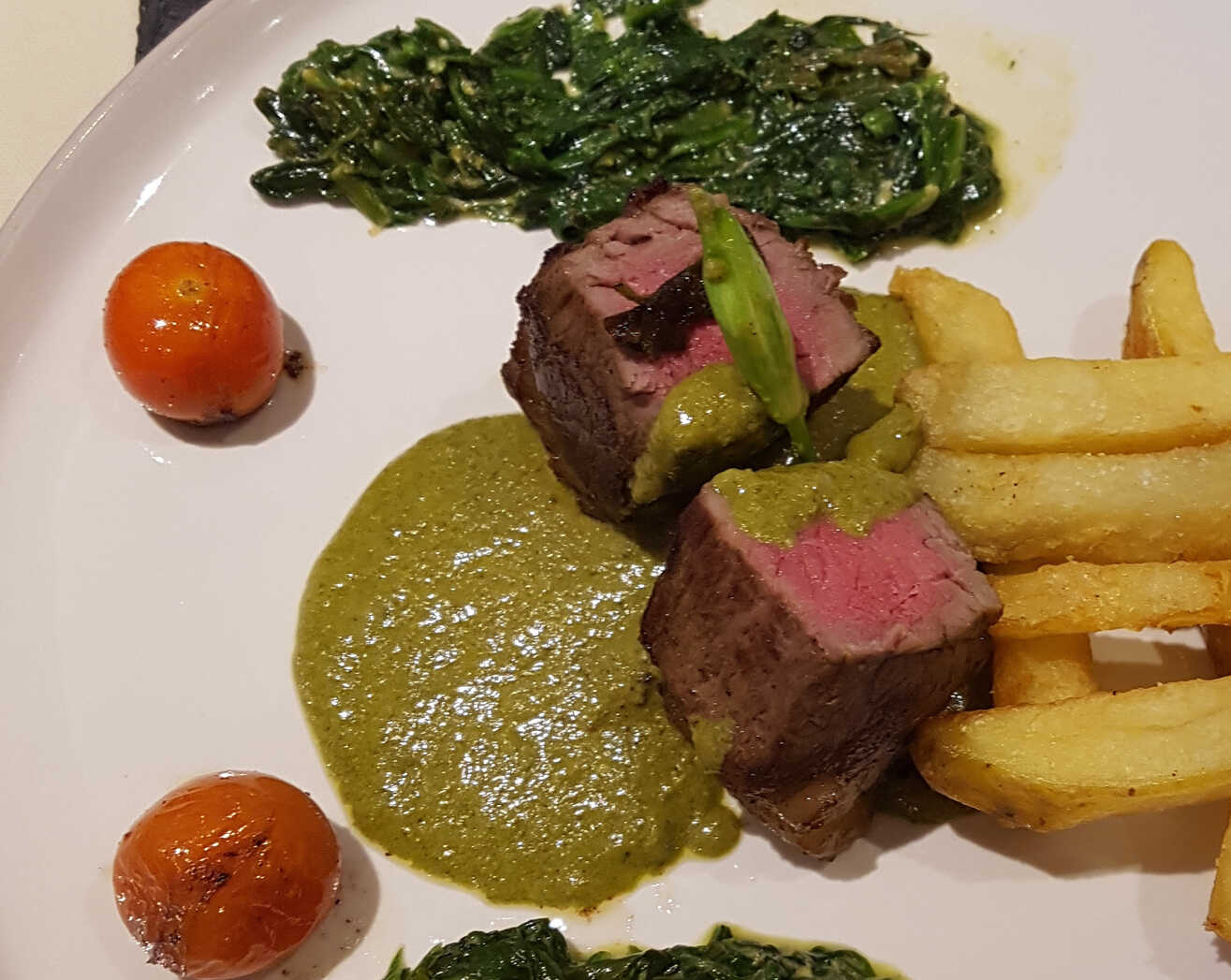
Plus a delicious sauce you can use to flavour any beef leftovers, since I've also been playing with my sous vide gear, some of which I got for Christmas 🙄, and honing in on the perfect steak dinner.
And some pretty decent lamb.

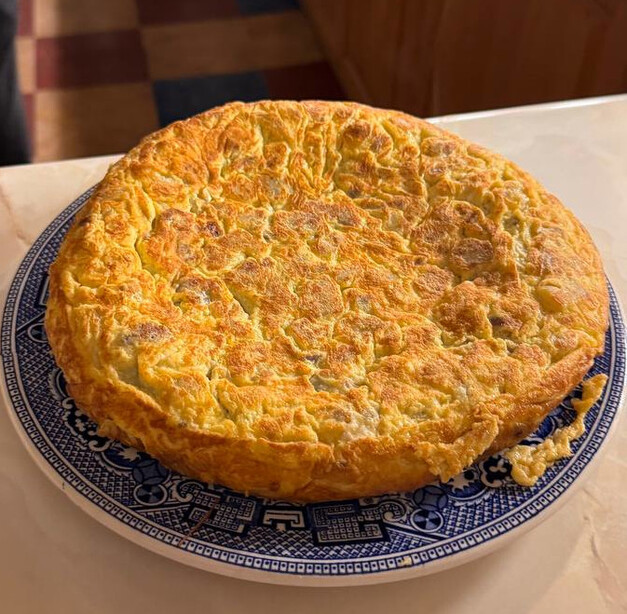
Tortilla de Patatas
Spanish Omelette
breakfast snack veg
There seem to be two fierce debates which rage in Spain over how to make their omelette:
  1. should it contain onions
  2. should the potatoes be diced or sliced
The answer to 1. is Yes, the answer to 2. is for you to decide.

Since there are only three four ingredients, you wouldn't think there was much more to say. Right?
Wrong!

Spaniards also will bicker about what varieties of potato to use (the potatoes should be waxy - like charlottes or fingerlings),
how browned the onions should be (they shouldn't),
how crisped the potatoes should be (they shouldn't),
how liquid the finished omelette should be (it shouldn't),
and whether Catalan is a real country er....
Wow, that escalated quickly!

Serves 4

Ingredients
  • olive oil, lots of olive oil - about 400ml
  • 8 smallish palm-sized potatoes
  • 8 regular eggs or 10 smallish
  • 1 medium onion

  • Flavourings:
  • salt
  • herbs - parsley/basil/dill/chives/tarragon/mint(?) etc
  • sweet red peppers
  • salt cod
  • sausage
Method
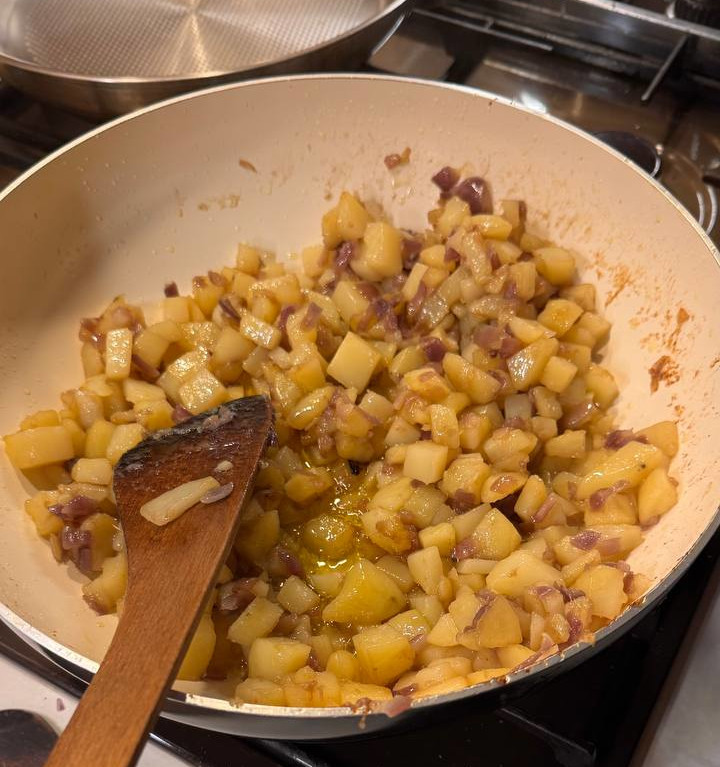
Peel the onion and slice or dice it. Sweat gently in a generous pool of oil in a large frying pan until they soften without browning.
Unless you like your onions browned, of course.
Peel the potatoes, and slice or dice them, the size is up to you but it's best if they're even. Add them with more oil to the frying onions and continue cooking gently until the potatoes soften.
Some segregationists insist that the onion and the potato should be fried separately.
Opinions also differ (SURPRISE!) on whether or not to add salt to the cooking potatoes which may soften them.
Meanwhile break up the eggs in a large bowl using a fork and add salt.
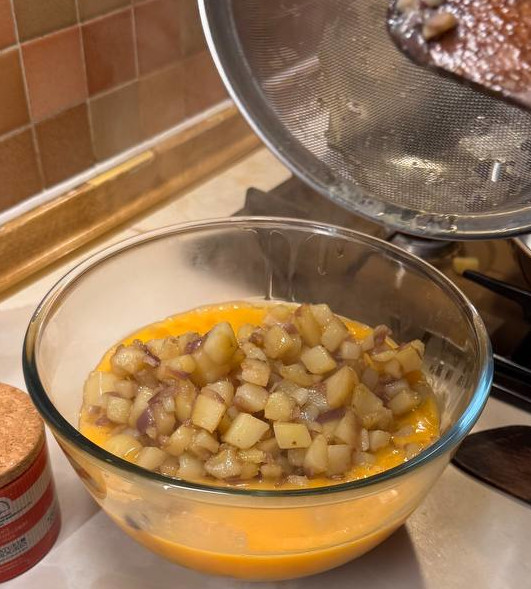
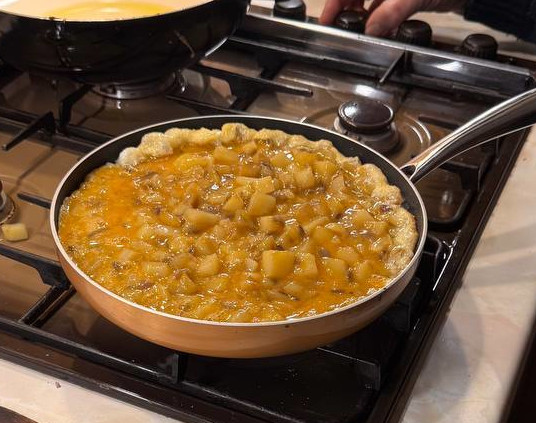
When the potatoes feel soft to the fork, sieve the mixture briefly over a non-sticky tortilla pan a non-stick frying pan with high sides is ideal then add the hot strained onion and potatoes to the eggs. Mix together well.
This will start slightly cooking the eggs.
Some Spaniards advocate for leaving the egg mixture to infuse for hours before continuing.
None of them suggest pouring the eggs into the potato in the pan.
Get the oil you previously strained into the tortilla pan really hot, then pour in the omelette mix, lower the heat and leave until nicely browned on the bottom but not burnt!. Have a peek with a spatula.
Using a plate, or two plates, or all the plates, turn the omelette over and slide it back into the pan with even more oil along with any leaked egg to brown the other side.
To flip the omelette you can hold a plate over the frying pan and turn it. Or you can slide the omelette out onto a plate.
Then either slide the flipped omelette back into the pan, or flip an unturned omelette between two plates and then slide it into the pan.
Either way you should make a big performance about not having quite the right plate for the job, which is why you got egg all over the floor.
Serve with ketchup.
ONLY JOKING SPANIARDS! Please don't kill me.
You can add bacalhau (suitably soaked and washed) or herbs or red peppers.
Or even shudder chorizo. But don't tell your Spanish friends.
Probably best enjoyed with a side salad and a bit of cheese, like burrata.

Entrecôte Sauce
Café de Paris Sauce
sauce
Entrecote sauce started life as Café de Paris Sauce at the eponymous Genevese restaurant in the 1930s.
In the early 1960s vintner and restaurateur Paul Gineste de Saurs adapted this sauce to serve with entrecôte steaks at his Paris restaurant Le Relais de Venise — L'entrecôte, and is now the standard sauce perenially served at its sister establishments around the world now run by his various daughters.

This version is based on one of the many attempts to duplicate it I found on the interwebs.
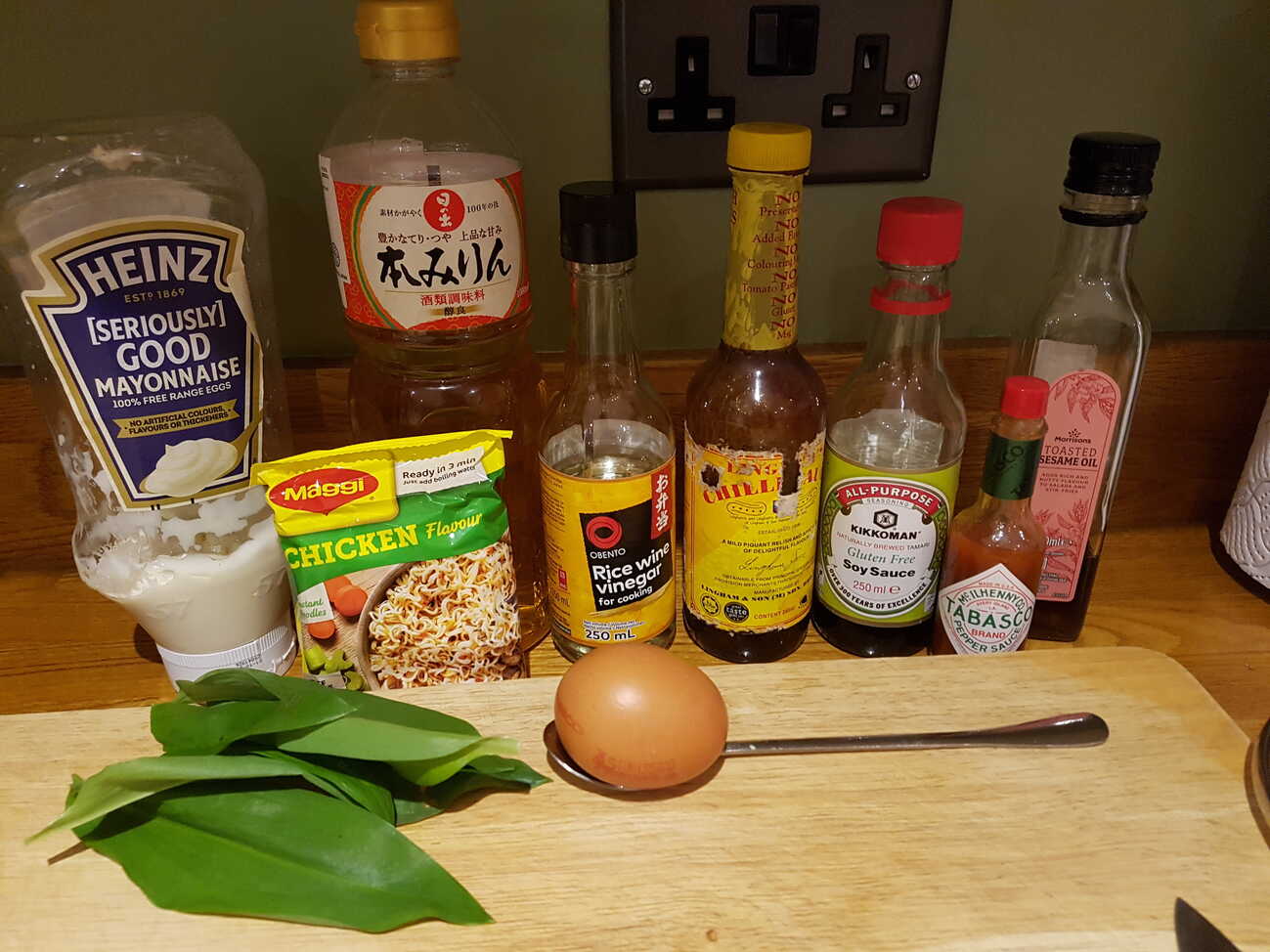
I can't speak to its authenticity, not having eaten in any of these places, and I couldn't get any fresh tarragon, so threw in some wild garlic that I'd picked for something else, and I would have added chervil, if I'd ever seen any in my greengrocery.
But it was still delicious.

Serves 2-4

Ingredients

  • For the Blended Sauce:
  • 1 shallot, finely diced
  • generous lump of butter - 50g or more
  • handful parsley
  • handful tarragon
  • handful basil
  • handful chervil would probably be nice
  • some sage leaves
  • 1 tsp (about 10) capers
  • 5 walnuts
  • 1 tin anchovies a whole tin is too much - try ⅔
  • ½ nutmeg grated seems like a lot - I'd go with ½ a teaspoon!
  • ½ lemon - flesh only
  • a dash of pepper

  • For the Mayonnaise:
  • 1 egg yolk
  • 1 teaspoon Dijon mustard
  • 1 scant tsp Worcestershire Sauce
  • 1 tsp white wine vinegar
Method
Make the Blended Sauce
Sweat the diced shallot you can use red onion in a generous amount of butter until softened without colouring.

Blend all the sauce ingredients together with the hot shallots and butter until fairly smooth. You can do this in two stages if you like.

Make the Mayonnaise
Mix 1 egg yolk, Dijon mustard, Worcestershire sauce, dash of white wine vinegar.
Whisk the egg with the mustard, vinegar and Worcestershire sauce. Slowly add the blended sauce while whisking steadily to make the mayonnaise.
The blended sauce is very thick at this stage and difficult to pour into the eggs, so it might make sense to loosen it with a little hot water.
Take about a third of the sauce and cook while stirring until it splits!!
Add this split component back to the rest of the unsplit sauce when slightly cooled.
Adjust the seasoning and add a squeeze of lemon if required.

Keep the sauce warm but not too hot! to serve with steak frites.
It's quite a lot of work, to be honest, but the result is delicious!
What Have the Romans Ever Done For Us?
Massive Snow Storm on Cue

Well spring is springin' around here - the birds are singin', the wild garlic is sproutin' and the crocuses crocci? are bloomin'.
Cue massive snow storm 😂

I've been experimenting a lot with guanciale - cured pig's cheek - since it appeared on limited offer at my local Lidl.
It turns out that this cured porky jowl is the basis for a series of pasta dishes from the Lazio region around Rome, elaborating on the basic cacio e pepe pasta (cheese and pepper - the local Roman cheese pecorinio romano, spiced with ground black pepper and usually served on spaghetti, bucatini or tonnarelli).
The first of these is pasta alla Gricia - basically just the inclusion of fried guanciale.
Then we add eggs to get carbonara, or tomato giving Amatriciana.
Or we combine these two, throw in some sausage, and get pasta alla zozzona. A slutty mess - for some reason rarely included in compendia of famous Roman pastas.

Despite the confusing order in which I presented them, Pasta all Gricia may be the oldest of this collection, perhaps going back to the 5th Century, though it's origins are controversial and obscure. Certainly it's older than the arrival from the Americas of the tomatoes and hot chillies (peperoncini) used in Amatriciani or zozzona. And pepper was a fairly rare and expensive spice until relatively recently, so not something peasants would have been chucking into their pasta by the handful.
Pasta carbonara was an unknown (or at least, unrecorded) dish before the Second World War, and several origin stories implicate occupying American forces and their prolific supplies of bacon.

This season I will be mostly cooking these for one 😢

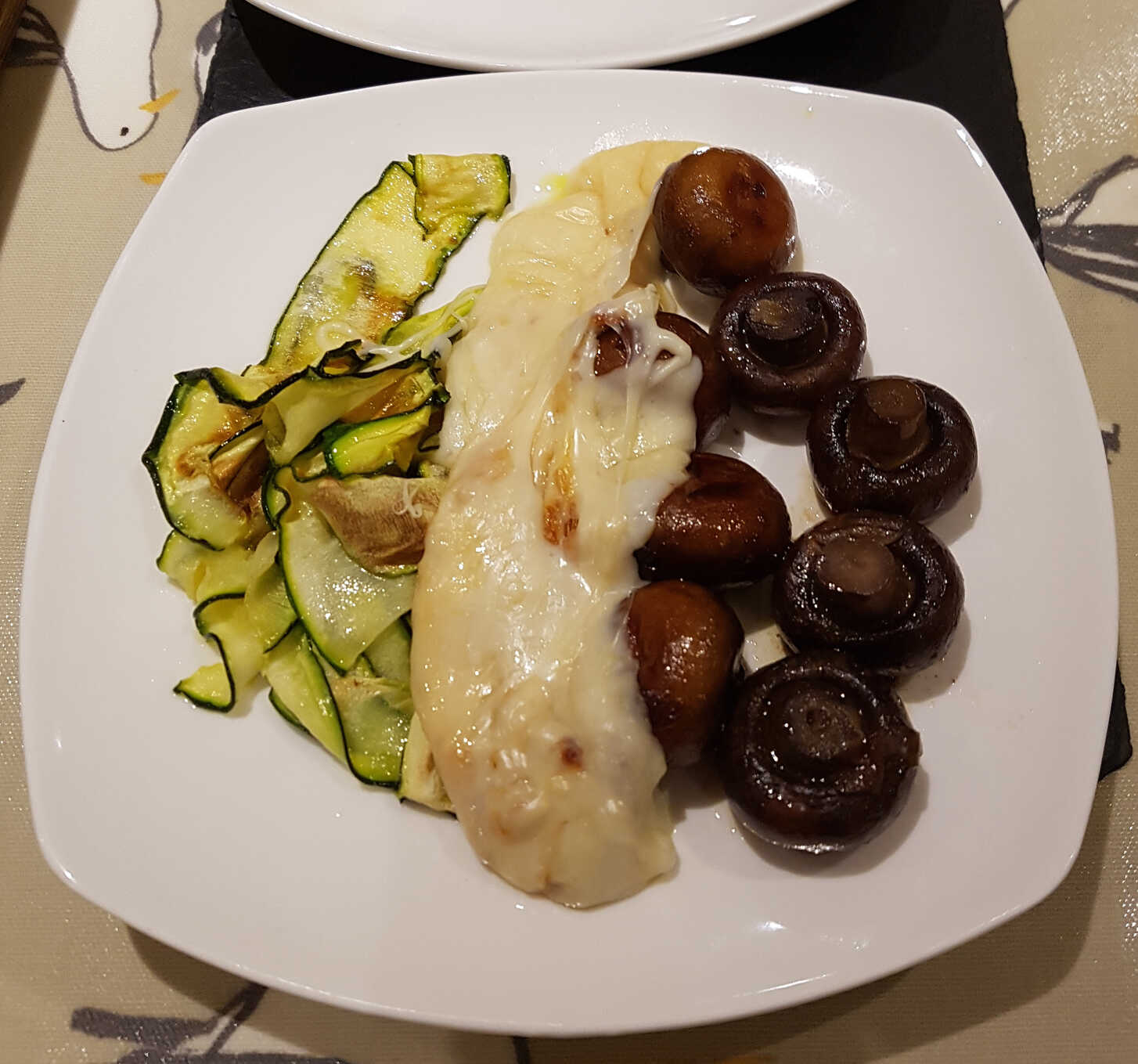
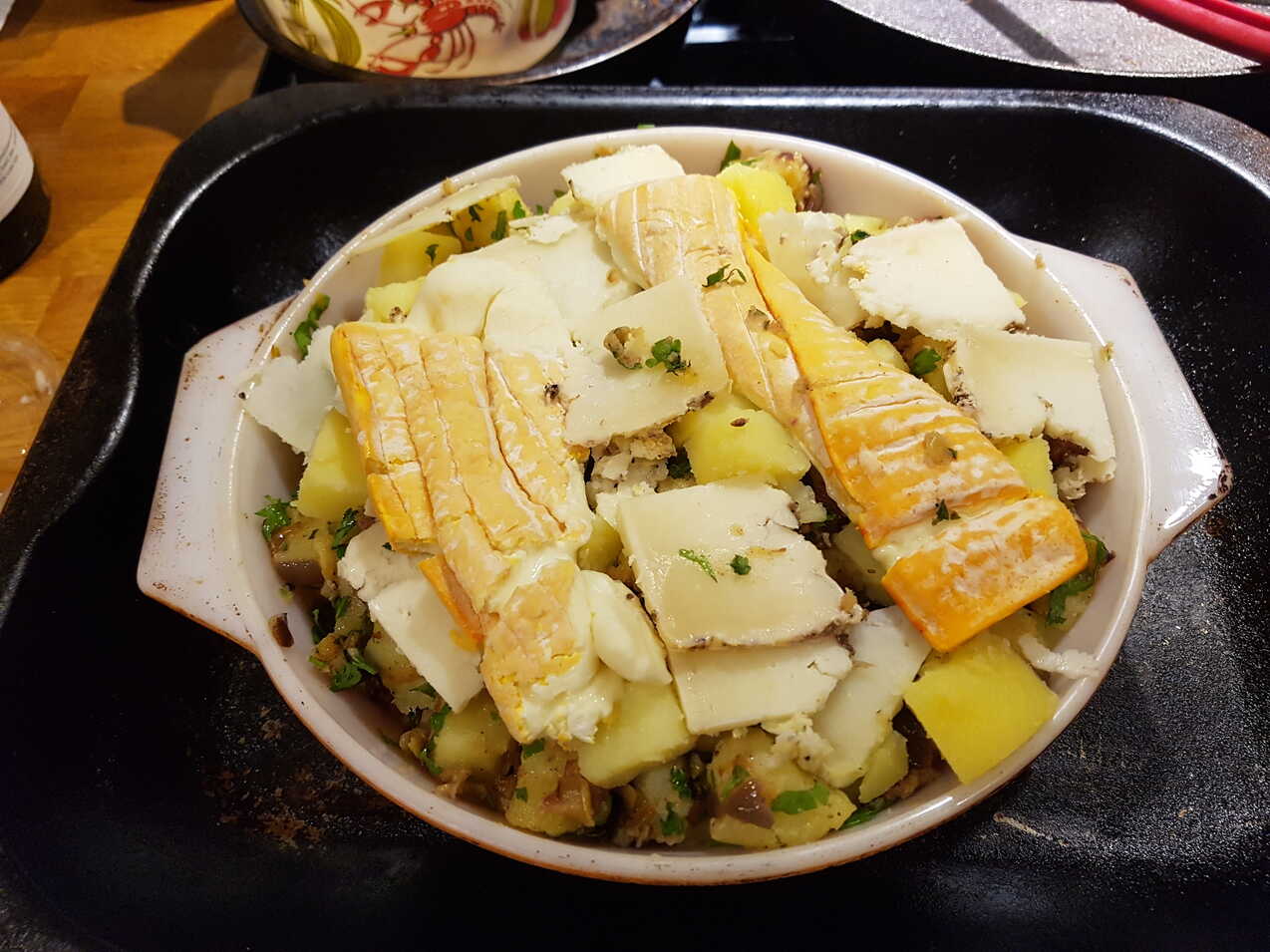
Lidl also had scamorza cheese along with their guanciale - must be Italy week or something, so I bought some of that too. It's less interesting than pig cheek, but you can melt it over most any cooked vegetables as an antipasto. Potatoes, courgettes, mushrooms, asparagus, aubergines, even experimental roast baby ones.
Most Italians seem like their scamorza sliced and pan-fried or griddled so it develops a nice crisp golden crust with a gooey interior, though you might want to us a very un-sticky pan or you'll be scraping off a lot of crispy golden crust!

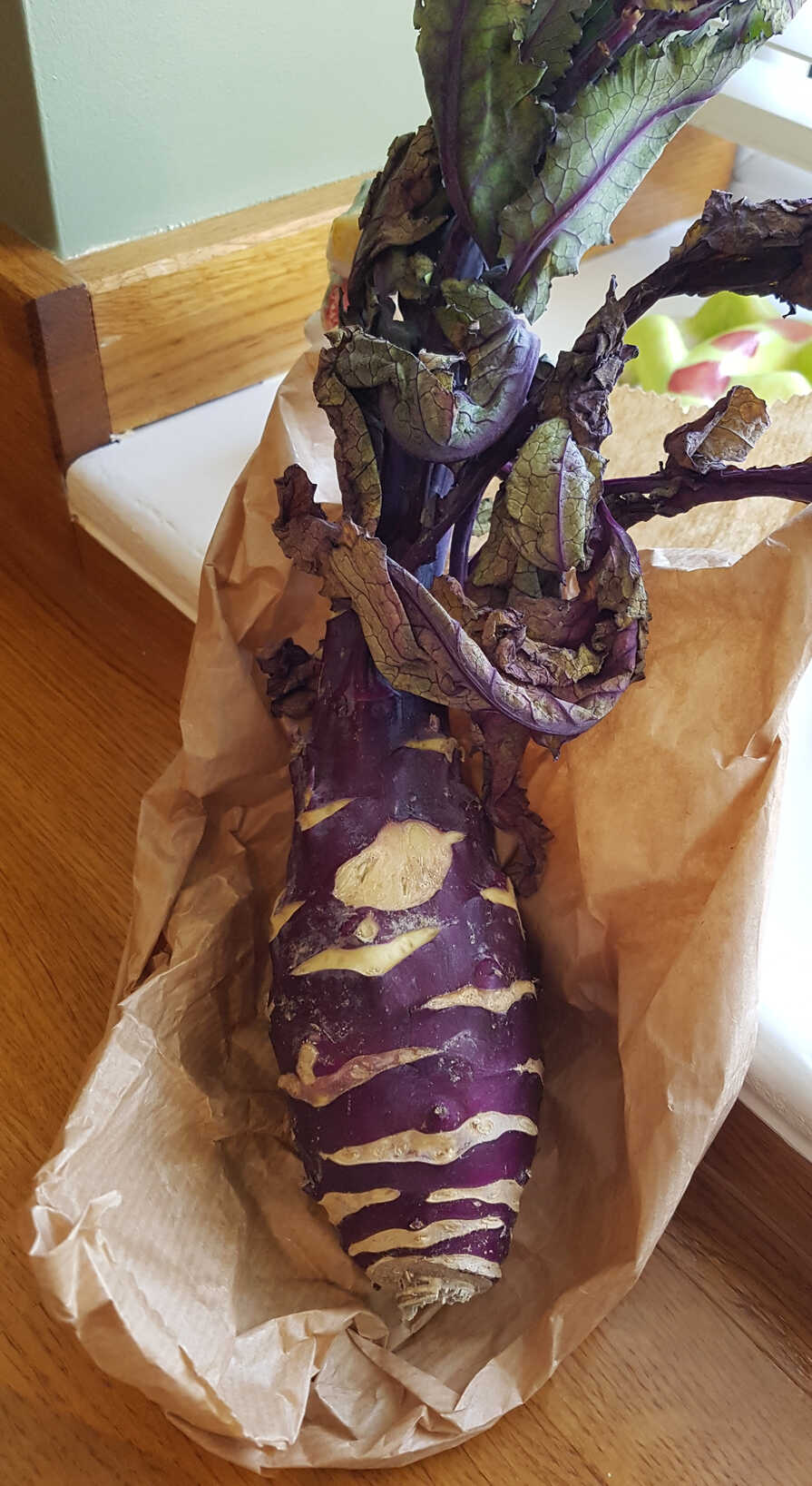
It's been a busy week for bargain spotting: My local health and wholefoods store had some weird-looking alien vegetable for sale that turned out to be kohlrabi. Not the smooth green-skinned kind though, the cracked red-skinned kind. Didn't even know that was a kind.
So I figured I'd look up things to do with them other than shredding in coleslaw or salad - it's refreshingly crisp, sweet and vaguely nutty like a cross between a radish and a turnip. Which is funny because Brassica oleracea are, in fact, a cross between a wild cabbage and a turnip, the direct translation of its German name: Cabbage Turnip.
Or possibly they're a cross of a wild cabbage and a beet.
This is distinct from a rutabaga (Brassica napus), also known as swede in England, although wrongly called turnip or neep in Scotland, which is definitely a cabbage-turnip hybrid.
These damn promiscuous vegetables!
Anyhoo, it's been suggested that kohlrabi also tastes great steamed, mashed, or added to soups, and I can now attest that it roasts up really well too. I thought that this would mean they would also make great deep-fried chips, but so far they haven't quite lived up to that.
You might need to do a fair bit of vigorous peeling though - they can have very thick fibrous skin.

Anyway.
I came here to talk about shipping companies.
Absolute dog shit aren't they? The lot of them.

Finding myself requiring additional guanciale, I recently ordered some from Amazon, who ordered it from Italy, who shipped it with OOPS - an American shipping company who's service is, you guessed it, dogshit.
OOPS' first optimistic delivery window was 08:20-10:20. (Odd isn't it how very specific these ficitious delivery windows are?)
As usual with these predictions, they are only useful as a guide for knowing when you absolutely do not need to be in, since this is the one period during which you can guarantee their Dogshit Delivery Drone™ will not attempt delivery.
4 hours later, they updated their delivery prediction to before the end of the day, whenever that is, only to revert to the original window now 14 hours in the past around midnight.
See. Absolute dogshit.
I stopped checking with them after that.

So an interesting question is, why are they so fucking useless? Don't they operate in a competitive capitalist environment renowned for driving innovation and efficiency?
Well the answer, my friends, is that the shipping companies don't work for you, and you aren't their customers. They work for the seller, because the seller pays them.
Have you ever tried complaining about your delivery, or lack of? You'll find there is absolutely no mechanism for you to send them meaningful feedback, and they don't give a shit if you do. Because they aren't competing for your business, so quite naturally they couldn't give less of a fuck about your delivery experience.

And the sad thing is - there actually is a simple solution: Payment on Delivery.
You can bet your arse that the instant their payment depends on your satisfaction they'd start to give a fuck about what you thought about their service. There'd be a lot less pushing a card through your letterbox and running away if the shitbags didn't get paid for doing it.
You'd be amazed how capable a shipping company could become at delivering a parcel into your hands if their profit depended on it, and how reluctant they would be to hide your parcel in your bin, or their depot in the next county if they suddenly weren't going to get paid for that.

You know what I want from my Dogshit Delivery Drone™? I want a notification about a day ahead, another about an hour ahead, and a final one about a minute ahead.
That's it.

You know what OOPS gave me? A detailed breakdown of the exact times my guanciale passed through all the their depots in Italy, three days ago.
You know what I don't give a fuck about? A detailed breakdown of the times my guanciale passed through their depots in Italy, three days ago.
You know what I do care about? Roughly when I'm to expect the parcel, and then a heads up just before it arrives.
Instead my OOPS guanciale arrived without warning several days later.

Fucknuggets.
After the Fireworks
First Snow of the Year

After the fireworks... The Cheese!

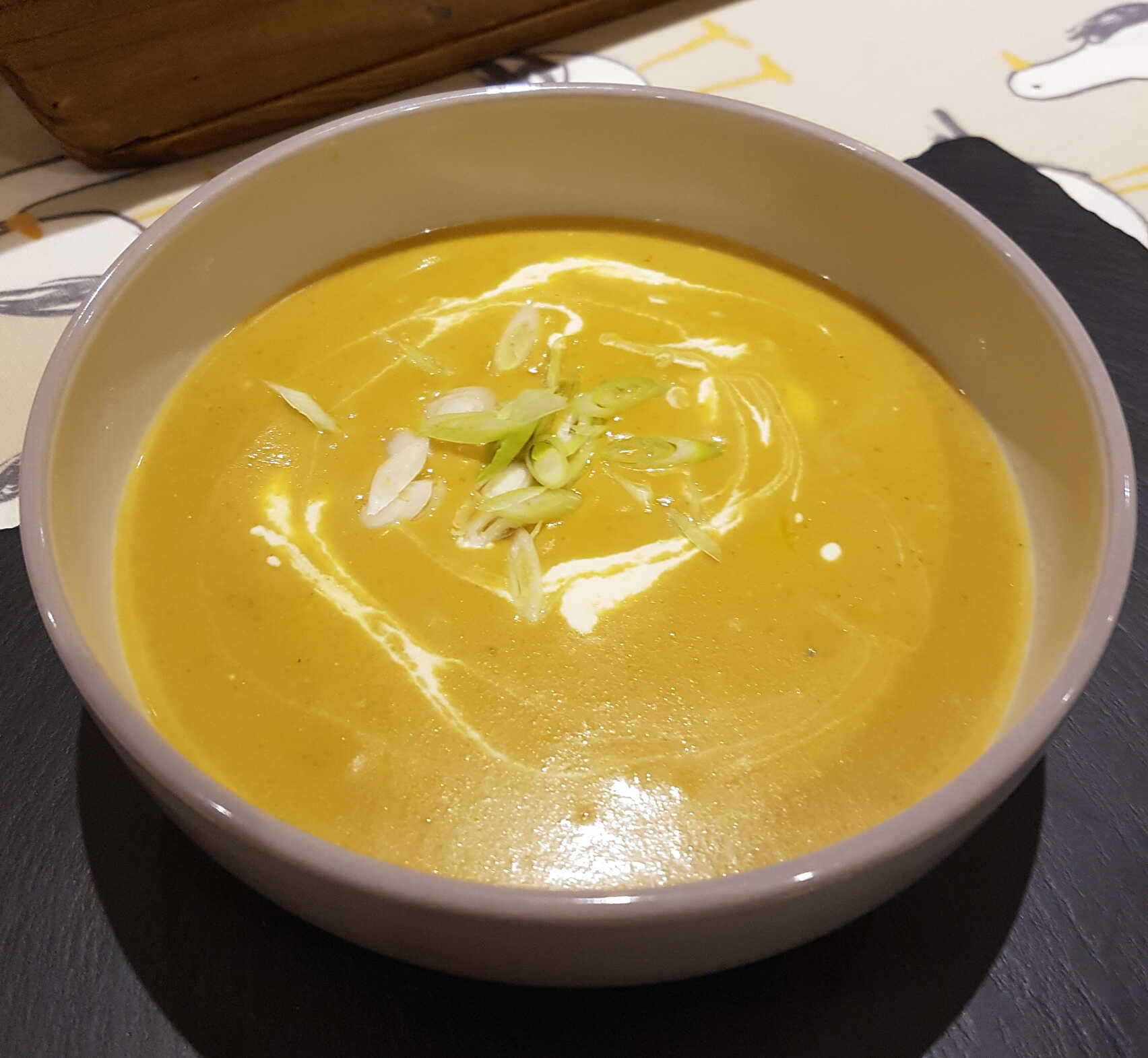
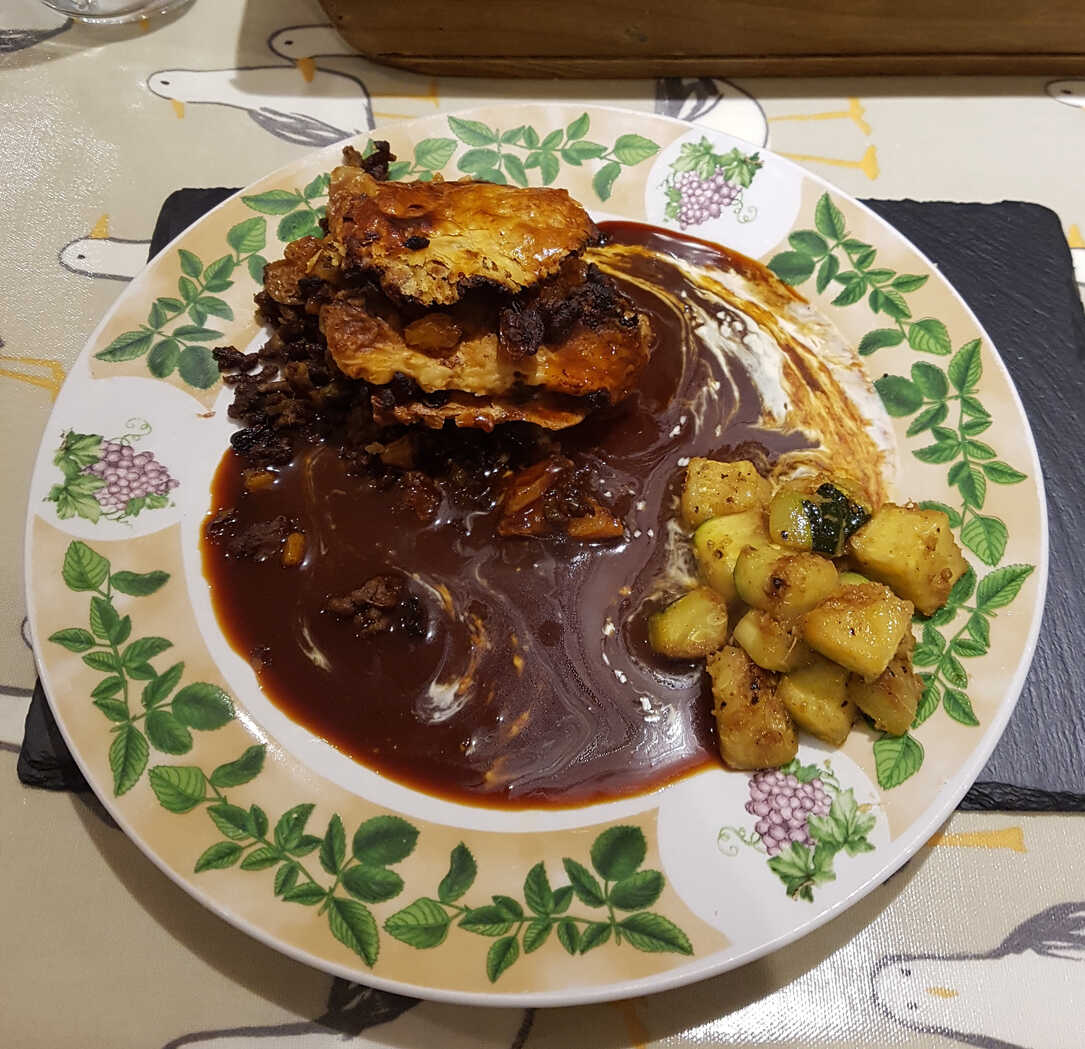
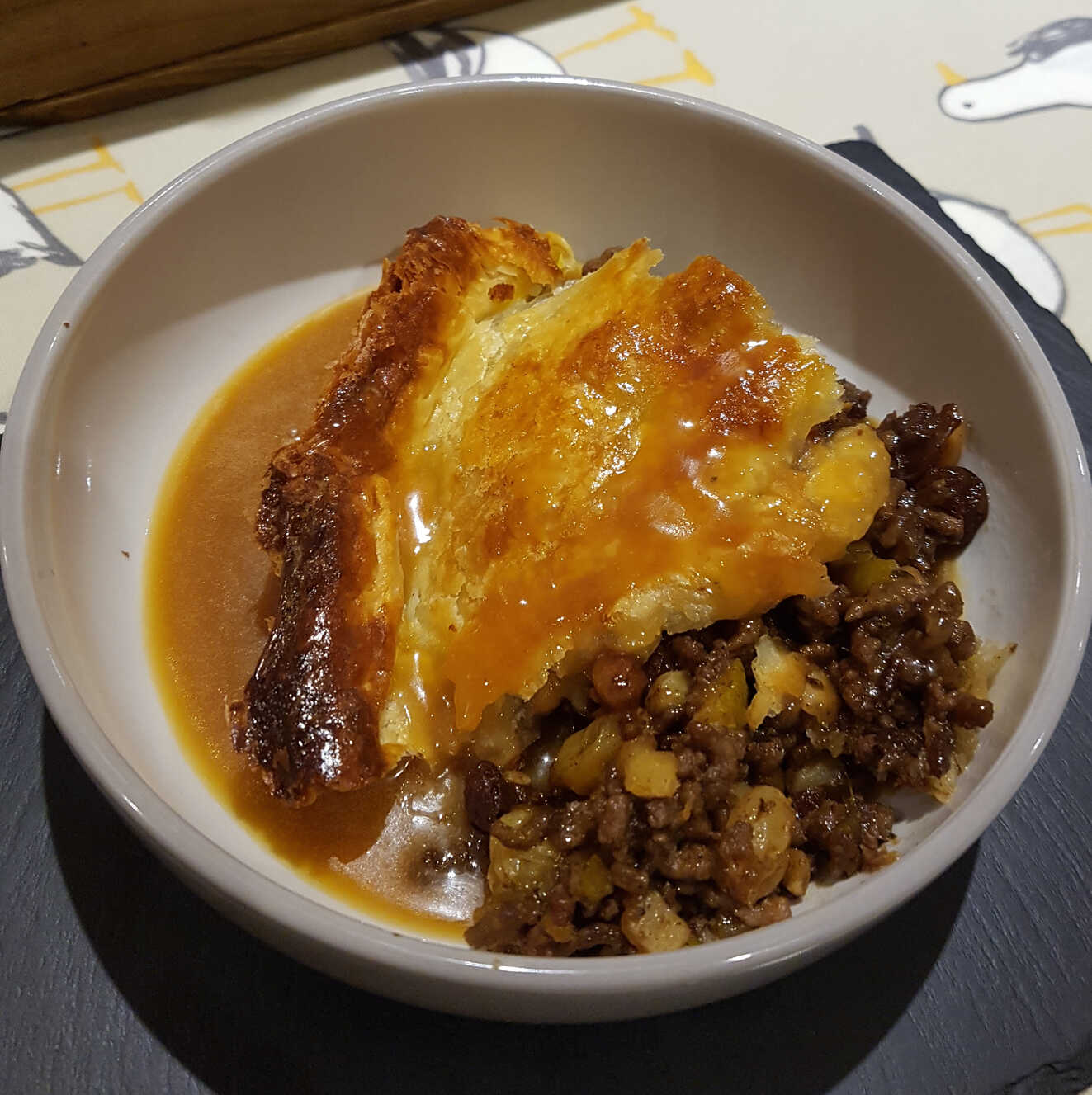
We kick off the New Year with a cheese soup, and a cheese sauce to go with a leftover mincemeat pie. Flora's home-made mincemeat mind you, which would have been sacrilege to discard.
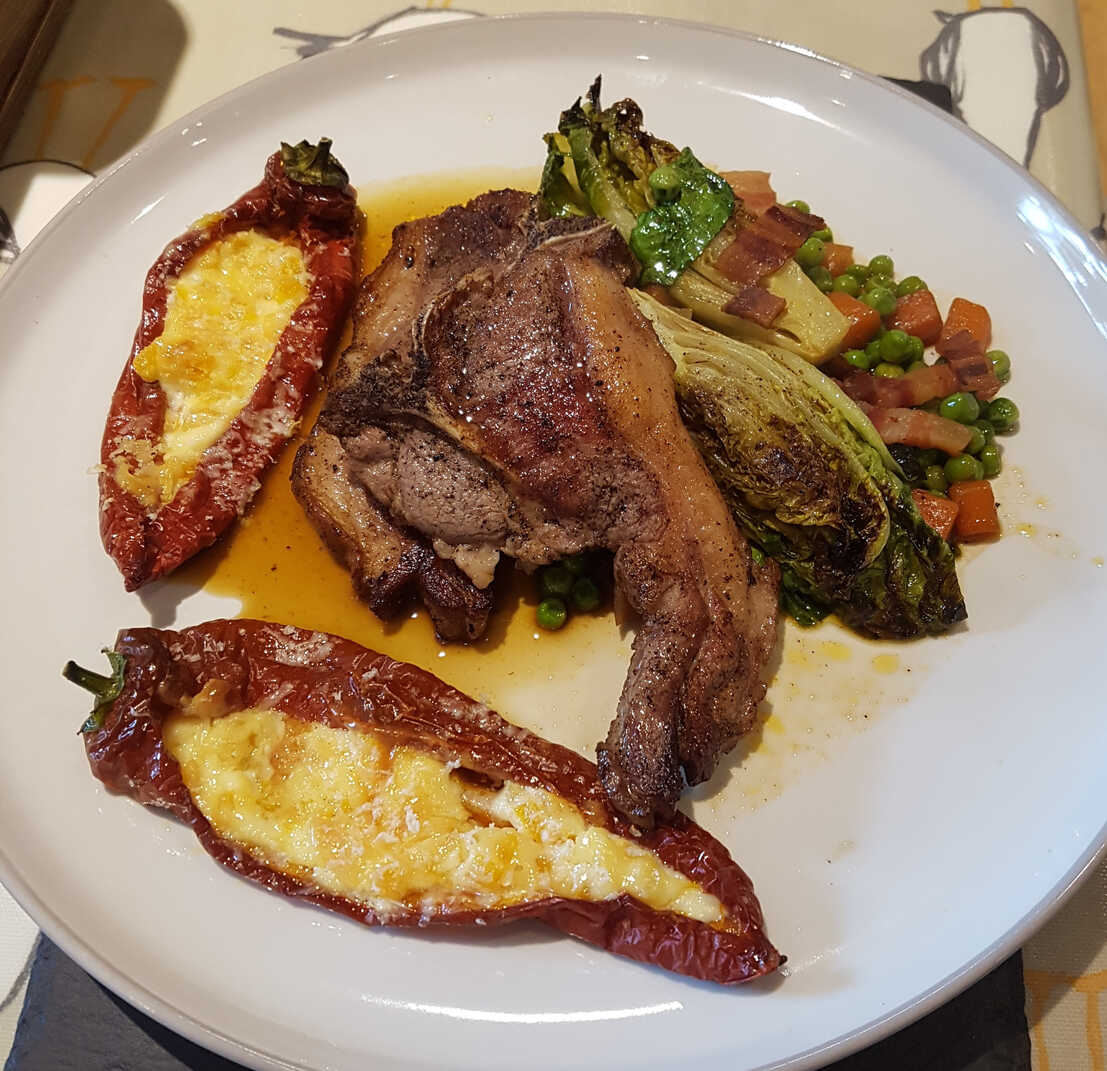
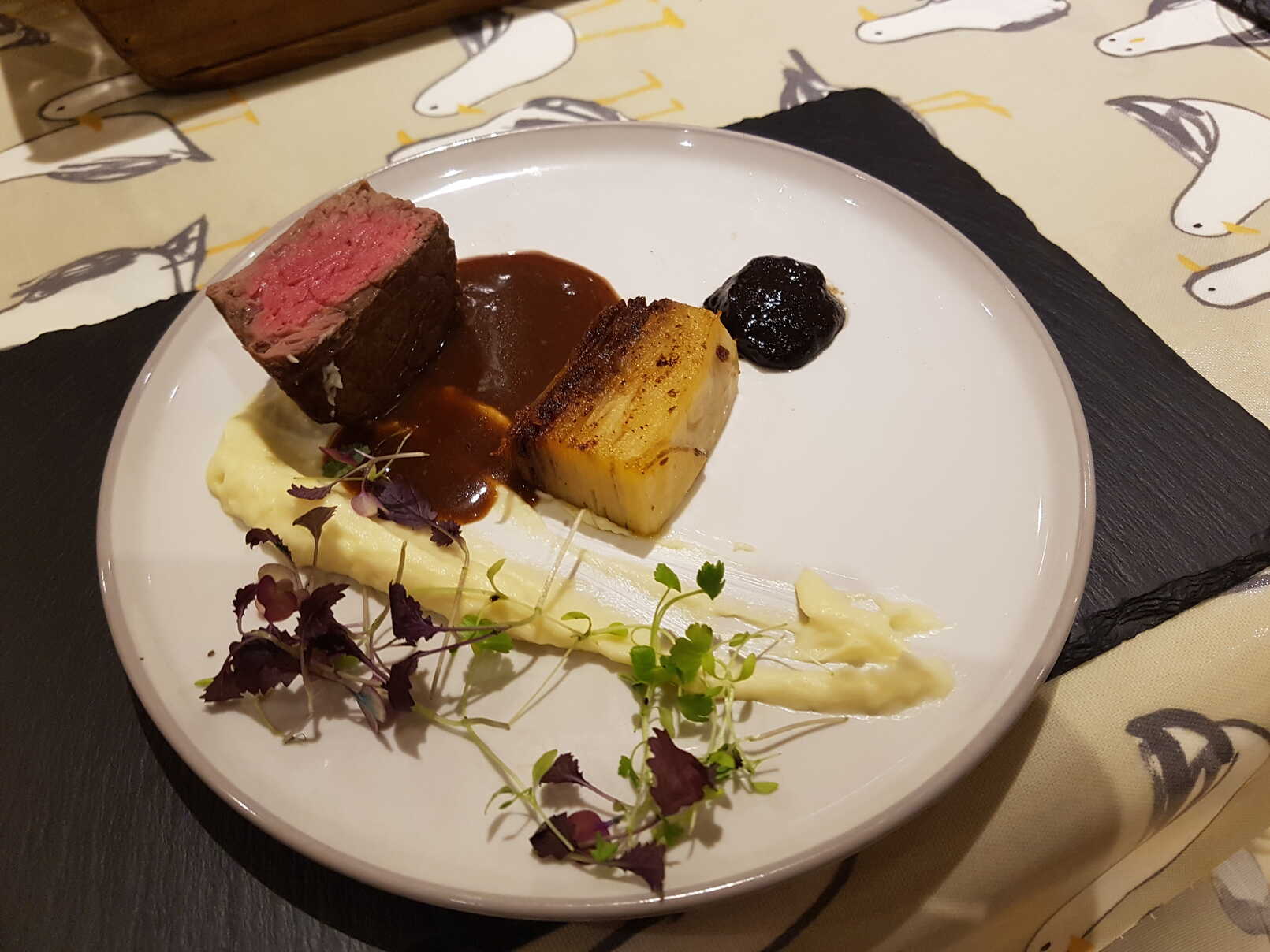
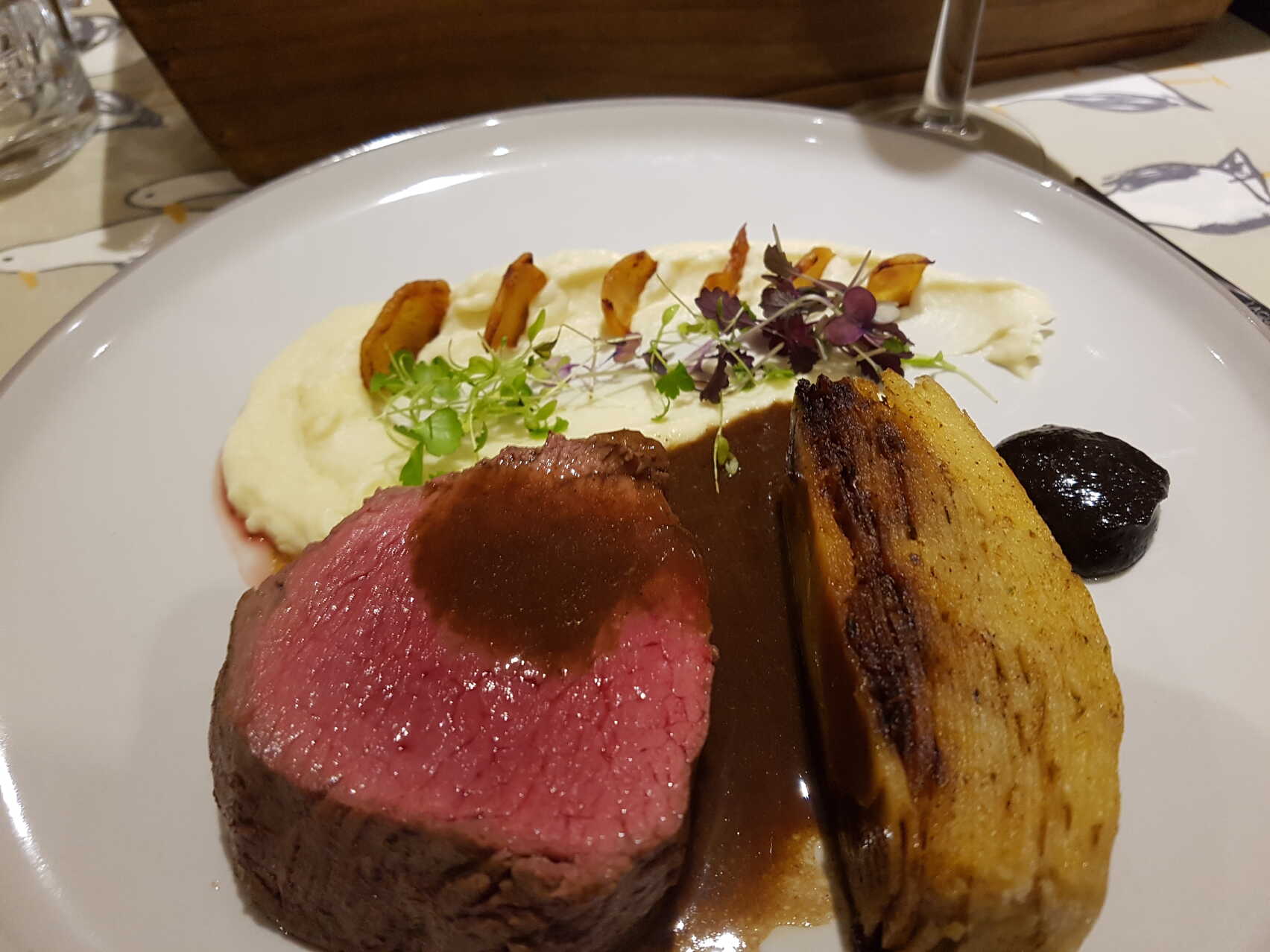
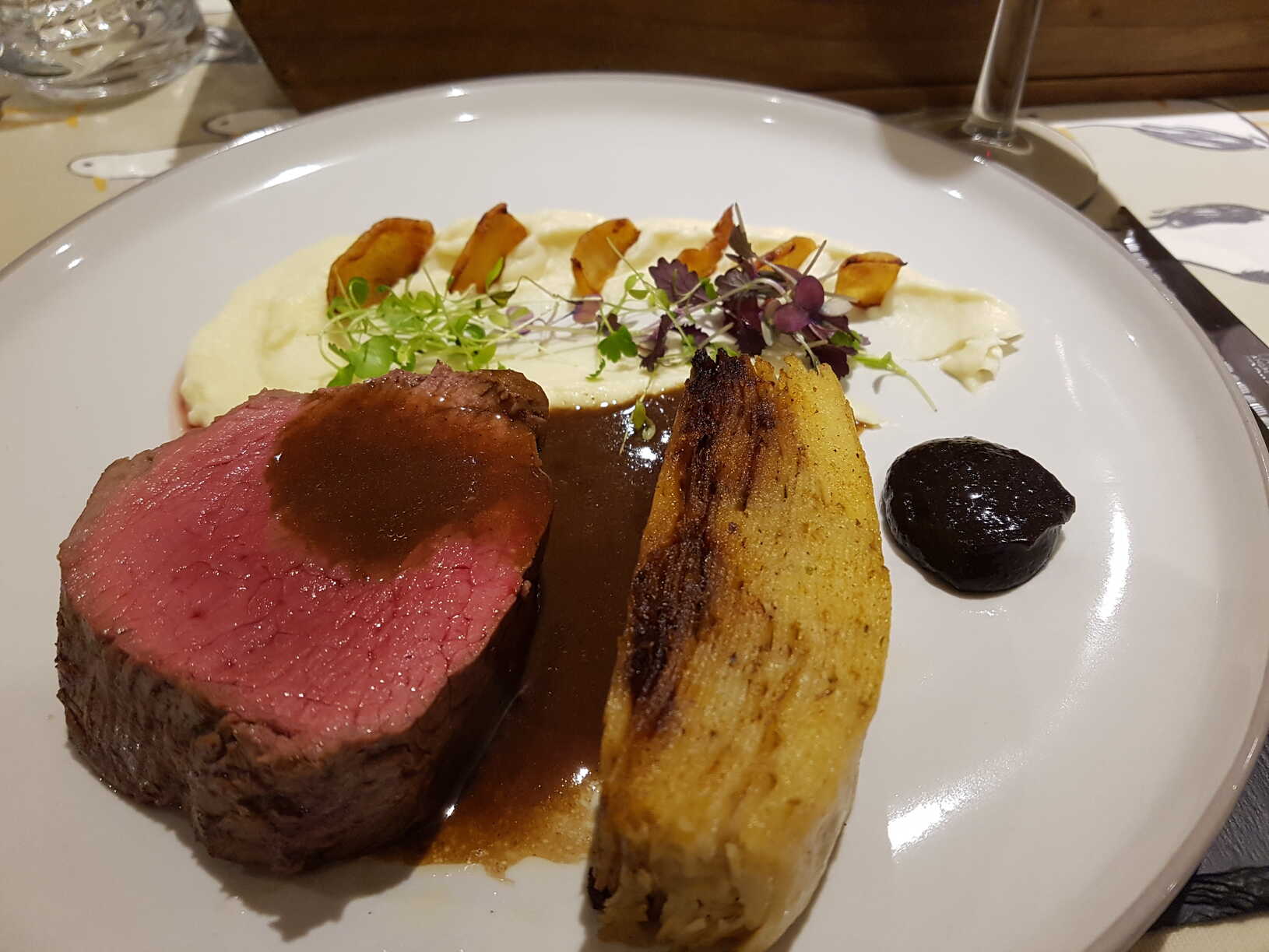
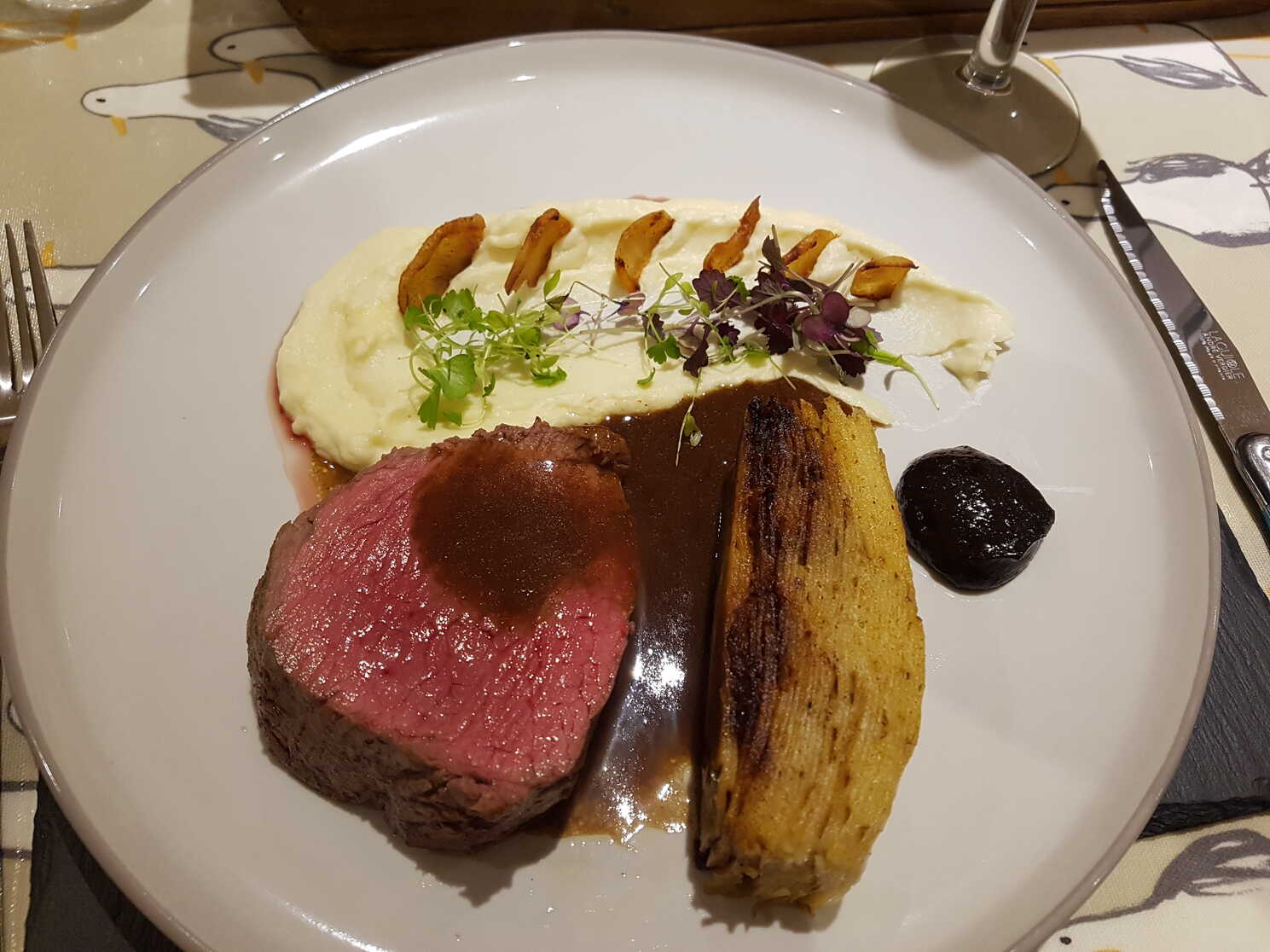
And then on to a particularly nice fillet steak meal with pommes anna, parsnip horseradish purée, black garlic gel, and red wine tarragon sauce lifted from various Great British Chefs.
You may spot one or two photos of the meal below 😉
Thanks Chefs!

In other news...
We had the usual media-bedwetting apocalyptic snowfall of a couple of inches over the second week of January to usher in the new year.
And I began experimenting with my sous vide Christmas present. It does a really nice fillet steak.
It's success with duck breasts is still in question though.

I started a new cookery class at Kirklees College - an Introduction to Pâtisserie this time, for a change.
And I managed to squeeze in another meal with friends to celebrate my brother and nephew being away JOKE!.

So a Happy New Year to all my reader 😘

Celery and Gorgonzola Soup
cheese soup
I needed to use up some Gorgonzola so I substituted that for the Stilton in Rachel Kelly's original recipe.
Celery and Wensleydale is a recognised combination, so I suppose a blue cheese is not too far off.
I had slightly more celery than the original recipe called for, which I don't think does any harm, boiled potato to thicken the soup, and I included a little bit of apple too, which seemed like a nice addition.

Serves 4

Ingredients
  • 50g butter
  • 1 English onion, finely chopped
  • a few garlic cloves, finely chopped
  • 1-2 heads of celery (including the leaves) or a medium celeriac (about 750g to 1kg), peeled and roughly chopped
  • 1 carrot, roughly chopped
  • 1 small apple, peeled, cored, chopped
  • 1-2 boiled potatoes
  • 1 litre chicken stock
  • 100ml white wine
  • 1 bay leaf
  • a sprig of thyme or a bunch of parsley
  • about 1 cup double cream
  • 250ml milk or less
  • 200g gorgonzola or other blue cheese, crumbled
  • salt and freshly ground black pepper
Method
Melt the butter in a heavy-based saucepan and add the onion. Cook over a gentle heat for 5 to 10 minutes, until softened.
Add the celery (or celeriac) and carrots. Stir and cook for a further 5 minutes. Add the garlic and apple and cook until softened.
Add the white wine and bubble off.
Add the stock and bring to the boil.
Reduce to a simmer and add the bay leaf and thyme if using - I didn't have any. Cover with a lid and simmer for 25 minutes.
Add pre-boiled potato to thicken and a bunch of parsley towards the end, if you like.
Leave to cool, remove the bay leaf and if using a sprig of thyme; the woody stem, and blend. Pass through a sieve for extra smoothness.
Return the soup to a clean saucepan and bring back to a simmer. Add some cream and milk and warm through.
Add cream to enrich the soup, and only enough milk to thin the consistency and help dissolve the cheese - I used about 120ml
Add the blue cheese and stir continuously until the cheese has melted into the soup. Do not let the soup boil as it may curdle.
Check the seasoning. It is unlikely you will need any salt as the cheese will be quite salty.
Serve with a little of the blue cheese crumbled over each bowl if it's the kind that crumbles 😉 or a sprinkling of snipped chives or sliced spring onion.
Pretty nice.
You can make the soup as thick or as thin as you like. I included potato, added double cream and used less milk and slightly less stock than advertised.

Traditional Mince Pie with Caramel Cheese Sauce
dessert meat
I have previously made meaty mince pies and thought them rather good, but I'm not so sure about this one.
I was inspired by Onemina's recipe, but to be fair to her (them?) I fried my mince rather than just including it in the mincemeat preparation.

Feeds 8

Ingredients
  • 500g mince
  • 2 cups mincemeat
  • 1" ginger, grated
  • 1-2 courgettes, peeled, chopped
  • 1 stick celery, chopped
  • 1 cup white wine
  • 1 cup stock
  • puff pastry

  • To Serve:
  • Caramel Cream Cheese Sauce
Method
Fry the mince to brown lightly, then add the grated ginger and the celery and cook them out.
Add the courgette and then deglaze the pan with the white wine. Add the mincemeat and moisten with as much stock as required.

Line a pie dish with the puff pastry, fill with the, er, filling, and roll puff pastry across the top. Cut slits on the crust. Brush with milk, cream or beaten egg if you like.
Trim and crimp the edges and bake for about 45 minutes at Gas Mark 4-5/350-375°F/175-190°C.
Yeah, it really wasn't great. I think there's probably some difference between basically adding mincemeat to a meat pie and including meat in the mincemeat.
One giant pie is a bit weird, and I don't think puff pastry is ideal for a mince pie either.
But the sauce was lovely!

Black Garlic Purée
veg side sauce
I made the purée, or gel as I'm calling it, with about 6 cloves of black garlic - amounting to ⅒ of the amounts below.
Which does make weighing, measuring and blending the ingredients something of a challenge!

Serves 6 - You Don't Need Much

Ingredients
  • 190g of black garlic, peeled
  • 85ml of water
  • 15g of xanthan gum
  • 2.5g of salt
  • 15g of white wine vinegar
  • 15g of caster sugar
Method
Place all the ingredients in a Thermomix set at 60°C and blitz until smooth.
Alternatively, place all the ingredients in a blender, but with boiling instead of cold water.
Pass through a fine sieve and set aside to cool
The purée is thick enough to turn out using a lightly oiled measuring spoon and have it hold its shape.

Parsnip Horseradish Purée
side veg
The original uses celeriac, but parsnip is just a nice, or nicer.
I also used peeled, grated horseradish root instead of the horseradish sauce.
You'll need perhaps 100g. Adjust to your taste.

Serves 4

Ingredients
  • 70g of horseradish sauce or about 100g grated horseradish root
  • 200g of parsnip, peeled and diced
  • 120ml of milk or milk and cream
  • 1/4 lemon, juiced
  • 20ml of olive oil
  • salt
Method
Sweat the celeriac parsnip down in a pan with the salt and oil until soft and tender.
I discovered that if you accidentally over-brown some of the sides of the parsnip cubes (I'd cut them into cuboids) you can cut a thin slice of the browned surface away and fry those off in a little butter to make rather tasty parsnip crisps. Then you can decorate your purée with them when you serve.
You might even consider making the crisps deliberately!
Add the milk and horseradish sauce and bring the whole lot to the boil.
I just used fresh grated horseradish root.
I also tried substituting cream for the milk, but it's actually too thick on its own, but some cream is nice and enriching. Loosen with as much milk as required.
Take off the heat once boiled, squeeze in the lemon juice and blend into a smooth purée using a stick blender. Pass through a fine sieve
Excellent.

Red Wine and Tarragon Sauce
meat sauce
A rather complicated, but quite satisfying and very rich sauce.
The xanthan gum is extremely effective, so you need to add it a little at a time to avoid over-thickening.
To prevent the gum clumping you need to whisk continuously as you slowly scatter in the powder. Preferably using an electric whisk or immersion blender to maintain a vortex.
Apparently you can also mix the powder with oil first to help disperse it through the liquid without forming lumps.
The small amount of milk is an interesting touch.

Use any old meat trimmings to get the sauce started.

Serves 4

Ingredients
  • beef trimmings
  • 300g of mushrooms
  • 1.5l chicken stock
  • 700ml of red wine
  • 20ml of milk
  • 5g of xanthan gum
  • 20ml of Cabernet Sauvignon vinegar
  • 5 sprigs of tarragon
  • salt & pepper
Method
Sweat the beef trimmings until golden brown, add half of the mushrooms and sweat for 10 more minutes.
Add the stock, red wine, the rest of the mushrooms and milk. Bring to the boil and cook for 45-50 minutes, skimming all the time.
Sieve the sauce and add the xanthan gum and the vinegar and season with salt and pepper. Now add the tarragon and simmer for 2-3 minutes before passing again through a sieve.
Or just add the tarragon towards the end of the simmering stage to avoid having to strain again after adding the gum.
Though that assumes you could manage to whisk in the xanthan gum without lumping. Which seems challenging!
Be sure to de-glaze your meat-frying pan (I used sherry) and strain those juices into your sauce too.

Pommes Anna
Or Pressed Potatoes with Onion
veg side
Basically Pommes Anna with fried onions pressed between the layers.
You'll need a surprisingly large quantity of onion to start with before it reduces down to golden crisps.
Though if they're crisp you've probably gone too far. Soft and golden is the description given!

Serves 4

Ingredients
  • 100g of butter
  • 1kg onion, finely sliced
  • 2kg Maris Piper potatoes
  • 2 sprigs of thyme
  • salt
Method
Place a large pan over a medium heat and add the butter. Once melted, add the onions with a pinch of salt and the thyme and cook until soft and golden – this will take at least 10 minutes.
Preheat an oven to 180°C/gas mark 4 and line a 20x15cm terrine mould with baking paper.
Peel and very finely slice the potatoes (use a mandoline if you have one). And you should have one! Place the potatoes neatly into the terrine mould in layers. After the first two layers, alternate with a layer of the cooked onion. Season between each layer and ensure the final top layer is potatoes. Cover with a sheet of baking paper followed by a layer of tin foil and cook for 40 minutes, or until completely cooked through when a knife is inserted.
Have some extra melted butter on hand to brush the potato slices with as you go to make sure everything is sufficiently well lubricated. You might want to only add onions every other layer or fewer.
Mine took 1½ hours to cook.
Once the terrine is cooked through, remove the tin foil and place something heavy on top of the potatoes. Place in the fridge to chill and set overnight.
Turn out the set potato terrine and carefully carve into thick slices. Ensure the oven remains on at 180°C/gas mark 4.
Place the slices of potato terrine in the oven to warm through as well.
Serve arranged with the potato slices vertically for best effect on the plate.
Actually the pressed potato slices will hold together well enough to pan-fry them in butter, layer-ends down, to give them a beautiful golden crust.
Though I must admit they don't look quite as appealingly uniform as regular Pommes Anna.

Caldo Verde Vermelho
Cabbage Stew
meat soup
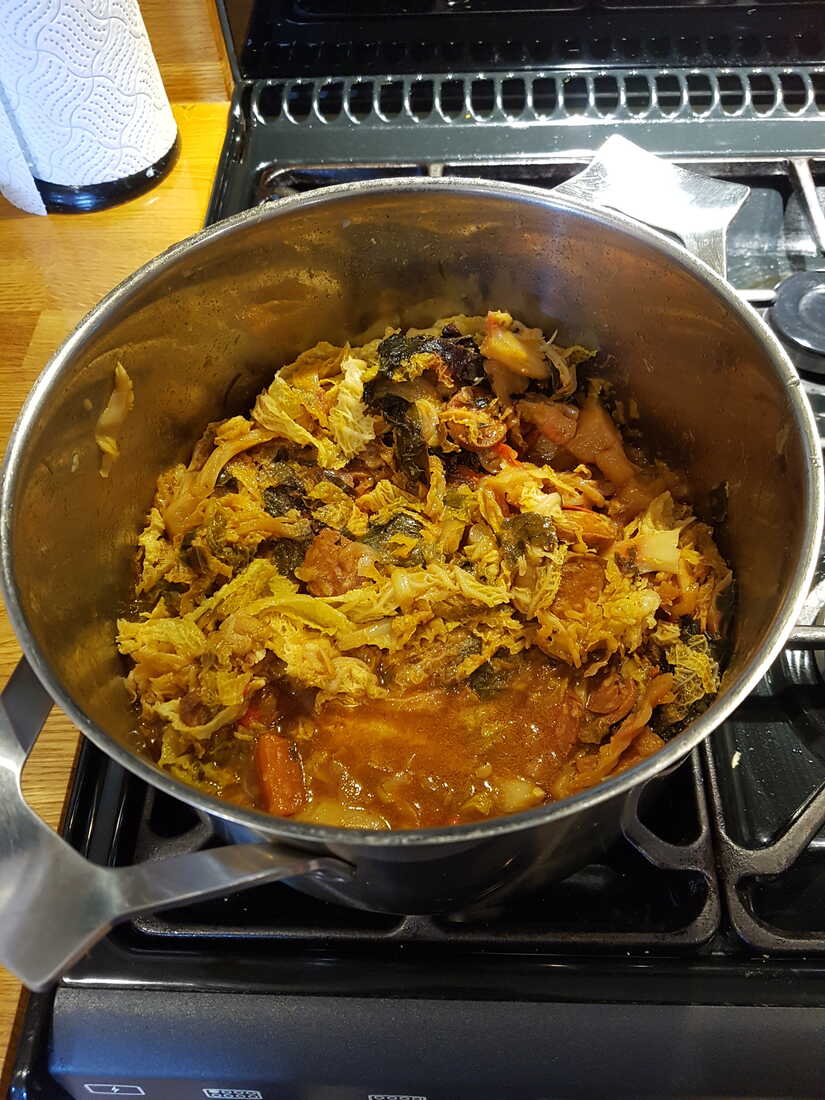
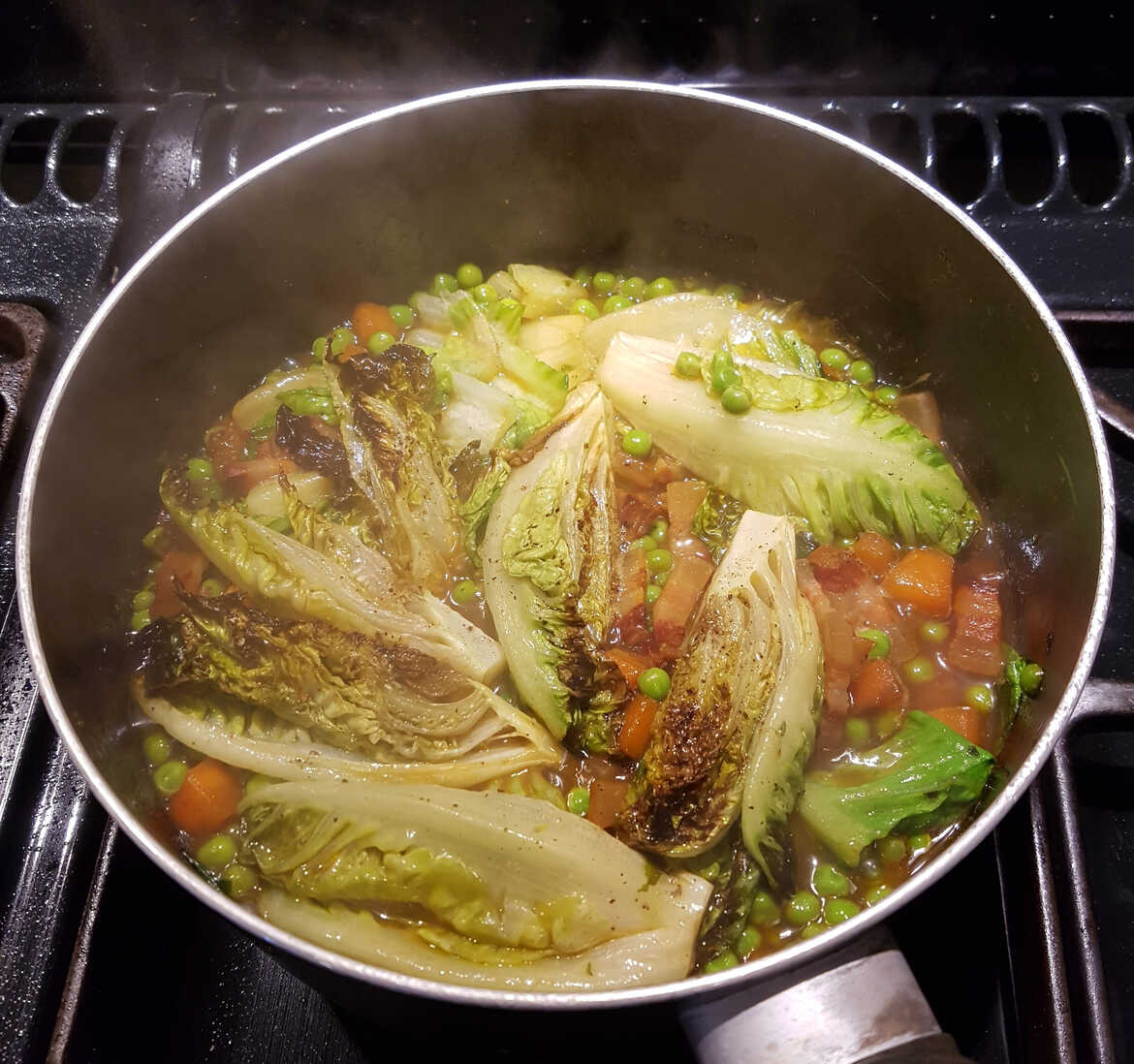
I had a lot of stuff left over that I needed to use up. Mostly cabbage.
So I started with this largely inauthentic Hairy Bikers recipe for Caldo Verde (Portuguese green broth) and just started chucking things in.
Though by the time I'd added the tomato and beetroot the stew was extremely red. So not Caldo Verde at all then.

I had recently bought 2 bunches of beetroots to make a purée with but they were so small that the bunches were more tops than roots.
So after making the purée I had a lot of beetroot leaves to eat (I did throw most of the actual stalks away - though you could add those too - they're perfectly edible) so they went in. Along with a handful of sad tomatoes, the stalks of a cauliflower I'd riced, some lonely carrots, shriveling sprouts, a withered apple, a few orange segments, and some of the juice from a jar of pickled chillies.
If I hadn't eaten all the pickles some of them would have gone in too.

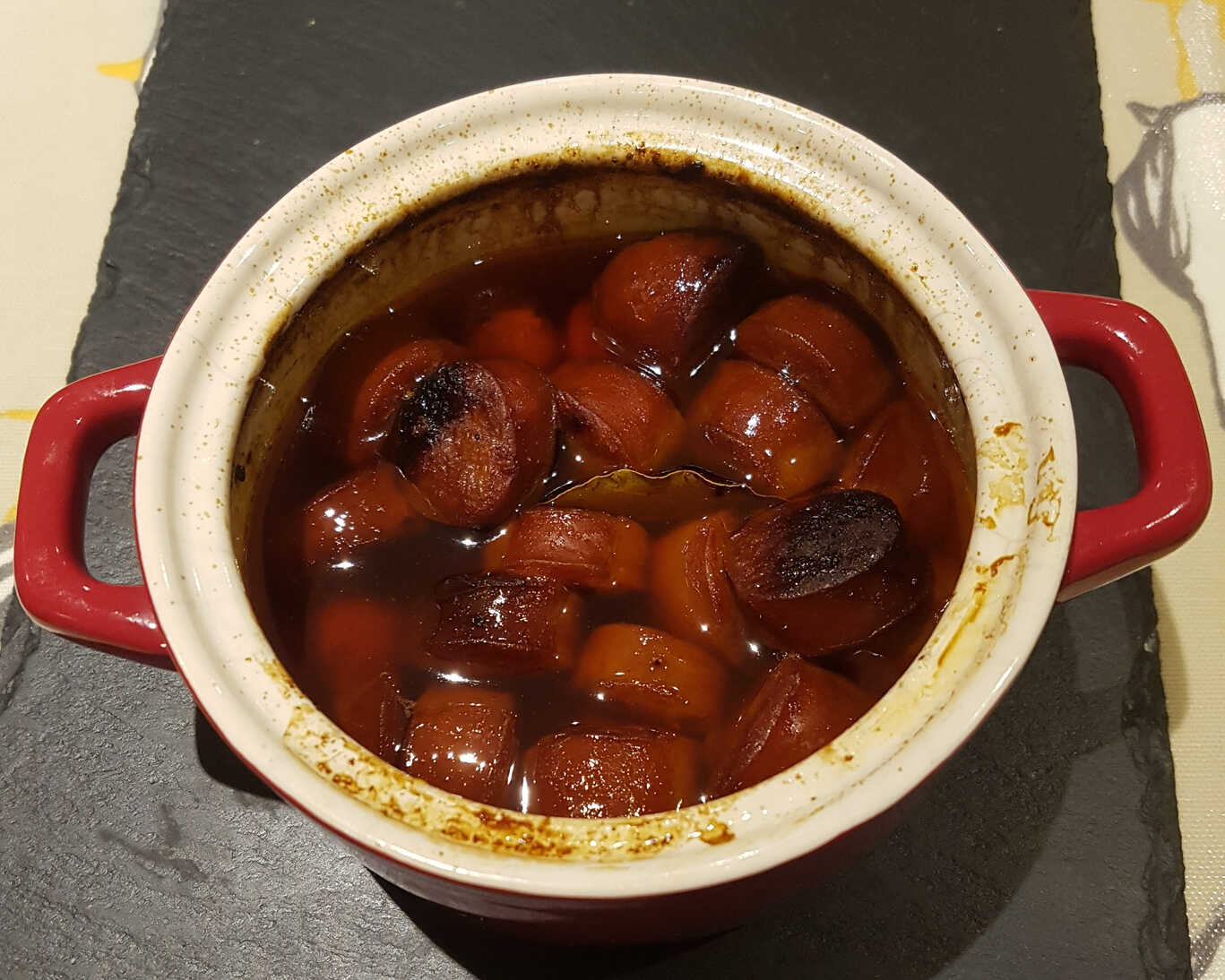
In fact, the only thing I actually needed to buy in for the stew was the chorizo!

Makes a LOT!

Ingredients
  • ¼ cup olive oil
  • 2 large onions and a couple of shallots roughly sliced
  • half a head of garlic, peeled cloves crushed
  • leaves from a bunch of thyme
  • 1 chorizo, peeled, sliced
  • 4 large potatoes
  • 1 litre strong stock
  • 2 small carrots, peeled, quartered lengthways
  • head of cabbage, sliced
  • beetroot greens, sliced
  • 1 tablespoon paprika
  • tinned tomatoes or passata

  • Optionals:
  • the cabbage stalk, roughly chopped
  • 1 cauliflower stalk, roughly chopped
  • a dozen brussels sprouts, halved
  • 1 apple, peeled, cored, roughly chopped
  • ½ an orange, segmented
  • 2 red chillies, de-seeded, sliced
  • a few tablespoons of pickled chilli liquor
  • a dozen halved cherry tomatoes

  • To Serve:
  • smoked paprika and olive oil, for dressing
Method
Peel the onions and shallots and slice them fairly thickly lengthways. Heat a very generous quantity of olive oil in a large pot and start sweating the onions over medium/high heat.
You're just going to add ingredients to the frying mixture - you want it to keep going but not stick or burn or really even brown much.
Peel a lot of garlic cloves, lightly crush them with the side of a knife and throw them in.
Strip the leaves away from the thyme stalks and throw the leaves in.
Peel and slice the chorizo fairly thickly, and throw it in.
Wash and chop the potato into fairly decent chunks and throw them in.
Mix in a tablespoon of smoked paprika to help out the chorizo.
Roughly chop any sturdy spare vegetables you have lying around and throw them in.
Like carrots, and the stalks of cabbage or cauliflower.
This is a traditional Portuguese stew after all, so it's important to be authentic.
Cover with a strongly flavoured stock.
I had some well-flavoured (and salty) duck stock from a confit, plus pork juices from a roast (as well as some of the fat).
They all went in, so no extra salt was required.
Cook until the vegetables soften up, then add any other less sturdy extras you have lying around like a couple of red chillies, seeded and sliced fatly, those aging sprouts, trimmed and halved, an apple or two, peeled, cored and roughly chopped, a handful of halved cherry tomatoes, even those spare orange segments.
Add a glug or two of passata or some tinned chopped tomatoes. And you might as well throw in some of the liquor from that empty jar of pickled chillies, because why not?

Finally slice up all the greens you have In my case a head of savoy cabbage and a shed-load of beetroot tops as thinly as you like and throw those in.
A traditional Caldo Verde would have the greens super-thinly shredded, but I think we're well past pretending there's anything traditional going on here!
Adjust the seasoning, cover and simmer until the greens are done.
Serve with some rustic bread and possibly dressed with olive oil mixed with smoked paprika, as the Barey Hikers suggest.
Surprisingly delicious!
Try not to overcook the greens, particularly the beetroot leaves - they won't take long to become tender, unless they're very stalk-y.
Although I must admit the meltingly soft cabbage is growing on me - so overcook to your taste!
It's Cheesemas!
Christmas Presents
'Twas the night before Christmas, when all through the house.
 Not a creature was stirring, except for the chefs...
 Frantically stuffing the goose and prepping the starters.
      

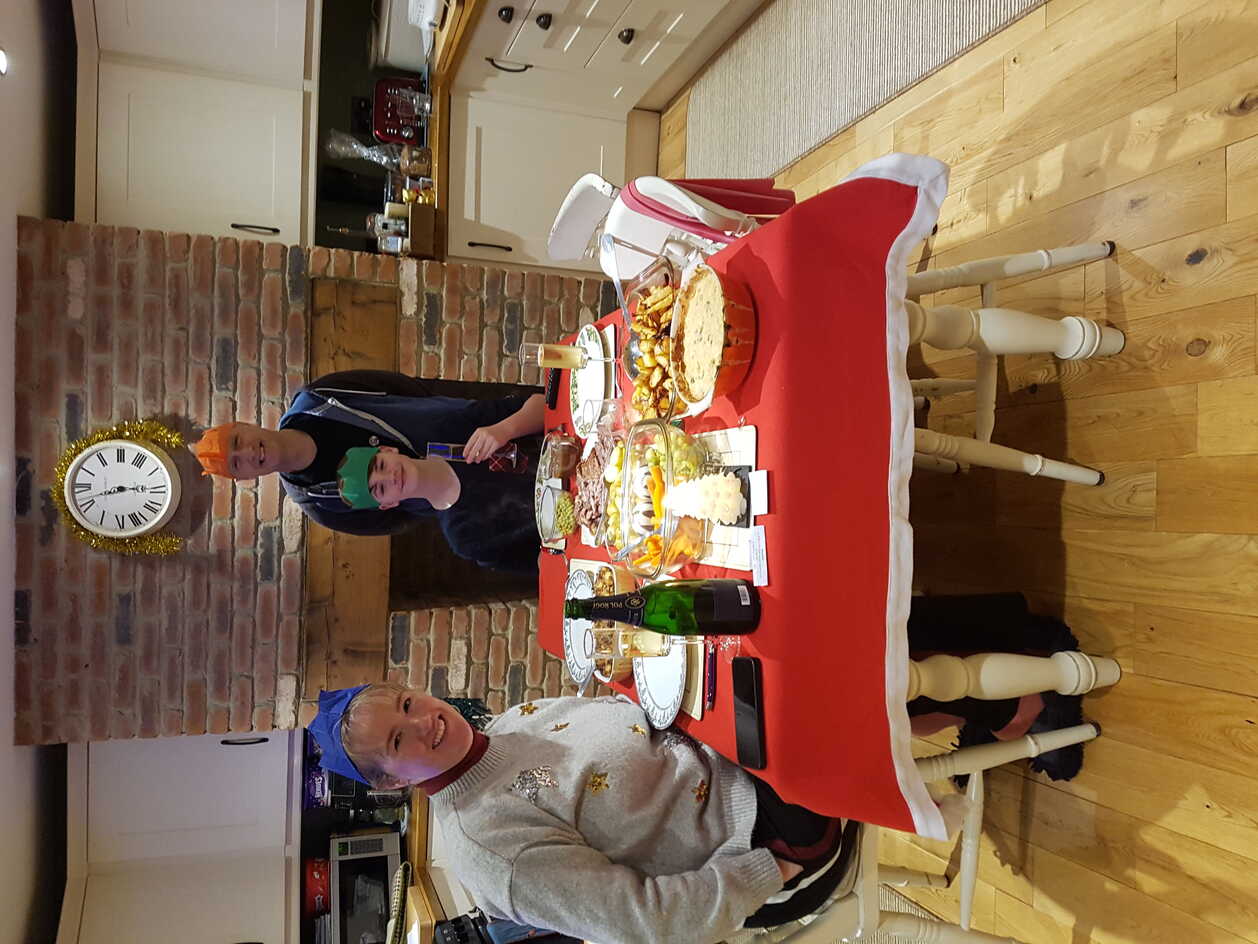
This year featured the long-overdue return of Flora:
We're Getting the Goose-Gang back together again 😀

Which means I needed to buy extra cheese. And then Flora brought extra cheese.
Plus Flora brought the specially ordered cheese that I had her sister bring back from Spain.

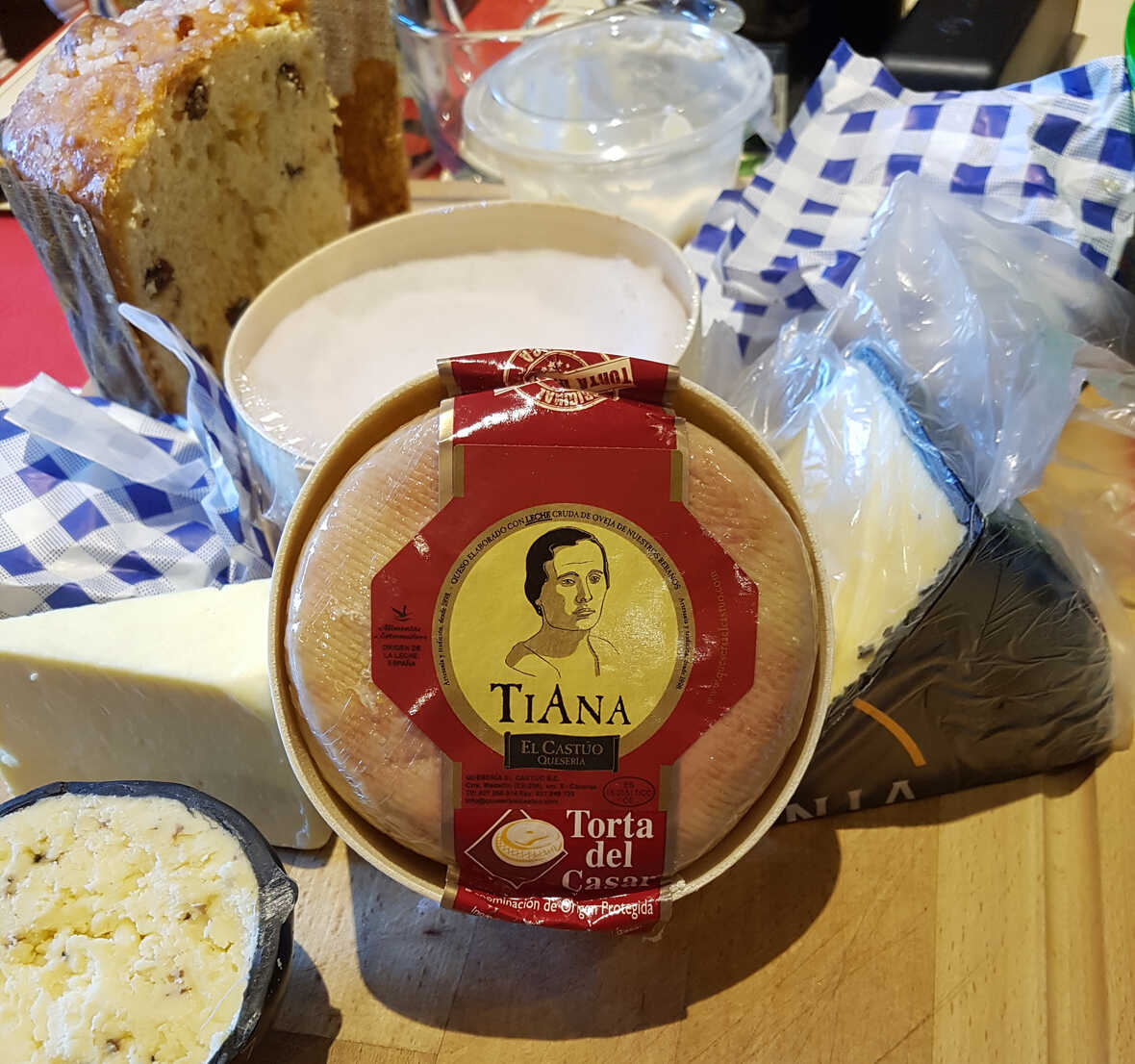
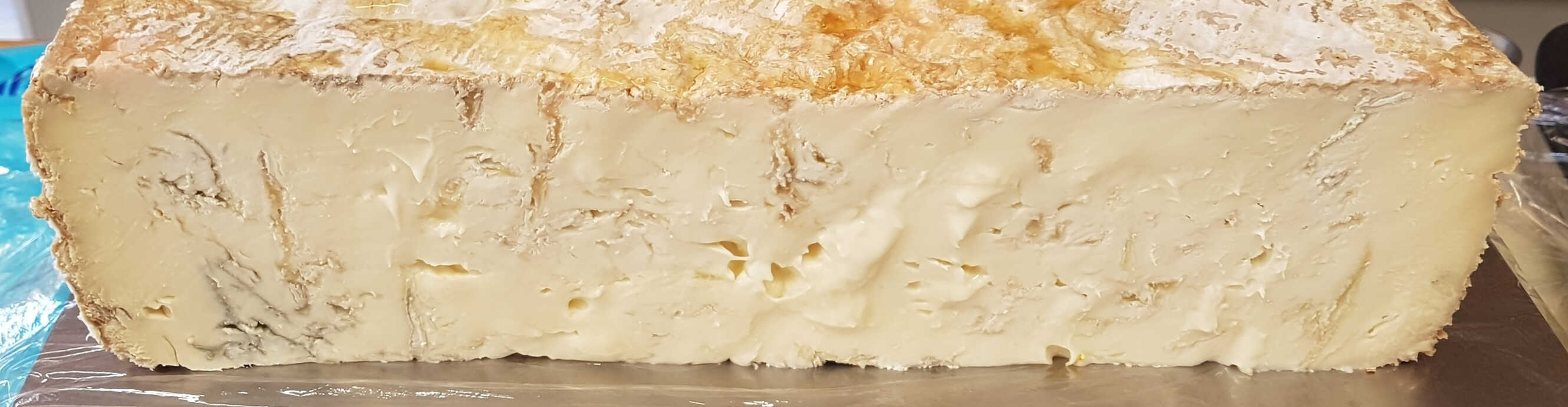
I'd read about this amazing Spanish cheese called Torta del Casar.
That it hails from the remote Extremadura region - roamed by wild black Iberian pigs from which also comes Spain's magnificent jamón ibérico ham.
How its curiously runny insides are coagulated by thistle pollen giving it a uniquely rich, salty bitterness.
So I tried to buy me some. To absolutely no avail.

It turns out to be practically impossible to get any around the North of my country, and I phoned a lot of cheesemongers. And no, I would not have cared how fucking runny it was. I would have liked it runny 🤣
So I resorted to asking Flora to have her sister bring some back from one of her many Spanish trips.

Unfortunately the cheese cake we got showed no sign of running runny-ing? despite being kept for nearly a month, and while the flavour was distinctive, I wouldn't call it particularly impressive.
I'll say this for the cheese though - it does dissolve extremely readily in cream to make a nice smooth sauce.

Anyway, all that's by way of explaining that I ended up with waaay too much cheese. As is traditional.
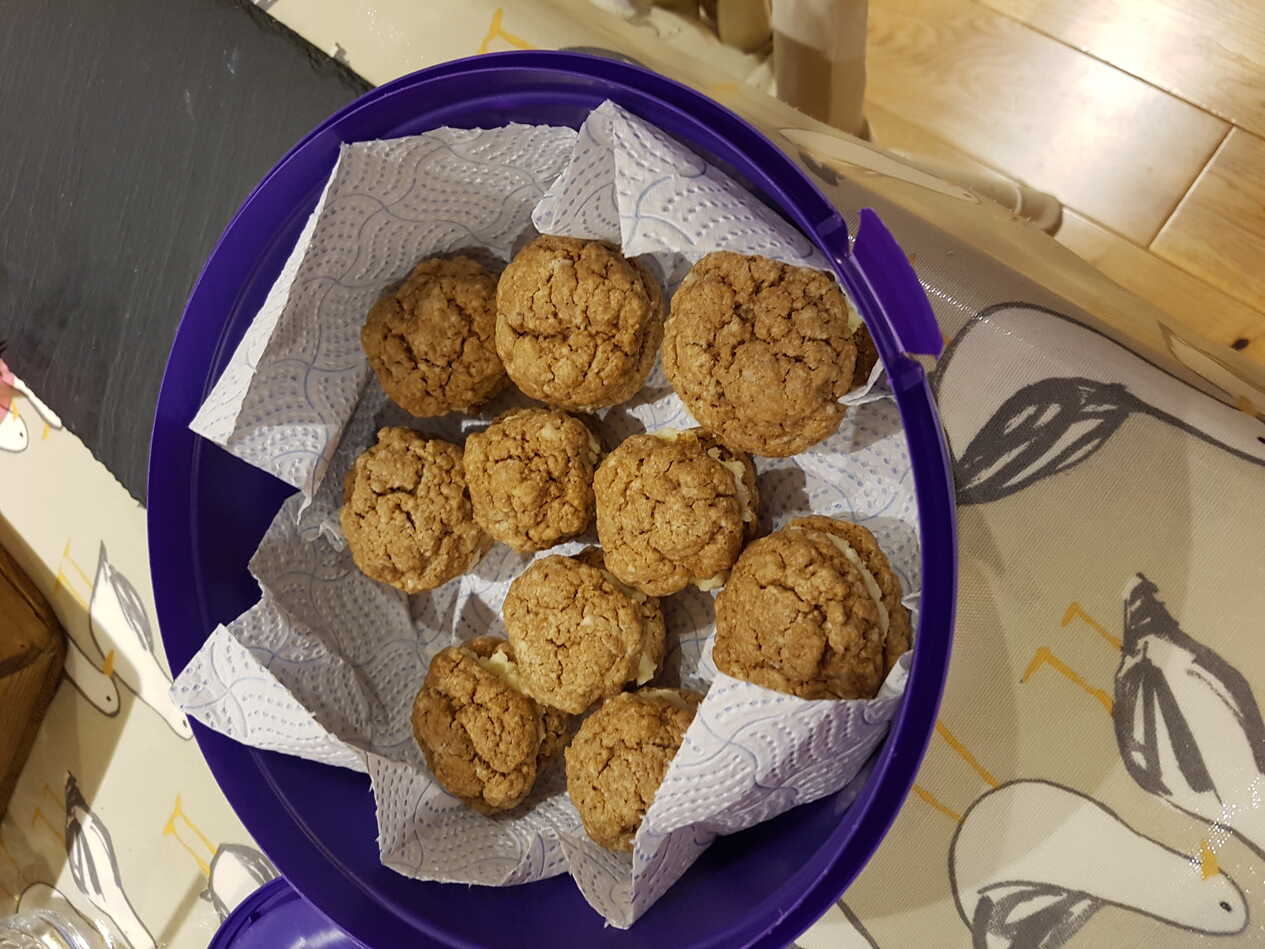
Unlike the coffee kisses that Mum used to make. Next year I should make double.

Despite the threat of limited goose sizes from our unreliable supplier, a full-sized bird turned up and all was well in the world. Other things of note this Christmas:
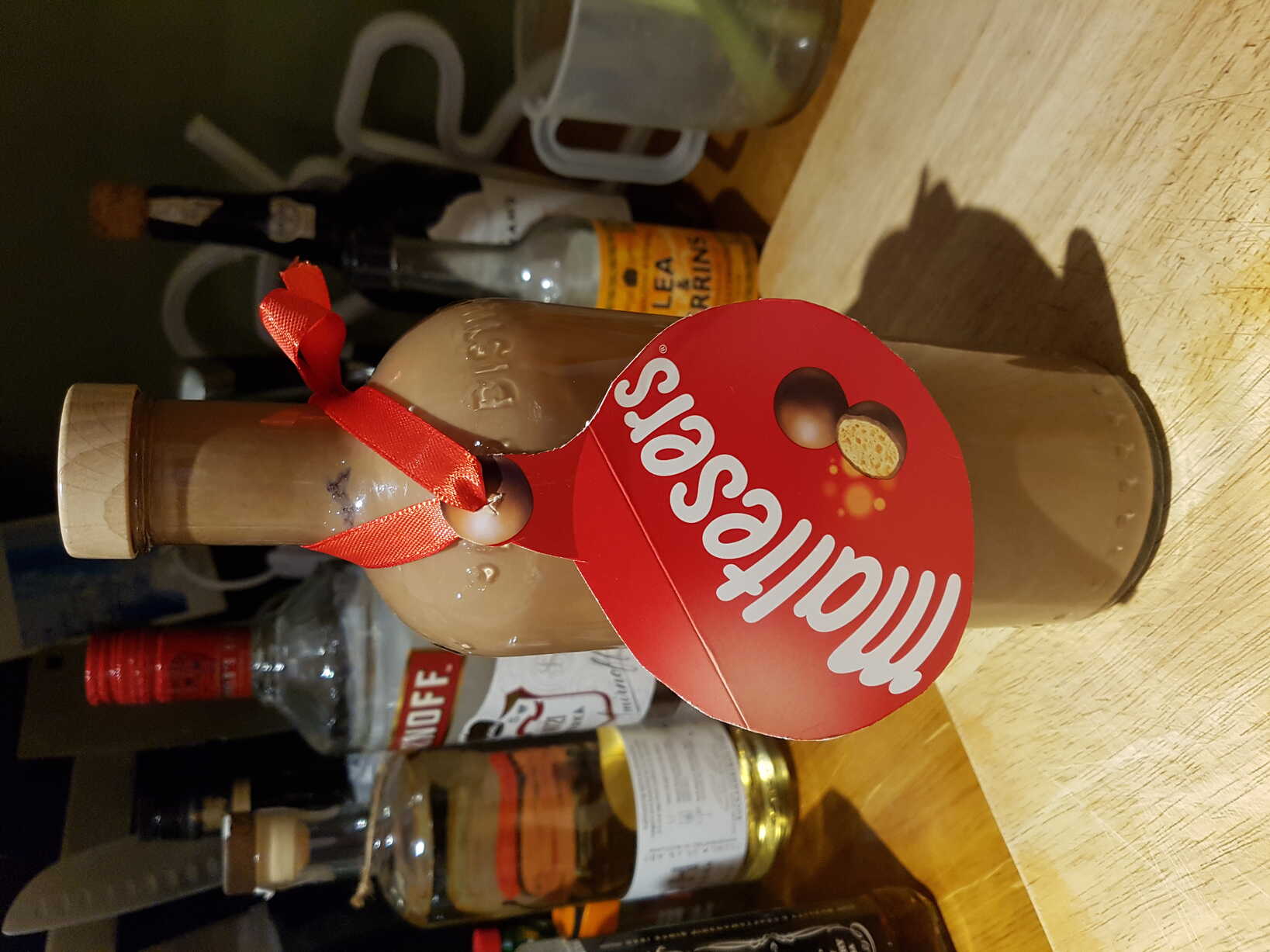
  • Vodka and Maltesers make an ideal gift for the alcoholic Malteser-lover in your life.
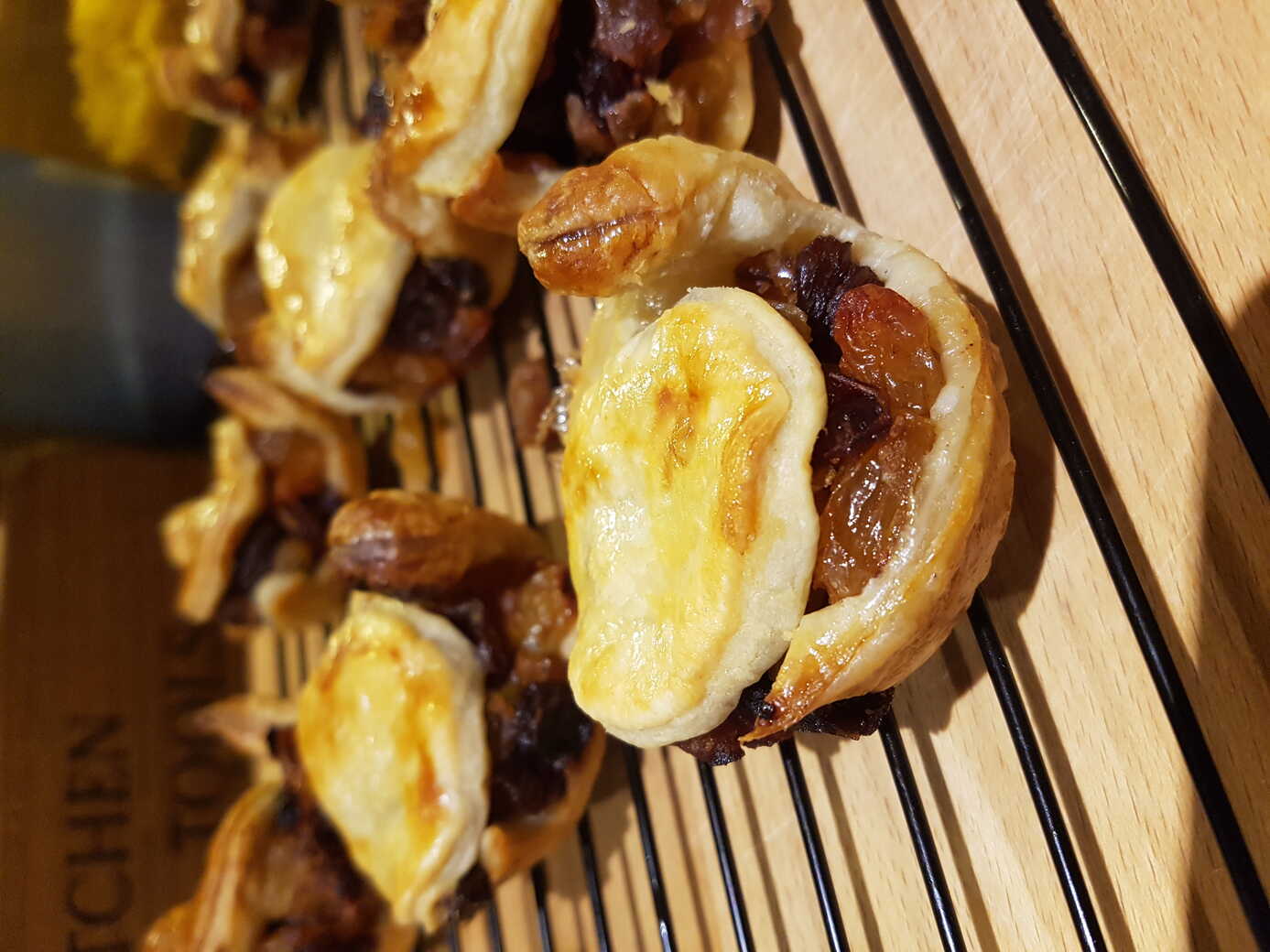
  • Flora introduced us to puff pastry mince pies in the shape of turtles. Or was it dinosaurs?
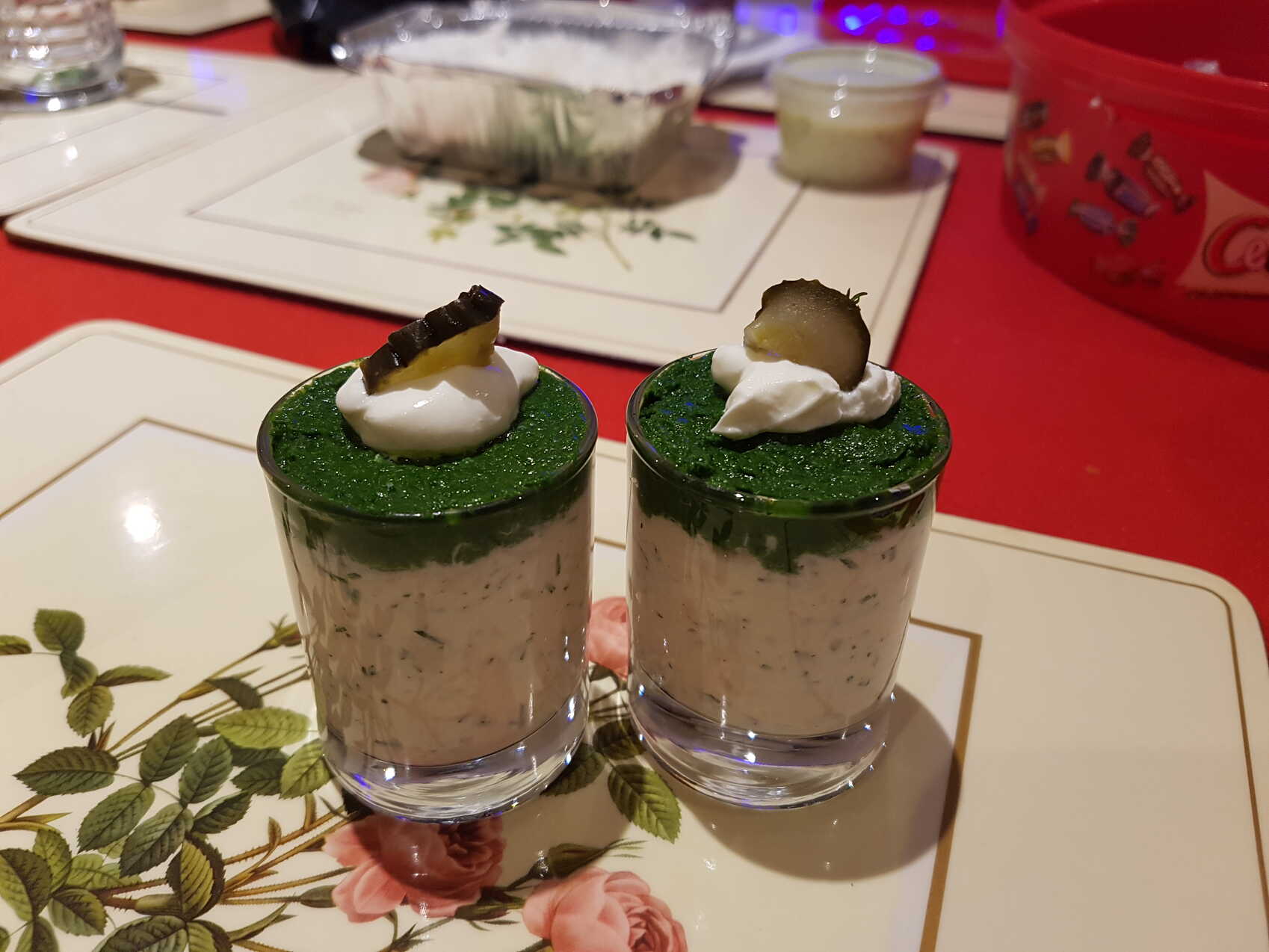
  • Shots of Salmon and Crème Frâiche make fine, if filling, starters.
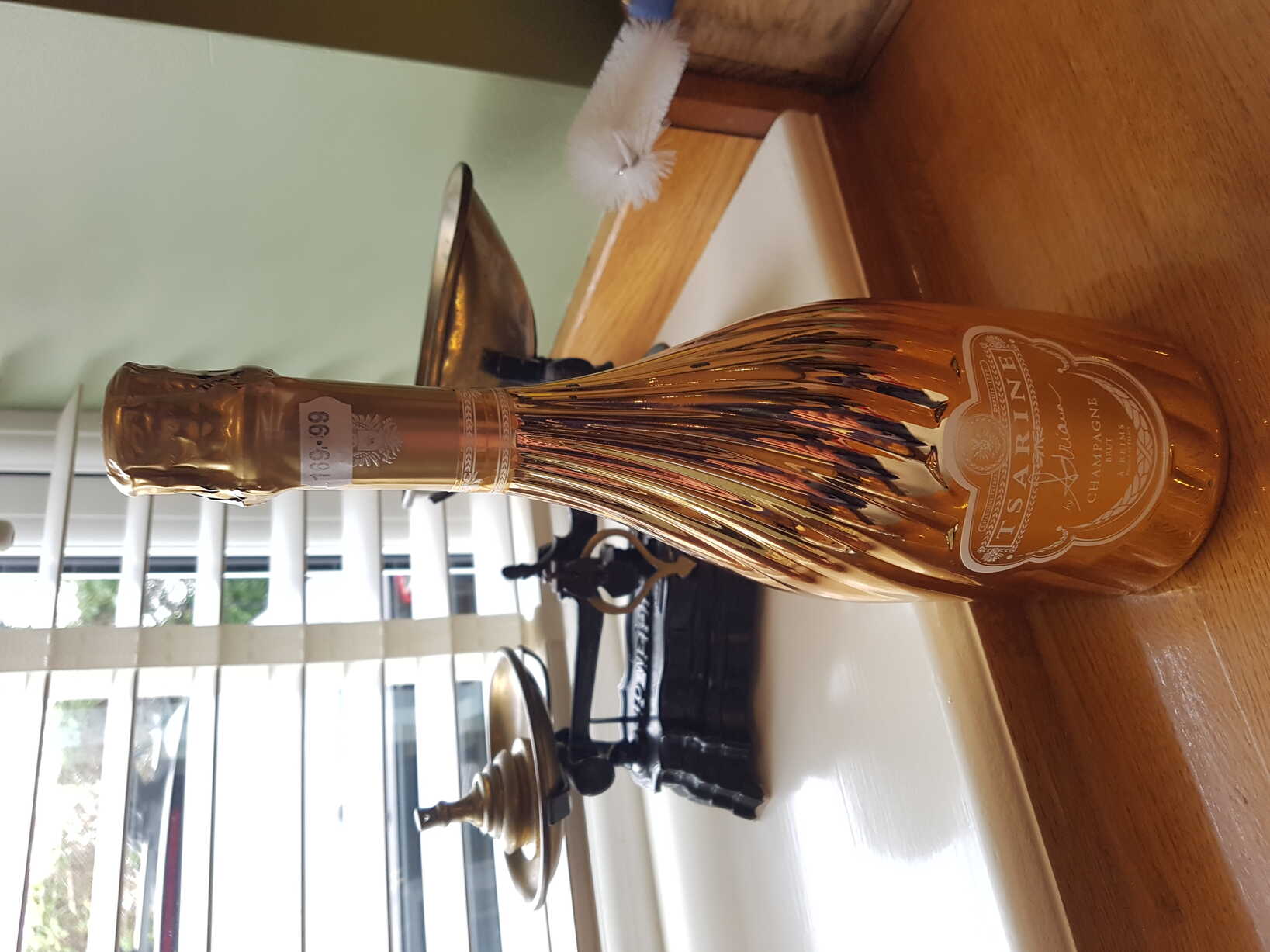
  • My local Wine'n'Cheese finally came through with a bottle of Pol Roger's Cuvée Winston Churchill Champagne for the dinner. Expensive but probably the last, since the store is shortly due to close. Sigh. Where will I get my wine 'n' cheese now?


Salmon and Crème Fraîche Shots with Watercress Purée
fish starter
I rather thought that this starter would be light and airy so I bought larger cocktail glasses to serve portions in, but it's actually pretty dense and filling, so you really will get 12 servings out of the recipe, even served as a starter rather than a canapé.
Buy small shot glasses!

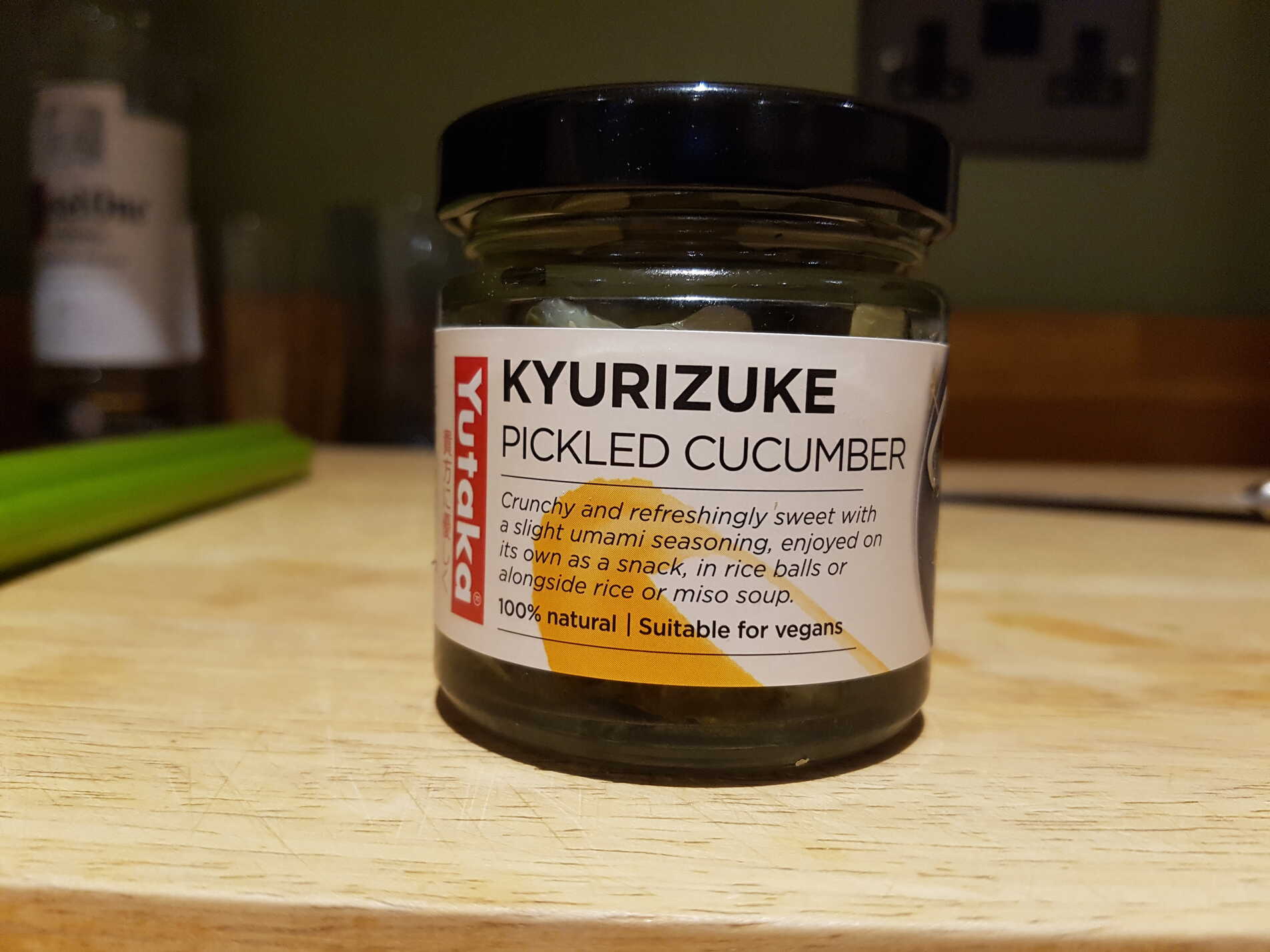
I also had to go to Newcastle for the Kyurizuke pickled cucumber!
Well, in fact I was there on business, but they did stock them at one of their large Chinese supermarkets, and I hadn't been able to find them anywhere else closer to home. So it was a handy visit.
Their Christmas market wasn't bad either.

Serves 12

Ingredients
  • 300g of salmon fillet
  • 150g of crème fraîche
  • 150g of watercress, roughly chopped
  • 2 lemons, 1 juiced, 1 sliced 1 lemon would probably be sufficient
  • 50g of Japanese pickled cucumber Kyurizuke
  • 1 bunch of dill, finely chopped
  • olive oil
  • salt & pepper
Method
Preheat the oven to 180°C/gas mark 4.

To begin, take your salmon fillets and lay them on some foil, approximately 25cm square. Drizzle with some of the olive oil and season liberally with the salt and pepper then place a few lemon slices on top.
You probably won't need a whole lemon's worth.
Wrap the foil around the fish to create a bag that is sealed at the edges and place in the oven for 12–15 minutes, or until the salmon is just cooked through.
I'd suggest using the technique for fish en papillote and cook in a very hot oven just until the package puffs out - about 15 minutes.
Take out the salmon and leave it to cool, then flake into a bowl using a fork.
Don't include the skin.
Mix in 100g of the crème fraîche and stir in the dill.
Finely chop half of the pickled cucumber and add to the bowl, along with a dash of lemon juice and salt and pepper to taste.
Cover and refrigerate for 1 hour.

For the watercress purée, bring a saucepan of salted water to the boil and add the watercress.
Cover and bring to the boil again (this should take about 1 minute maximum) then drain and plunge the leaves into a bowl of iced water.
Drain the watercress again, reserving just a couple of tablespoons of the water, then place in a blender and blitz to a purée. Use the leftover water to thin the purée if necessary and season with salt and pepper.
Be heavy-handed with the pepper. You can add a squeeze of lemon juice too.

To serve, divide the salmon between glasses then top with a layer of the watercress purée. Finish by dotting some of the remaining crème fraîche in the centre and add half a slice of pickled cucumber to each glass.
Pretty tasty, even if it is quite dense.

Maltesers Vodka
drink veg
Kurt loves Maltesers, so thanks to The Crazy Kitchen lady for the gift idea.

Makes about 70cl

Ingredients
  • 350ml vodka
  • 2x110g boxes Maltesers
Method
Put the Maltesers into an empty bottle that has been sterilised.
I dunno man, I would have thought vodka was pretty sterile!
Anyway, you'll need about 70cl of space.
Choosing a bottle with a neck wide enough to pass a Malteser ball will make your life easier 😉
Pour in the vodka.
Place the lid on and shake vigorously.
Shake regularly over a couple of days until the Maltesers have dissolved - this procedure can be sped up by placing the bottle in a bowl of warm water. Or on a radiator.
Smooth and delicious, though I'd probably use a better quality vodka next time!
Give it a good shake before pouring.

Dinosaur Mince Pies
or Are They Turtles?
sweet veg
As enjoyed by Flora's friend Matt Toynbee.Requiescat in pace
Thanks to Flora for the transcription.

No Quantities are Provided

Ingredients

  • For the Mincemeat:
  • sultanas
  • currants
  • dried cranberries
  • dates, cut up small
  • dried apricots, cut up small,
  • apple, grated or chopped small
  • lemon rind, grated
  • lemon juice
  • orange juice
  • mixed spice
  • cardamom
  • cinnamon
  • brandy/armagnac

  • For the Pie:
  • puff pastry
Method
Put the mincemeat ingredients in a small pan, add some water as needed and stew on a low heat making sure it doesn't dry out.
Put in big sterilised jar for making any extras - to use before New Year.

Grease a cupcake tray. Preheat the oven to 180°C.
Using a dinosaur-shaped cookie cutter cut out puff pastry shapes and press into each cupcake dimple.
Add the mince meat (in the cupcake depression).
Cut small circles for the dino bellies, or invent shapes like stars or crosses, and place them over the mincemeat piles.
Put an egg in a ramekin for glazing before putting in the oven for 5 minutes or until fluffy and golden brown.
Although the mincemeat is fine, there's something fundamentally unsatisfying about a puff pastry mince pie.
It might be worth trying with a short crust?
And they do look like little turtles - right?

Caramel Cream Cheese Sauce
cheese sauce
Torta del Casar dissolves surprisingly easily into simmering double cream. Which is handy.
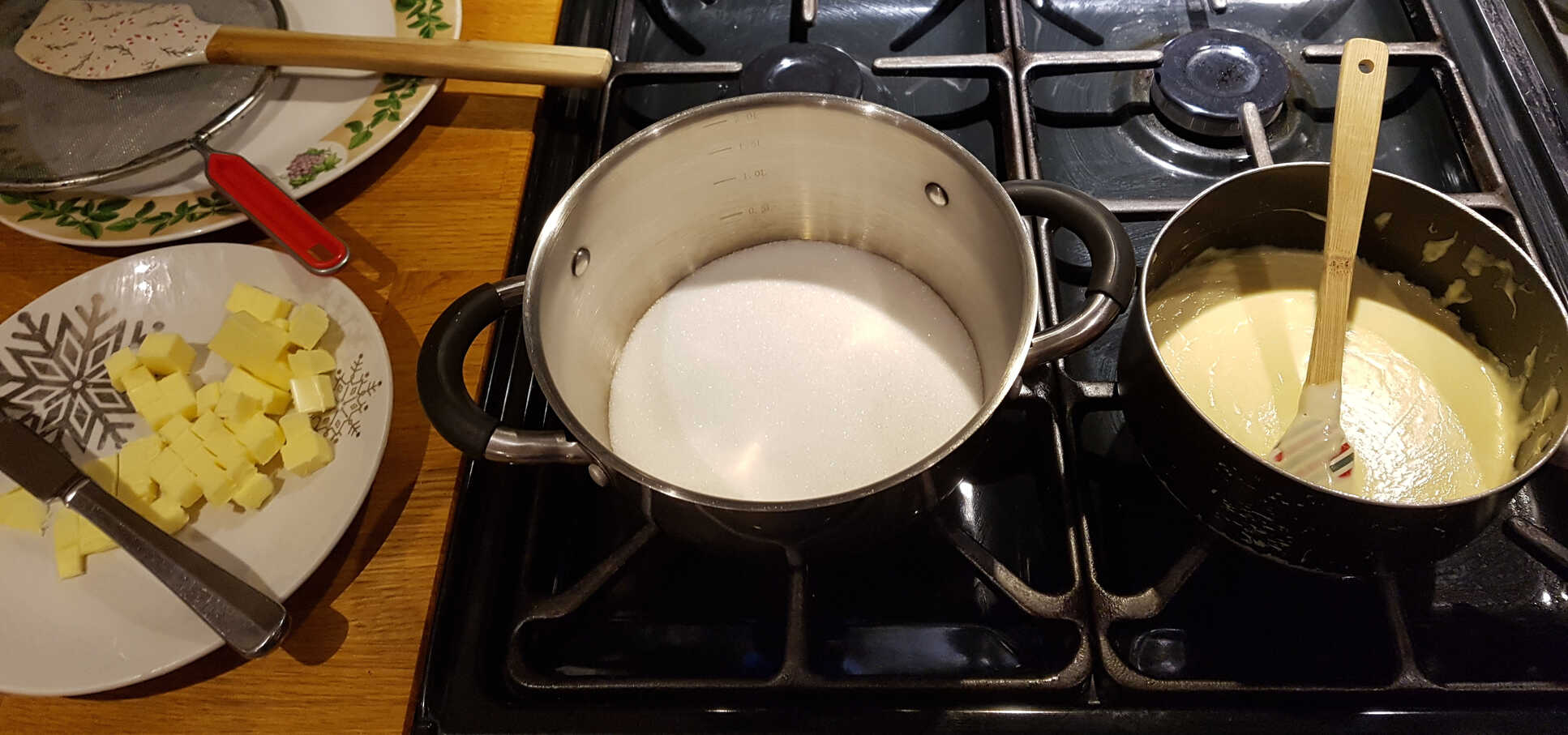
Generally when you make a caramel sauce you add the cream directly to the boiling caramel to cook the milk solids slightly, but I didn't want to do that with the cheese, so I blended in the butter first. Be sure to beat the mixture vigorously to avoid curdling as you do this.
You might, I suppose, consider keeping some unmixed cream to add to the boiling sugar first, before adding the cheesed cream and finishing with the butter.
In the likely event you have no Torta del Casar you could probably use Philadelphia Cream Cheese mixed with cream a là Rebecka
There seem to be three approaches to turning your sugar into caramel:
  • Pour the sugar into a pan and heat it directly over a fairly low heat, until it all melts into a brown puddle. You might have to swirl or stir carefully if the heating is uneven and you start to get the melting in isolated spots.
  • Add just enough water to moisten the sugar so it resembles wet sand and proceed as above.
  • Add the same quantity of water as sugar, set it over a very high heat, stir a little at first to dissolve the sugar, then boil furiously without touching it until it reaches the caramel point (180°C). You'll need to watch it like a hawk at this point as it browns quickly, though you can turn the heat down once it reaches the crack stage.
The third method is preferred by my Introduction to Pâtisserie class tutor, and I have had the most success with it.
The first two methods are very similar and always seem to end up with lots of unmelted sugar crystals all around the edge, or big chunks of un-melted sugar in the caramel when I try them.

The general opinion is that you shouldn't use brown sugar for this since
  1. The non-sugar molasses type elements will only burn at the temperatures you'll be raising the sugar to and turn it bitter.
  2. The colour of the sugar will make it difficult to tell exactly how much caramelisation you have produced - which is essential to controlling the process.

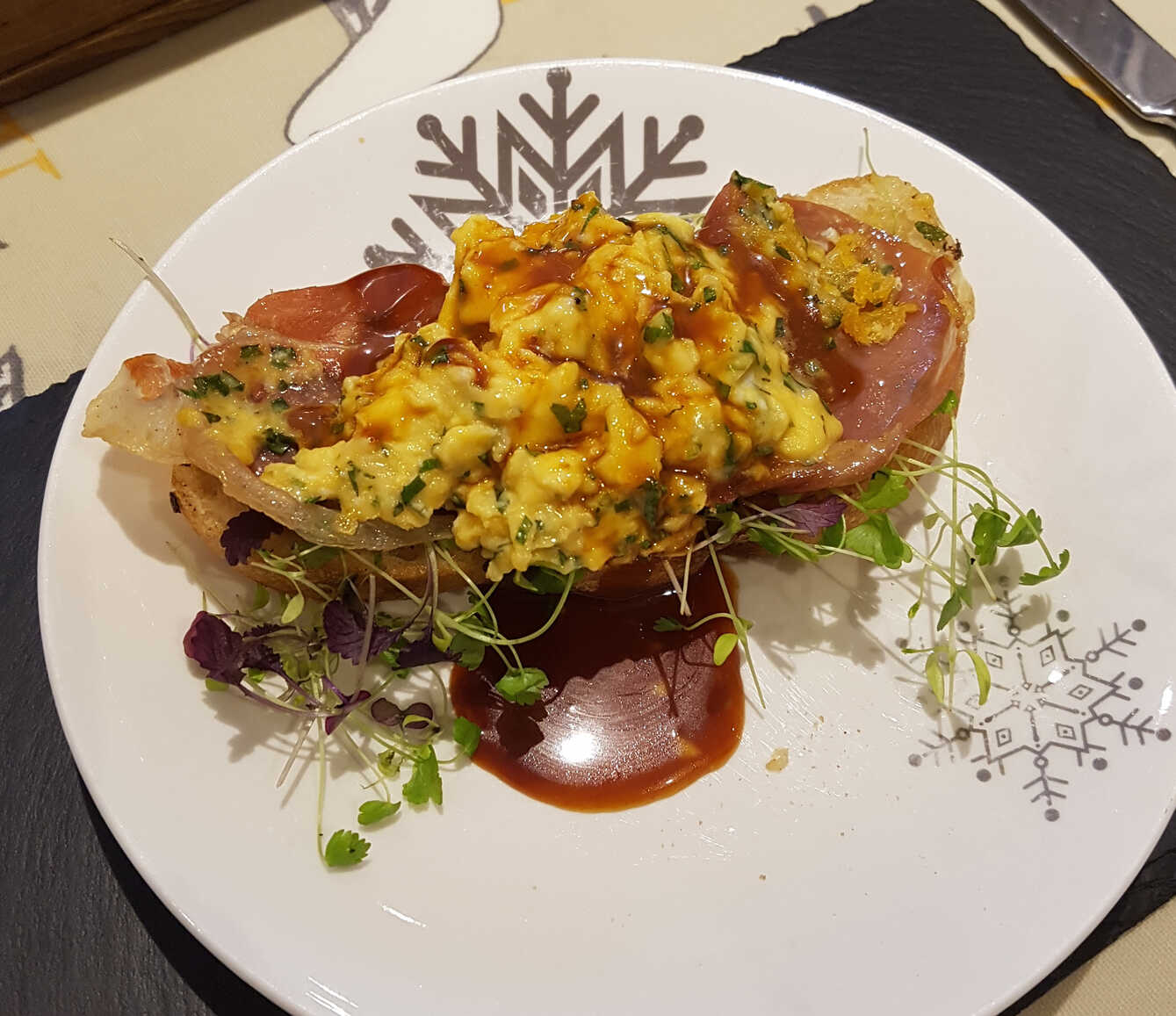
The caramel cream cheese sauce also goes quite nicely on scrambled egg - about 1 teaspoon per egg!

Makes About A Pint

Ingredients
  • 200ml double cream
  • half a Torta del Casar
  • 250g sugar
  • 60g butter
Method
Chop or break the cheese into chunks, discarding the rind. Heat the cream in a small saucepan, drop in the cheese, and stir until it dissolves.
Set it aside.

Dissolve the sugar in an equal quantity of water then bring rapidly to the boil over high heat and allow it to reach caramel temperature untouched.
Or whatever your preferred method is.
It will brown rapidly at this point - so watch it carefully.
Remove from the heat sticking the pan briefly into cold water might not be a bad idea to halt the caramelisation process, then whisk in the cold butter a little at a time, then beat in the creamed cheese.
Quite nice really.
It does stink a bit, and the Torta del Casar has an oddly bitter edge to it which might not suite every dish. Perhaps a milder, sweeter cheese Like Philadelphia? might work even better?
Serve with your giant mince pie if you must.
Winter Filth
Rain Rainy Rainy Day

Ah, Winterfylleth. The ancient Anglo-Saxon month that marked the beginning of winter - as recorded by the Venerable Bede.
Roughly corresponding to October in the modern Gregorian calendar. Starting this year on the New Moon of the 3rd of October and wrapping around the first full moon of winter on the 17th.
Not to be confused with Tolkien's Winterfilth - the tenth month of Shire-calendar. Running from 22nd September to 21st October if you are a hobbit.
Best appreciated with strong liquor.

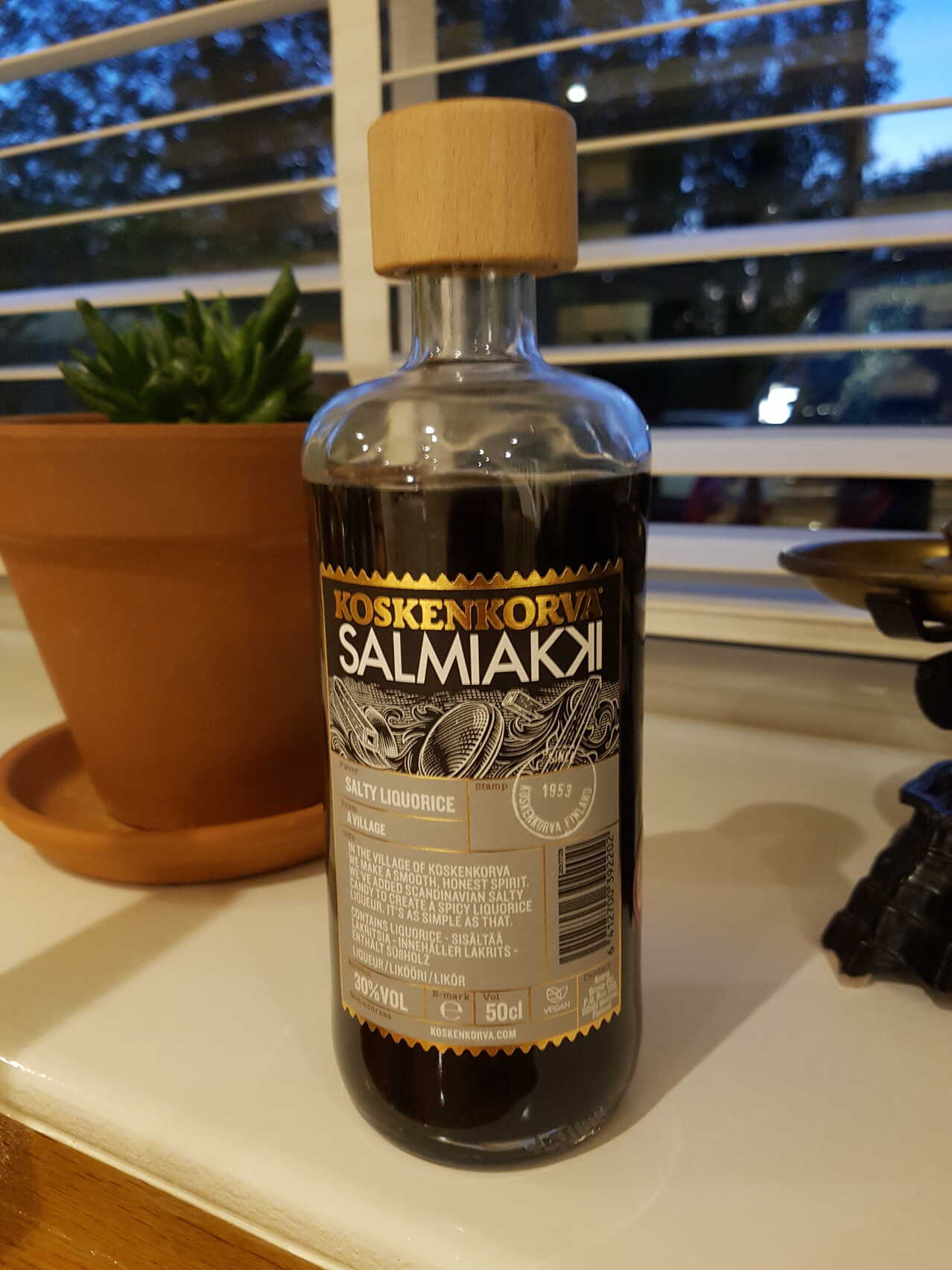
Speaking of which, ever since I went to Finland to sample Fazer's chocky eggs (and visit Moomin World) I've been a great fan of the Finnish salty liquorice flavour sal ammoniac (ammonium chloride), which they call salmiakki.
Fazer hide surprise bursts of it in many of their sweeties.
So I was delighted to discover, the other day, that you can get a salty liquorice flavoured vodka called Salmiakki on Amazon.

From there, it's just a short step to combining a Japanese salmon preparation technique with a strongly flavoured Finnish vodka to create an obvious pun-based dish.
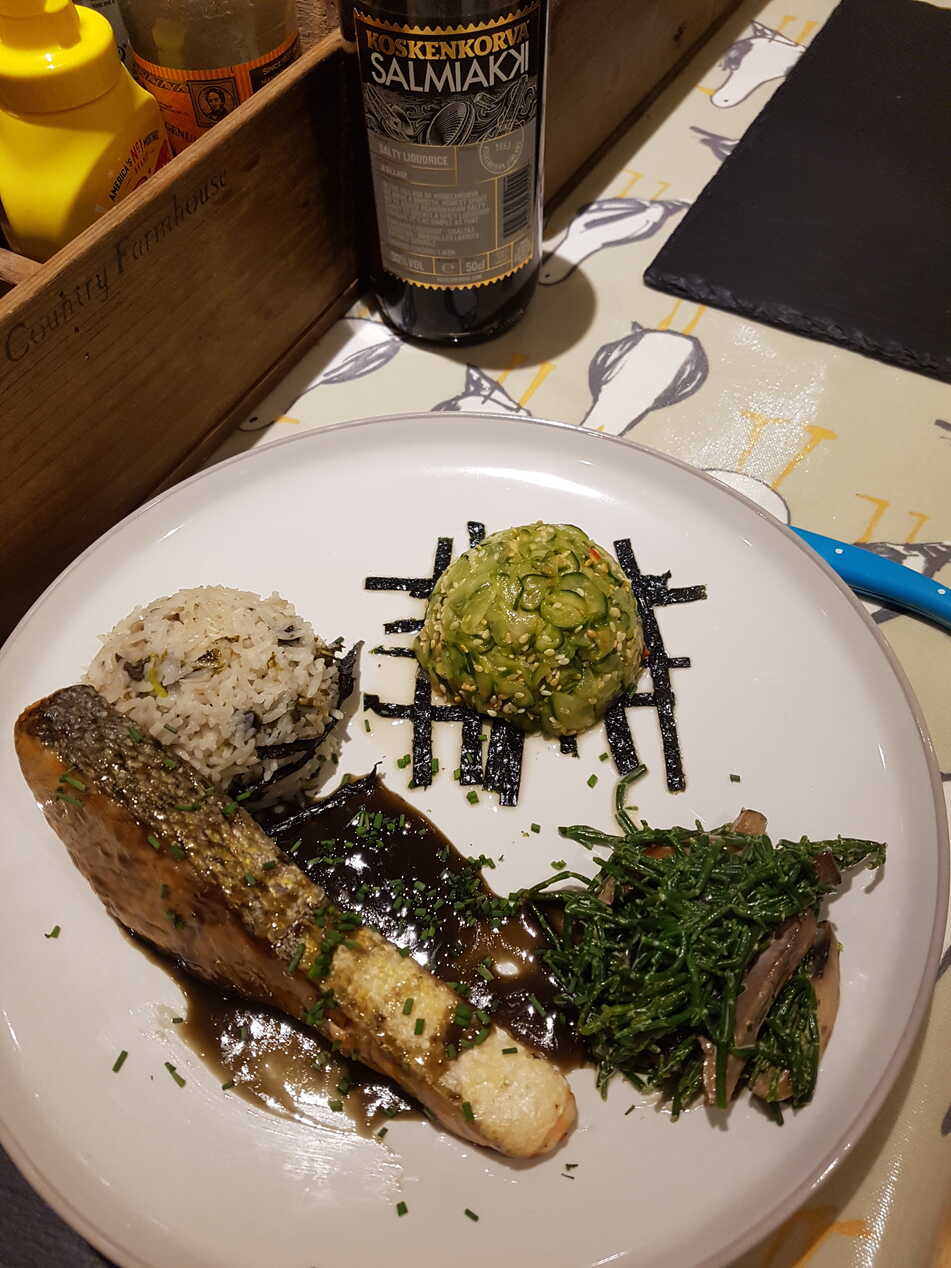
And thus was SALMONIAKꞰI born.

Salmoniakki
main fish
I couldn't resist this Finnish salmiakki-flavoured vodka. I thought it might make a great flavour for salmon en papillote. Or possibly teriyaki-style, bubbled into a sauce with maple syrup perhaps? Maybe some vinegar. Fry the salmon coated in potato starch, or tapioca starch.

The problem I had was that the sauce wasn't thickening the way a teriyaki does - probably the lack of soy sauce, which I don't want to add. Nor do I want any more maple syrup since the sauce is sweet enough. So I thought I'd try adding a thick beer - Barley Wine yes, I realise the name is confusing. I know that the Finns do drink a barley-based beer called sahti so it doesn't seem inappropriate, and in fact the flavour does blend well, mellowing the more aggressive sal ammonia notes, but it doesn't actually thicken things terribly much.
So after much experimentation I gave in and whisked in a few pinches of xanthan gum. Add cautiously - and whisk furiously lest it clump.

So now, what to serve it with?
I started with Flora's Samphire and Creamed Chanterelles (because Finns like their mushrooms), a Japanese Cucumber Salad (because Finns like vinegar), and some rice with spring onion slices (because teriyaki!).
I'm not sure about the mushrooms (maybe add some pickled anchovies?), but the cucumber salad worked very well.
I'm wondering about potato, or a potato purée (since the Finns like potatoes and after all, they don't eat rice), and perhaps a beetroot and horseradish puree (because they also seem like the kind of things Finns eat)?
Beetroot and horseradish agar-agar caviar seems like it might be nice.
I might even make a meal out of it.

Serves 2

Ingredients
  • 2x2" slices of salmon fillet
  • potato or tapioca starch

  • For the Sauce:
  • 3 tblsps Salmiakki flavoured vodka
  • 2 tblsps barley wine
  • 1 tblsps maple syrup
  • pinches of xanthan gum
The Development
Round One
Ding Ding!
The fish is delicious, but the sauce isn't thick and sticky enough. Not like real teriyaki anyway.
I Probably mixed 2 tblsps salmiakki : 1 tblsp maple syrup - teriyaki gets a lot of its glutinous gloss from the soy sauce, but I don't want to add any of that since the salmiakki is already salty enough. (Or at least, that strange ammonia salt that makes it so distinctive.)
Nor do I want to add more syrup or sugar since I don't want to make it over-sweet.
Perhaps I will need to thicken it with tapioca starch, potato starch (Finns like potatoes) or cornflour, though that feels a little like cheating.
Some Mushroom powder perhaps (Finns like mushrooms)?

Round Two
I tried Equal volumes of salmiakki and syrup. Also, I used about 1 tsp tapioca starch dissolved in 2 tsps water to thicken the sauce. Added off the heat after the sauce has already reduced and foamed.
Nope.
Too sweet and the salmiakki flavour (the whole point of the exercise) is lost.

So now I'm thinking, what about beer, stout or porter?
Or Barley Wine?
What about a splash of red wine vinegar? Finns like vinegar.

Round Three
Jackpot!
Salmiakki:Barley-Wine:Maple-Syrup in ratios 3:2:1 gives a pretty good reduction with a nice barley edge to it. You can thicken it slightly with tiny pinches of xanthan gum if you like.
And you may just have to!

The Method
So. After some experimentation, here is what you do:
Clean de-bone and descale the salmon. Cut and trim neat pieces.
If you have the time season the fillets and leave them uncovered overnight in the fridge.
Mix all the sauce ingredients in a small pot, and bring to the boil.
Stir to dissolve the maple syrup, then simmer until reduced by ½ or ⅔.
Whisk in a couple of pinches of xanthan gum to thicken it if you want - it probably won't coat the fish well without it.

Sift potato or tapioca starch over the fish fillets.
Heat a little oil in a frying pan and fry the fillets skin-side down over medium heat until the fillets colour about a third of the way up.
Flip the fillets and again colour them about a third of the way up.
Transfer the salmon to a plate and clean the pan with kitchen towels. Pour some of the salmoniakki sauce into the frying pan, return the salmon pieces, and flip them in the sauce to coat and glaze.
You avoid overcooking the salmon on the first fry-through since it will cook some more at this stage in the sauce.
Serve the glazed salmon with extra sauce drizzled over it.
It even surprised me how delicious this is!
I wonder how well this would work en papillote?

If it were teriyaki you'd serve it over rice, but I doubt the Finns eat much savoury rice. Potato probably. Maybe some Karjalanpiirakka pastry?

Have a Heart
Birds of Summer

I blame the cider.
Sometimes, when I visit meat-town I have a complete and extensive shopping list and know exactly what I'm cooking.
And sometimes I have no idea, and wander around aimlessly seeking for inspiration. This time inspiration arrived in the form of cider. As I suspect is often true in the prelude to a tractor crash or a haystack fire.

Anyhoo, my local Wine'n'Cheese happened to have some champagne-style cider bottles for sale. Which I thought intriguing, since I wasn't sure how it might differ from regular cider Nor am I now - I thought this was how all cider was made! so I bought some, then went to the butcher to see what he had that might go with it.
Turned out he had pig's heart.
So that's what's for dinner.

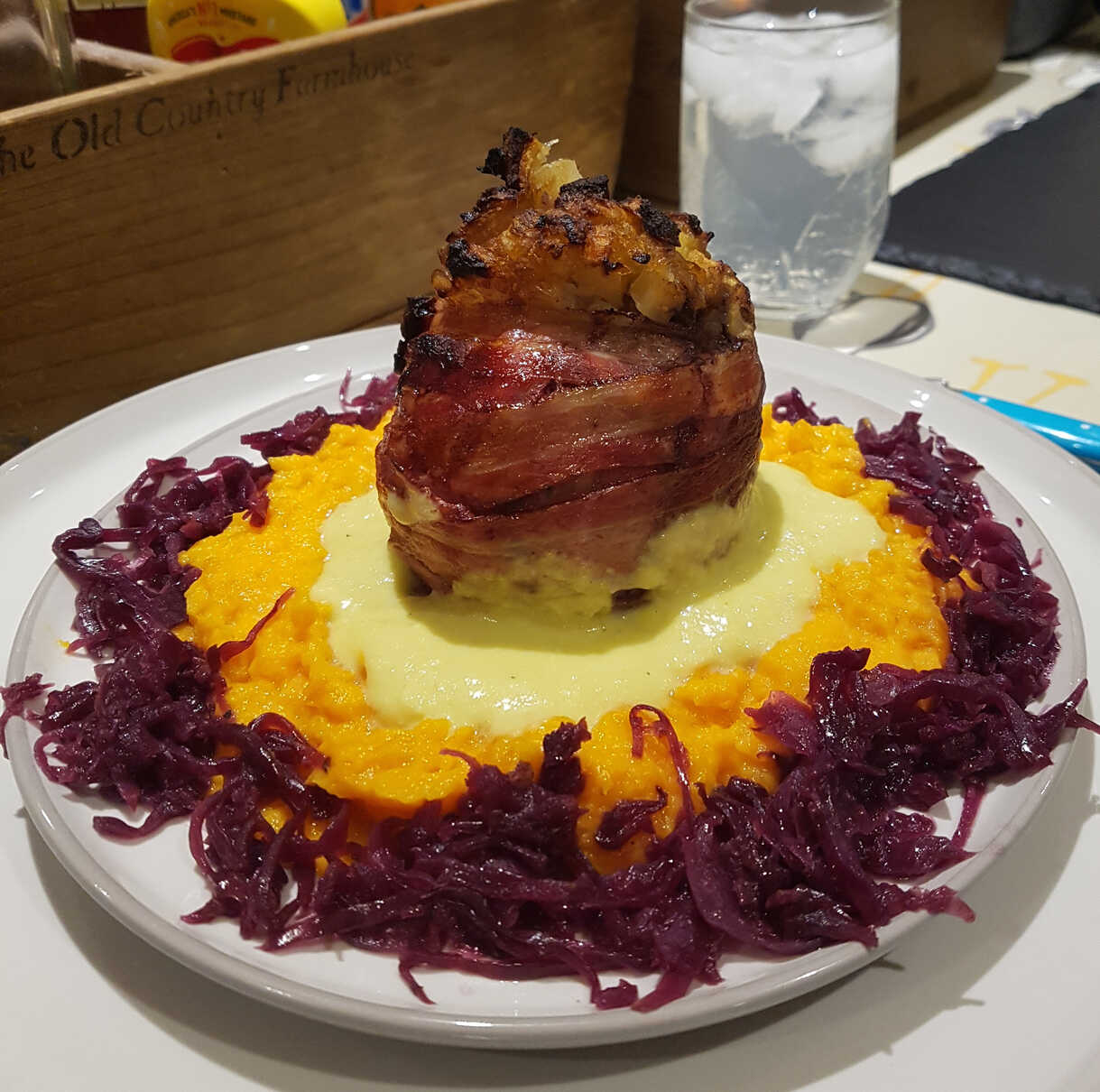
Apple Stuffed Heart
main meat
Well, I found a bottle of Champagne-Style cider in the local Wine'n'Cheese store. And the rest is history.

Serves 2

Ingredients
  • knob butter
  • 2 shallots minced
  • 2 cloves garlic, minced
  • 1 Bramley apple, peeled, cored, chopped
  • 1-2 cups cider
  • streaky bacon
  • 2 pig's hearts
  • salt, pepper, sugar to season

  • Optional Flavourings:
  • lemon or lime zest
  • herbs, e.g. thyme, tarragon, dill
Method
Heat a generous knob of butter in a small pan and sweat the minced shallots until they collapse. Add the garlic and sweat until it softens.
Add more butter as required. Peel, core and chop the Bramley or other cooking apple into 1cm pieces.
Add it to the pan and stir until it is nicely coated in the butter. Add the cider and cook off until you have a thick, chunky apple sauce.
Season the stuffing, sweeten it if necessary, and add any herbs you fancy. Perhaps tarragon or thyme. Maybe lime or lemon zest?

Hollow out the hearts by cutting out the fat blood vessels in a cone shape from the top. Avoid removing too much pure, smooth muscle.
Season inside the heart with salt and pepper.

Fill the hearts with the apple mixture and pile it up out the top. Roll the back of a knife along each bacon slice to stretch it, then use them to wrap the heart from the bottom to the top. This will secure any cuts or breaks in the heart wall. You can extend the sides upwards to help contain the stuffing, but don't go over the top 🙂
I used smoked bacon.
Pre-heat the oven to Gas Mark 3.
Stand the hearts upright in an oven-proof dish using ramekins, or crumpled foil or baking paper. Bake them for 1½-2 hours until the bacon is crisped, the heart cooked through, and the stuffing caramelised at the top.

Camping. Condensed.
Memorial Camping

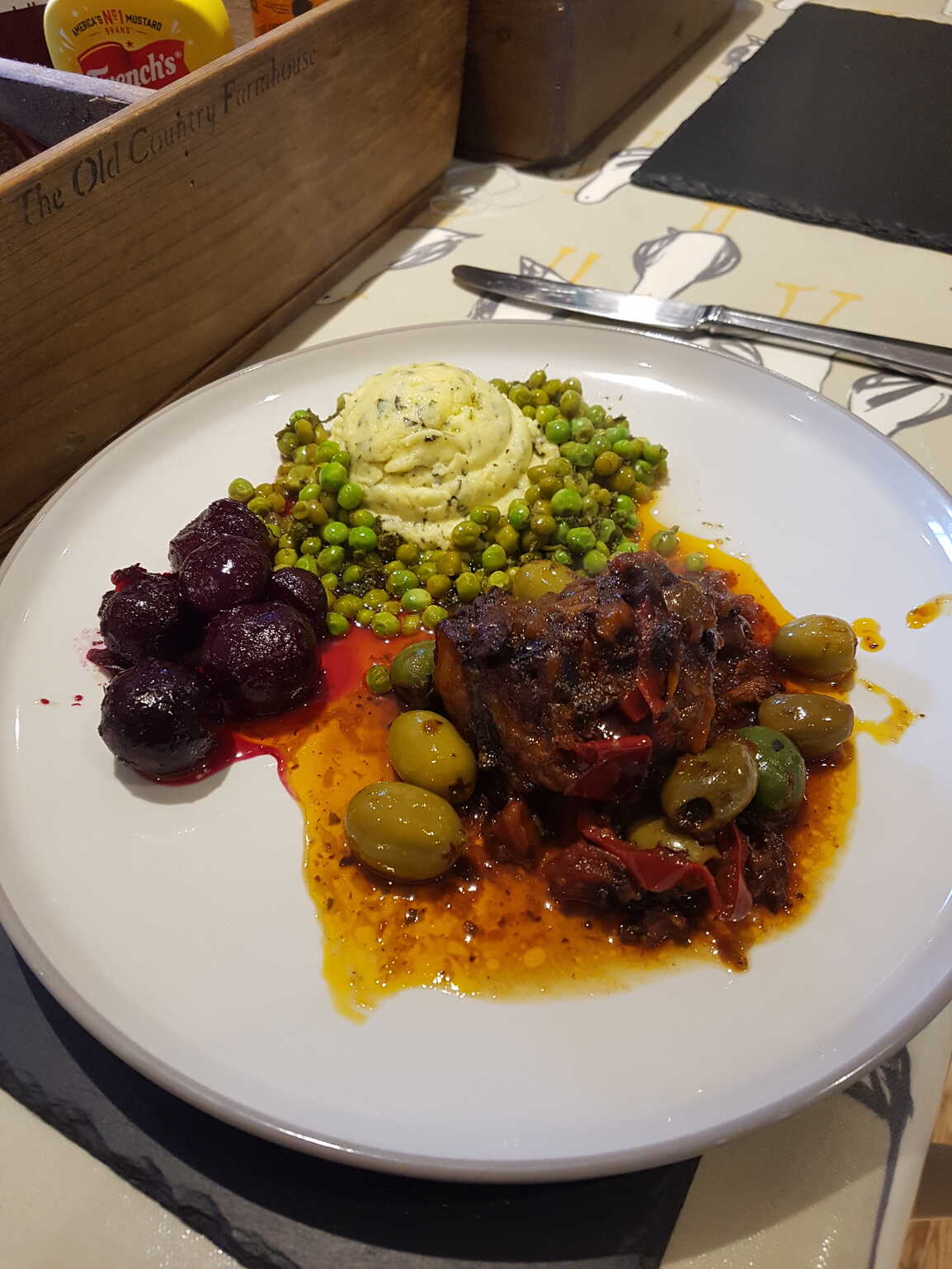
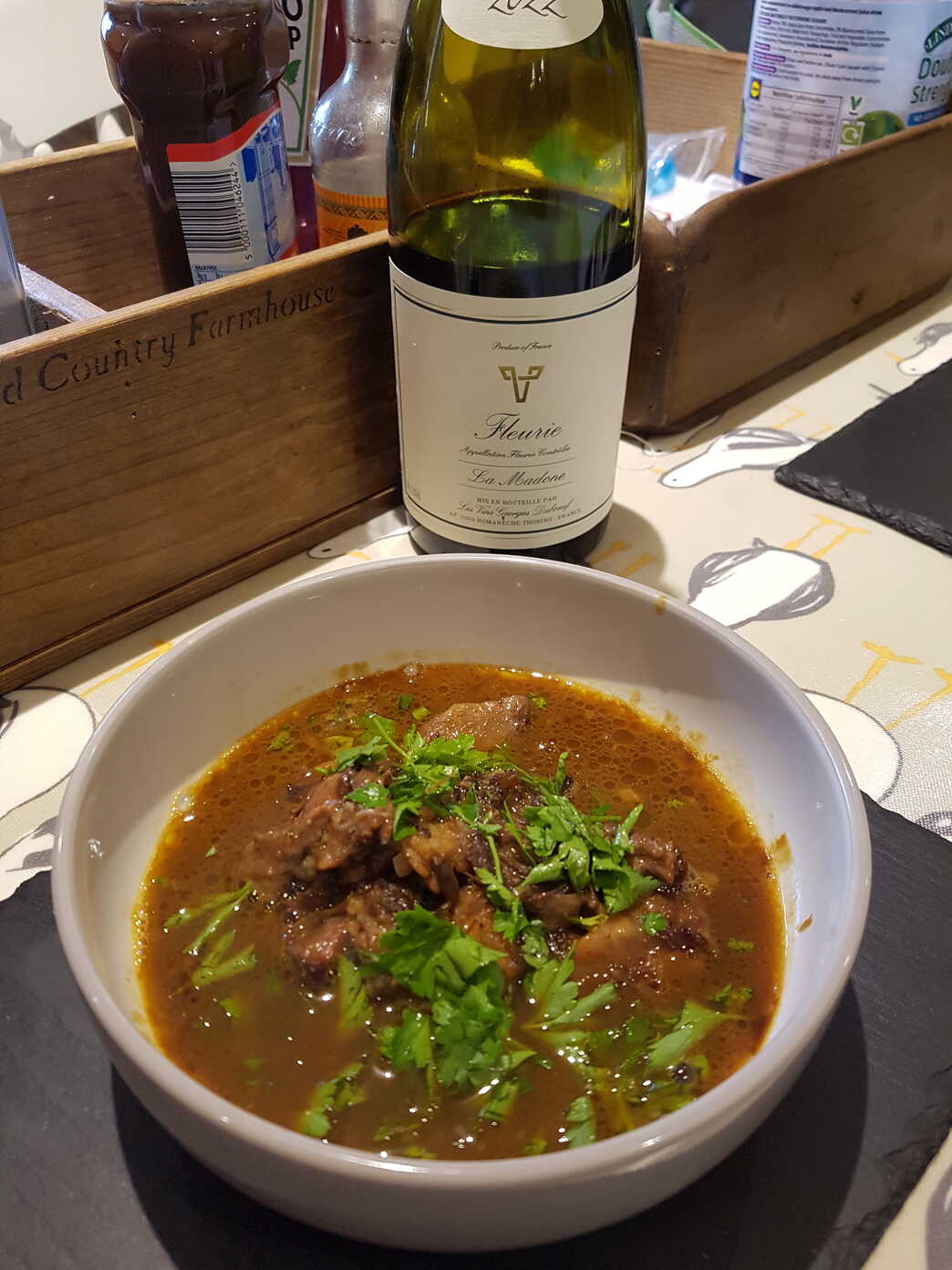
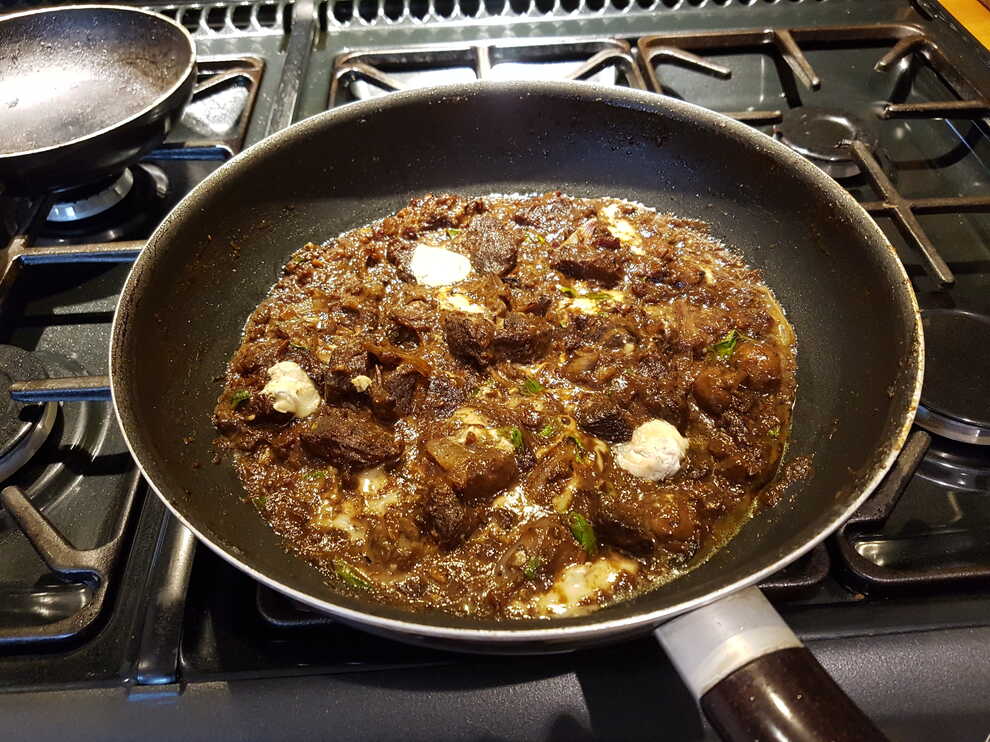
It's that time of year again, and I've run out of my ersatz Campbell's condensed oxtail soup.
So I made up another batch. Details below.

Our usual camping spot down by the river at the delightful Rue du Chateau campsite was taken by interlopers so we had to make do with the opposite side of the field near the horsebox.
Which sounds charming, but is unfortunately where they keep the toilets.
Still, the camping spaghetti bolognese tasted just as good as ever.
And the Samye Ling Buddhist Centre was as calm and meditative as ever. I also had a couple of spare oxtail segments (are they still called vertebrae if they're in the tail?) after condensing the soup so I improved Wishart's Oxtail stew with the addition of a little soy sauce and some star anise. And some red peppers.
I now call it a tagine. So sue me.
Condensed Oxtail Soup Redux
meat soup
Another bash at making an ersatz Campbell's Condensed Oxtail Soup.
This time with more accurate measurements.

Makes 2 Tins-Worth

Ingredients
  • oil for browning
  • flour
  • 2 oxtails (about 2kg)
  • veal/beef stock
  • 2 onions, peeled, chopped
  • 2 (small) heads garlic, halved
  • 2 carrots, peeled, chopped
  • ½ head celery, chopped
  • 1 turnip, peeled, chopped
  • 4 bay leaves
  • bunch thyme
  • bunch parsley
  • ½ cup pearl barley, toasted
  • ½ bottle red wine
  • handful black peppercorns
  • half a dozen star anise
  • half a dozen cloves (maybe shouldn't?)
  • 100g cooking bacon, chopped
  • 1 tblsp tomato purée or ketchup
  • 2 tsps marmite
  • 1 tsp paprika
Method
Simmer for about 8 hours, or leave it in the oven overnight at its lowest setting as I did.
Strain the stock through a colander and carefully lift out the oxtails with their meat attached and set aside to cool.
Wash the vegetable pulp in more water to extract all of its flavour and strain again into the stock.
Strain the stock once more through muslin or a sterile hairnet as I did.
Separate the meat from the oxtails, being sure to remove any bone or cartilage, and blend with enough hot water to cover to make a foamy, meaty paste.
Strain through a sieve into the stock.
No need to strain out all the grainy meatiness which will contribute to the condensed soup's texture.
Reduce the stock until it becomes a thick, rich, sticky, sauce.
Makes about 2 cans-worth. For roughly £15 each 😢
Though you can scoop out a couple of bonus bowls of regular oxtail soup with extra oxtail (as pictured) before you start your blending and reducing process.

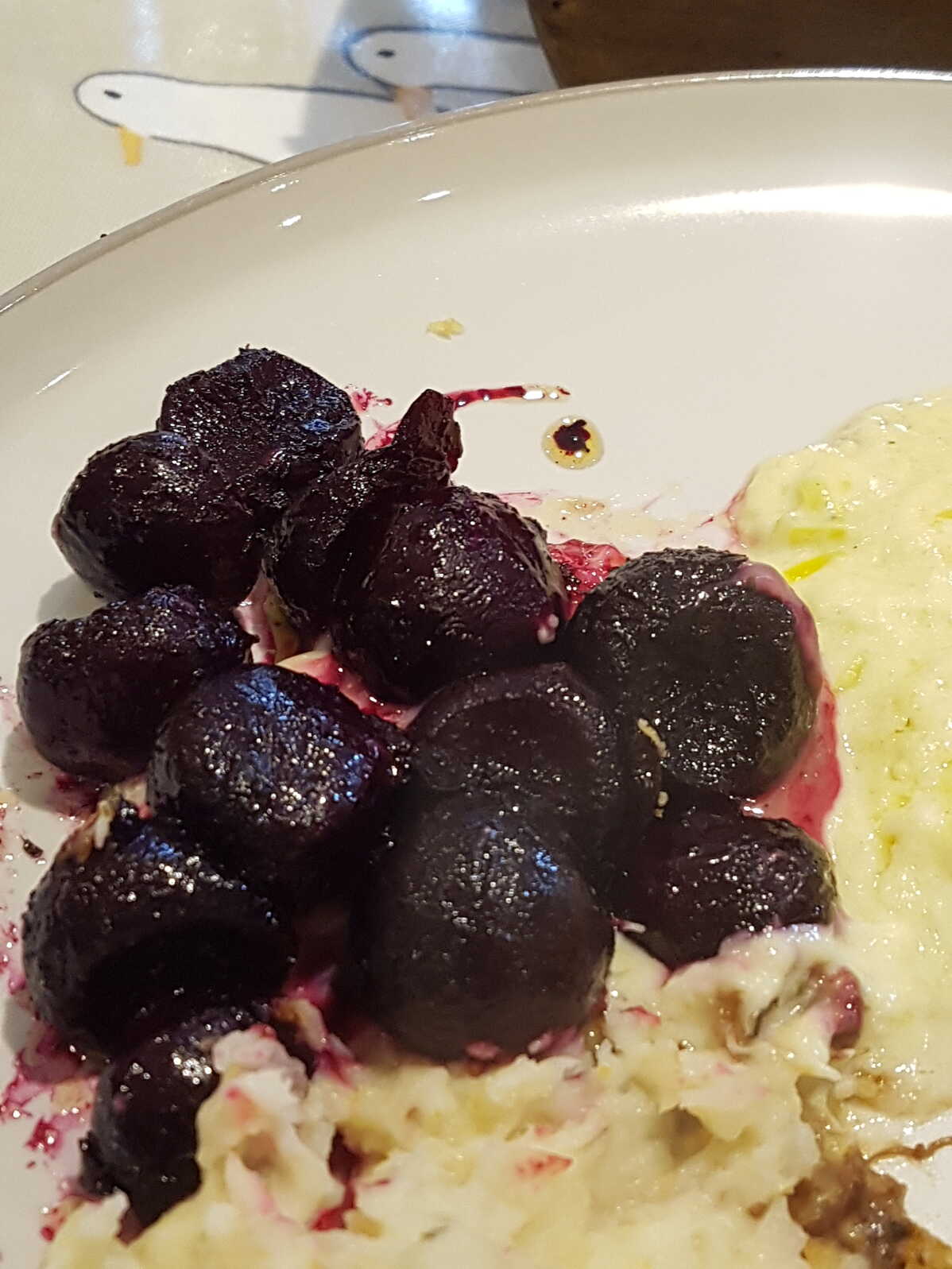
Honey Roasted Beetroot
side veg vegan
As served with an Oxtail Tagine.

Serves 4

Ingredients
  • 2 tsp chopped fresh thyme
  • 2 tsp balsamic vinegar
  • 2 tbsp olive oil
  • 2 tbsp clear honey
  • 500g/17½oz beetroot
  • salt and freshly ground black pepper
Method
Preheat the oven to 220°C/425°F/Gas 7.
Mix together the thyme, vinegar, olive oil and honey in a bowl until well combined.

If the beetroot are raw, boil them whole and un-skinned, until easily penetrated with a knife, then cool and peel them.
The skin should slip off easily scraping with a spoon or the back of a knife.
Trim away the rough ends.

Using a small melon baller or small spoon, scoop out balls of the beetroot or cut them into wedges and place into the bowl with the honey mixture and season, to taste, with salt and freshly ground black pepper.
Transfer into a deep roasting tray and roast in the oven, stirring occasionally, for 30-45 minutes or until the beetroot is sticky and glazed.
Rather good.
The glaze does burn on pretty hard though, so if you want to avoid a lot of scrubbing you should line the tray with foil.
In Which Karl Solves Pastry
Gooey Gorgonzola

My Wine 'n' Cheese Man™ sold me so very much oozy Gorgonzola Dolce that I was struggling to eat it all, so I thought I'd put some of it in a pie.

Now I like a steamed suet pudding as much as the next Yorkshireman, but I'm not soo keen on the stodginess of baked suet pastry, and being too lazy to go to all the trouble of blind-baking a shortcrust pastry so it doesn't go all limp and soggy, I thought someone should invent a new pastry.
One which is light and airy enough to rival shortcrust, but robust enough to crisp up even when filled with watery content.
And here it is!
Finally!

Karl's MAGIC™ Suet Shortcrust Pastry
ingredient
So I invented a new pastry. Or I think I did. Which deserves its own page!
After extensive research I've discovered evidence that some traditional and Cornish pasties also blend lard and suet.
So maybe I didn't really invent it after all 😠
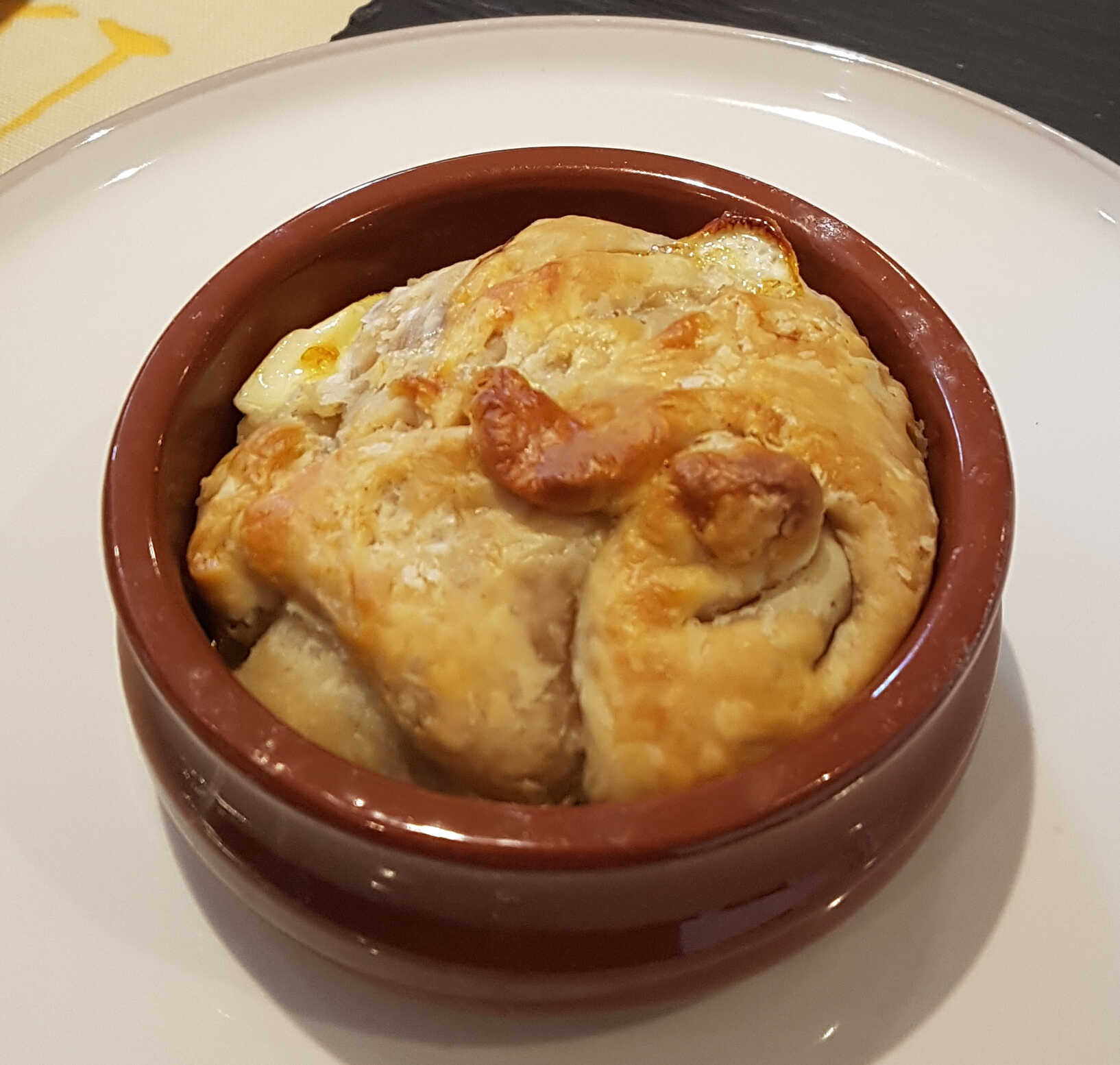
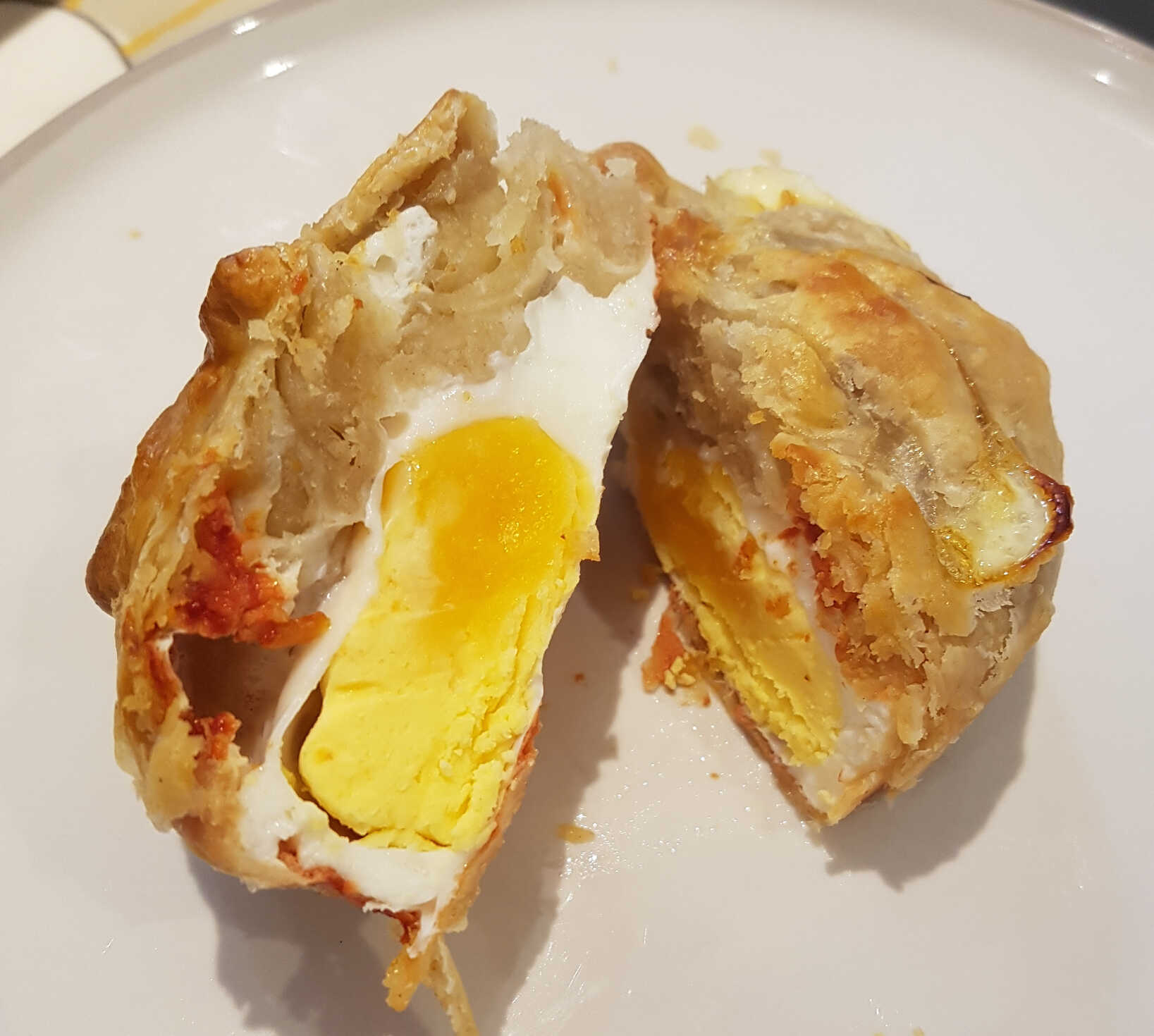
I wondered if it might be possible to cross a lard-based shortcrust pastry with a suet pastry to get some of the crispness of the shortcrust, the robustness of the suet and avoid any need to blind-bake the casing.
And here it is!

The pastry swells and browns quite nicely, a bit like puff. And crisps well when filled without becoming soggy.
It's almost possible to soft-bake an egg in it!

Serves 6-8

Ingredients
  • 600g self-raising flour
  • 200g lard, diced
  • 100g suet
  • salt
  • egg yolk loosened with a little milk for the wash

  • Flavour Options:
  • 2 tsps mustard powder
  • handful of fresh herbs
  • 1 tblsp dried herbs
  • garlic
  • citrus zest
  • 200g hard cheese, grated
  • spices
  • toasted nuts
  • seeds (sesame, cumin, fennel, caraway, etc)
Method
Sift the flour into a bowl with a little salt.
Add any flavour options you fancy.
You might want to add any fragile flavourings, like fresh herbs, at the end of the mixing.
Chop the chilled lard into small pieces and cut into the flour to make breadcrumbs without over-working it.
Add the suet, then cut in just enough ice cold water to bring the dough together into a ball.

To Make a Pie:
Separate about a third, make a flattened ball of each part, cover them in clingfilm and refrigerate for an hour or so.
Pre-heat the oven to Gas Mark 5.
Mix an egg yolk with a little milk to loosen.
Roll out the larger ball on a floured surface and line a baking dish.
Spoon in your chosen, cooled, filling.
Brush the pastry edges with the egg wash.
Roll out the smaller ball to cover, crimp the wetted edges and trim tidily with a knife.
Decorate with shapes cut from the spare pastry if you like, and make a couple of slits to let out the steam, then brush the top with egg wash and bake for about 45 minutes or until the pie is nicely browned and cooked through.
Adjust the oven temperature as required to prevent burning or to speed things up.
Be sure to crimp the top onto the wetted walls of the base pretty firmly, or they will separate when baked. As mine did!
Give the top another couple of egg washes after the first 30 minutes for a glossy finish!

Steak and Gorgonzola Pie
meat main cheese
I thought I'd try my MAGIC™ Suet Shortcrust pastry with one-third suet and two-thirds lard.
I didn't bother blind baking it, but the bottom turned out crisped and well-cooked without being soggy.
Although I do rather like a soggy bottom myself!

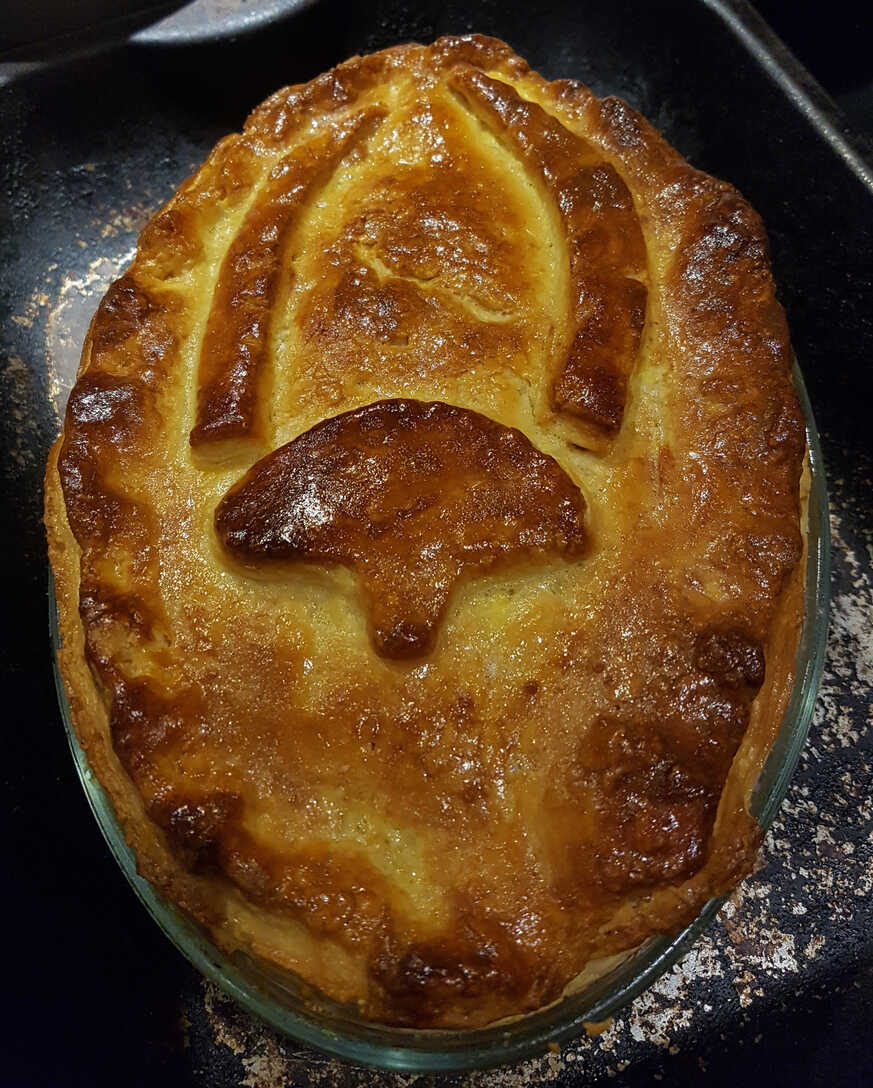
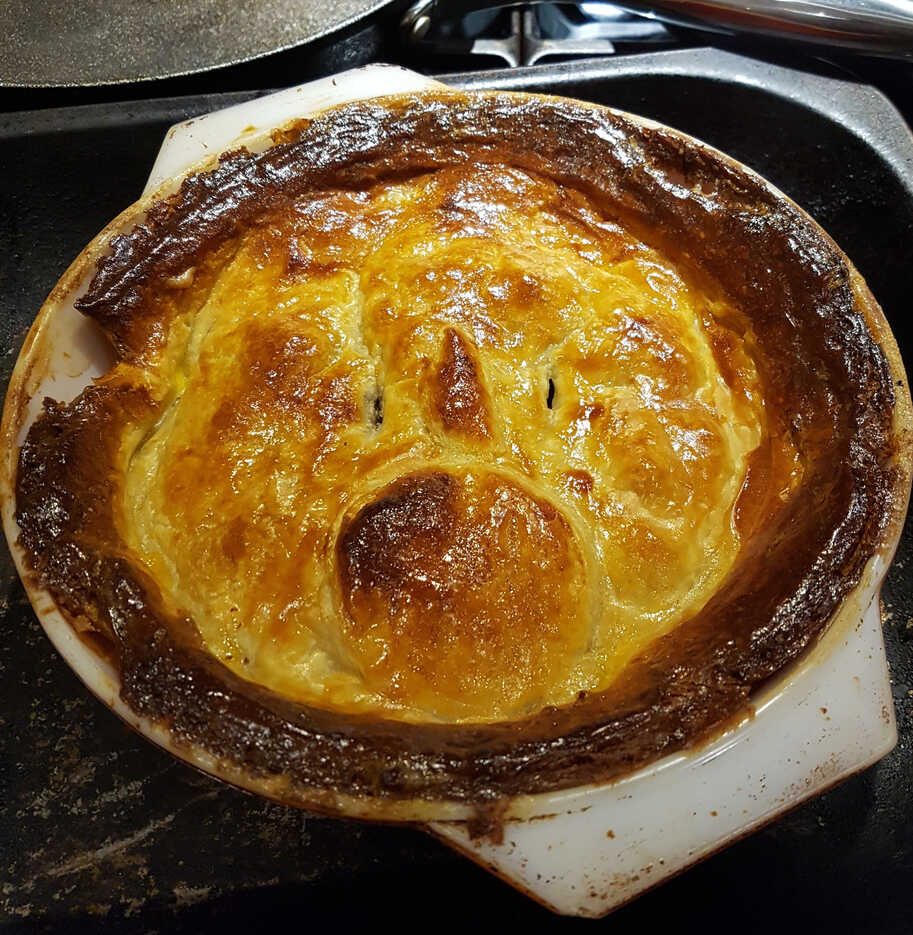
In case you were wondering, the decoration on the pie was meant to be an impression of a beef's nose and horns, with steam slits for nostrils.
Unfortunately the horns were much too long to fit on the pie horizontally, so now it looks more like a mushroom and a couple of whale's jaw bones.
Ah well, I never claimed to be an artist.

Serves 6-8

Ingredients
  • 1 kg beef chuck, shoulder or shin
  • 5 tblsps flour
  • 1 tblsp mustard powder
  • pepper
  • oil for frying
  • 250g bacon lardons
  • 2 carrots, chopped small
  • 2 onions, chopped small
  • 1 head garlic, pressed
  • thyme
  • bottle red wine
  • 500ml beef stock
  • handful parsley, roughly chopped
  • 200g button mushrooms
  • a dozen baby onions, peeled
  • 250g gorgonzola, cubed

  • For the Pastry:
  • 600g self-raising flour
  • 200g lard
  • 100g suet
  • 2 tsps mustard powder
  • salt
Method
Cut the beef into ½" chunks.
Shake in a bag or a bowl with the flour, mustard powder, ground pepper and a little salt.
Fry in batches over high heat in a little sunflower or rapeseed oil to brown nicely.
Transfer to a large pot.
Fry the bacon lardons until beginning to brown and add them to the pot.
Add more oil and fry the carrots and the onions until they begin to caramelise nicely.
Mince, purée, or crush a head of garlic or push it through a garlic press and add to the frying pan for a few minutes.
If you halve a head of garlic and place the cloves a few at a time in the press with the cut sides against the mesh - you don't need to peel them.
The peel will magically remain in the press. Hopefully!
Decant everything to the pot.
Deglaze the frying pan with red wine and bubble until reduced by half, then add the reduced wine and the stock to the pot.
Cook for two hours until the meat is tender.

Meanwhile heat a little oil over high heat and char the baby onions a little. Set aside.
to add to the pot about 15 minutes before finishing.
Add a knob of butter and fry the button mushrooms to give them colour, then add them to the pot. Simmer for another 15 minutes so there is very little sauce remaining, then stir in the parsley and the gorgonzola to melt it through.
Allow to cool.
Other blue cheeses are available. And more-or-less as good.

Sift the flour into a bowl with the mustard powder and a little salt.
Cut the chilled lard into small pieces and cut into the flour to make breadcrumbs without over-working. Add the suet, then cut in just enough ice cold water to bring the dough together into a ball.
Separate about a third, make a flattened ball of each part, cover in clingfilm and refrigerate for an hour or so.

Pre-heat the oven to Gas Mark 5.
Mix an egg yolk with a little milk to loosen.
Roll out the larger ball on a floured surface and line a baking dish.
Fill with the cooled stew. Brush the edges with the egg wash.
Roll out the smaller ball to cover, crimp the wetted edges and trim tidily with a knife.
Decorate with shapes cut from the spare pastry if you like, make a couple of slits to let out the steam, then brush the top with egg wash and bake for about 45 minutes or until it is nicely browned and cooked through.
Adjust the oven temperature as required to prevent burning or speed up the cooking.
Give the top another couple of egg washes after the first 30 minutes.
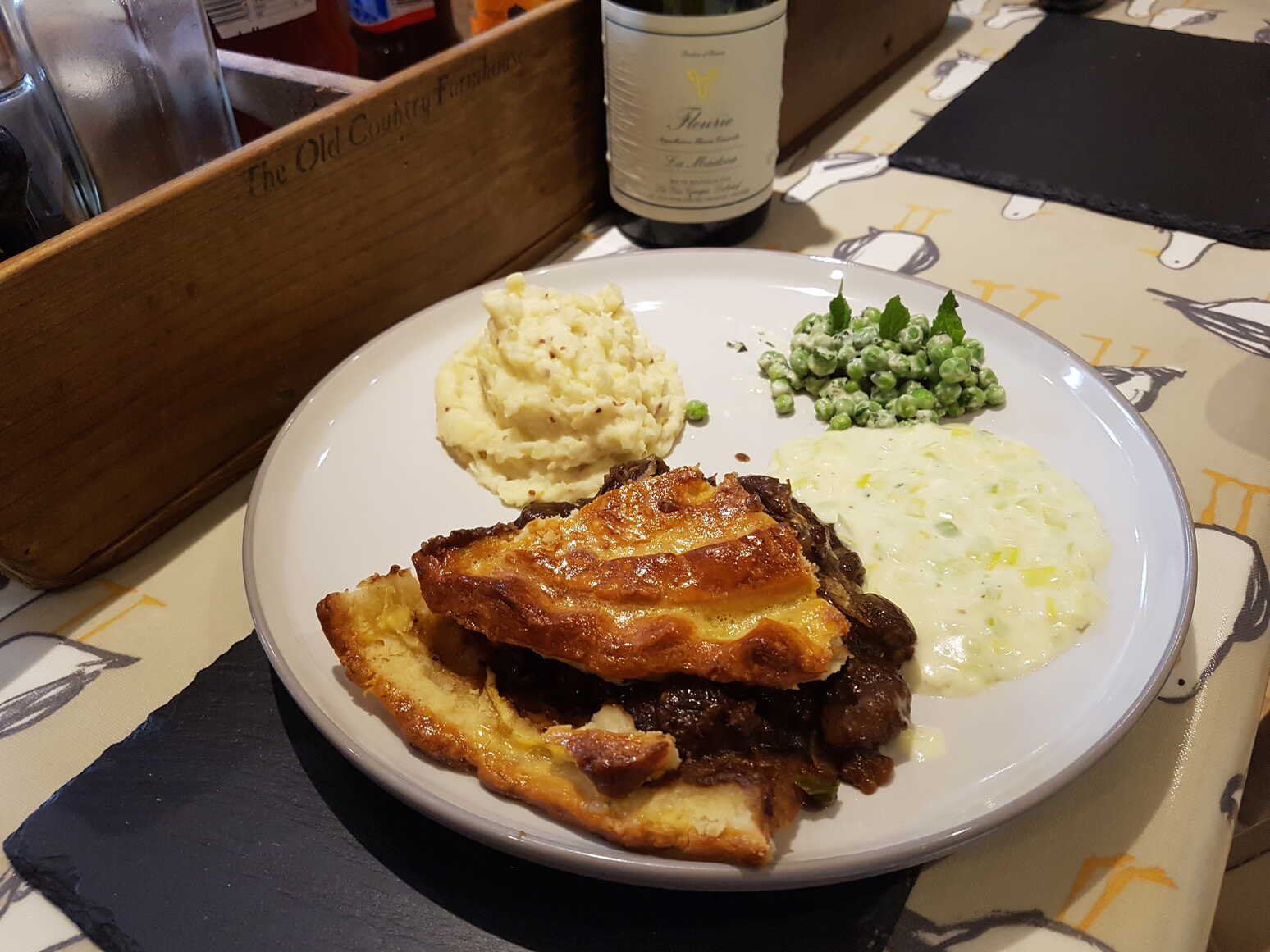
Serve with gravy or creamed leeks, celeriac and mustard mash, and peas lubricated with a splash of cream. Or peas with a dab of cream cheese dressed with chopped mint.
Though on reflection the peas can be a little rich. How about mint and a splash of Forvm Chardonnay vinegar?
Or better yet, how about peas and a minty gastrique?

Celeriac and Mustard Mash
side veg
The addition of potato gives a smoother result than just celeriac which can be quite grainy. I had about 25%.
Add more potato if you prefer.

Serves 4

Ingredients
  • 1 celeriac, peeled, chunked
  • 2 small potatoes, chunked
  • 2 tsps wholegrain mustard
  • large knob butter
  • 100ml double cream
  • salt & pepper
Method
Peel the celeriac and potato and cut into fairly large, even chunks.
Add the celeriac to boiling water, return to the boil and simmer for 5 minutes.
Add the potatoes, return to the boil and simmer for another 10 minutes or until the vegetables are quite soft.
You may need to remove one or other of the vegetables early if they cook more quickly.
Drain them, then mash with butter and cream.
You can use a blender if you want a smoother purée, but you may need to add more liquid.
Season and mix in the wholegrain mustard.
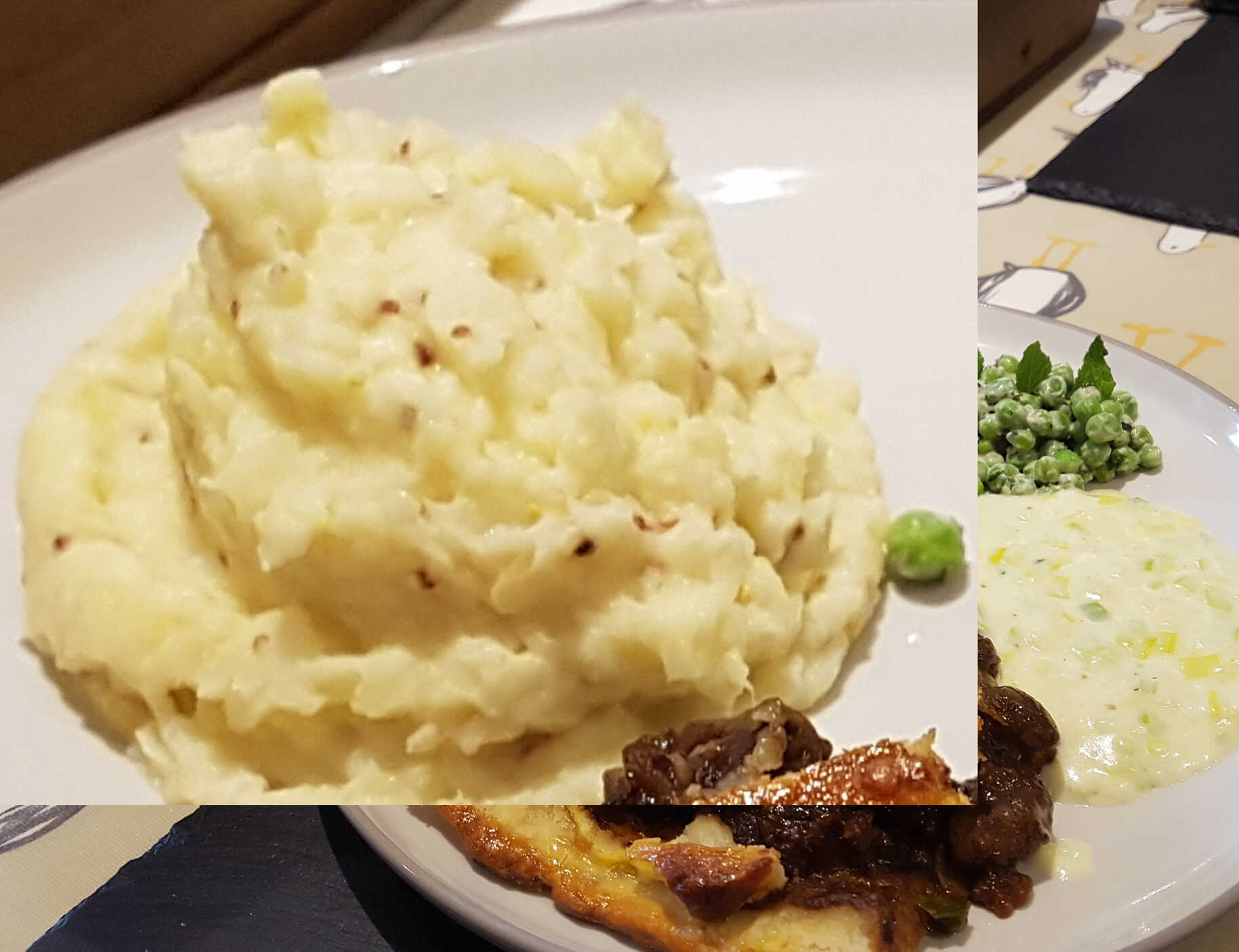
Pretty good mash.

Peas with Minted Chardonnay Gastrique
veg side
This is a bit tricky, but can be quite a tasty way of jazzing up some peas if you get it right.
Make sure the gastrique is quite thick. If it's too watery it will just turn the peas wet and disappointing.
Whisking butter in at the end helps.

Serves 2

Ingredients
  • 1 tblsp honey
  • water
  • 1 tblsp Forvm chardonnay vinegar
  • 1 tblsp mint, minced
  • knob of butter
  • 1 cup shelled peas
Method
Dissolve the honey in a little water to get rid of any crystals then cook it in a small pan until the water is boiled off and the honey begins to bubble and caramelize.
Once it has darkened to your liking add the vinegar and reduce until it becomes sticky.

Take off the heat and throw a knob of butter into the gastrique. stir to make a smooth sauce.
Shell the peas and boil them in salted water for a minute, then drain and dress them with the sauce.
Stir through finely minced mint leaves to serve.
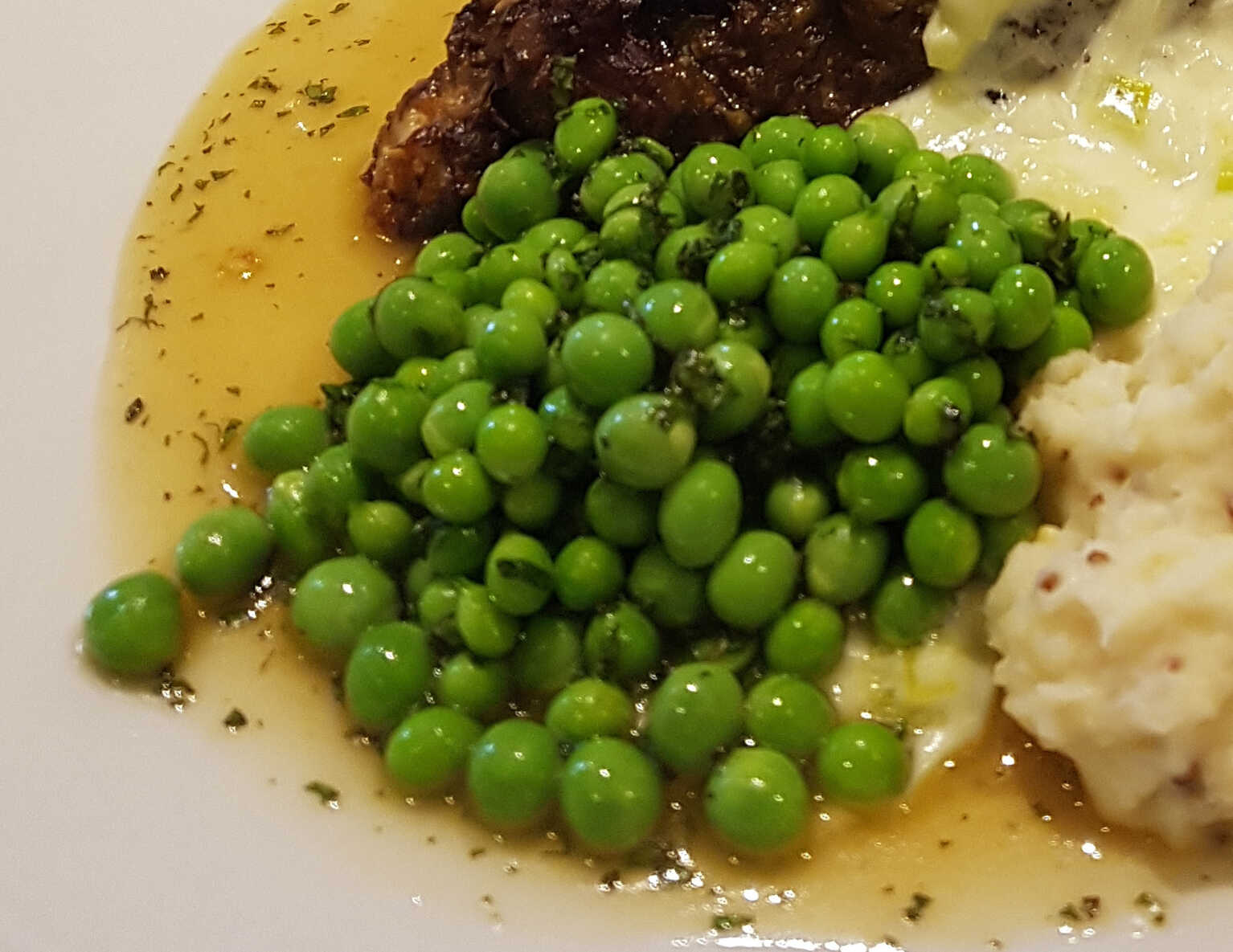
A work in progress. First tip: don't add the mint leaves until the peas have cooled slightly or they'll blacken.
Second: You might consider whisking some butter into the gastrique before dressing the peas.
Yep, the butter makes for a nicer, richer, dressing.
Love. Age. Die.
Wild Garlic Seeds

Chris from my Culinary Master Class brought a whole bunch of lovage to class.
So I offered to give it a good home.
When life gives you lovage... Make love?

Speaking of leafy plants, as we were, it's Prairial - wild garlic season, and around here the spring woodlands become carpeted with them.
First you get their distinctively odoriferous versatile young leaves which you can just throw into a leafy salad, then as these turn heavy and coarse you get the flower buds, which you can pickle, apparently
And having now tried some I can attest to their potency!
Then come the flowers.
I don't know about eating them
Then you get the seeds. Which you can also pickle.
My God, perhaps I could live off them?

Chilled Cucumber and Lovage Soup
soup veg
Not a bad soup - surprisingly rich. The boiled egg garnish really works well.

Serves 4

Ingredients
  • 3 long cucumbers, peeled
  • 3 tbsp of crème fraîche
  • 350ml of natural yoghurt
  • ½ lemon, juiced
  • 75ml of olive oil, good-quality
  • 3 sprigs of fresh lovage, leaves picked
  • salt
  • ground white pepper

  • Garnishes:
  • hard-boiled eggs, chopped
  • chives, chopped
  • lemon zest
Method
Cut the cucumbers in half lengthways and scrape out the seeds with a teaspoon.
Discard the seeds.
Roughly chop into chunks and place in a blender.

Add the rest of the ingredients (except the garnish, if using) to the blender and season with salt and pepper.
Start initially with 12 lovage leaves.
Good advice - though I ended up using considerably more. Perhaps double.
Blend until completely smooth — the soup should have a pleasing, pale green colour.
Taste.
Is there a good balance of acidity and mellowness from the yoghurt? Add more lemon if it seems too creamy-tasting.
Can you taste the lovage enough? It should be defined but not overpowering.
Add the lovage leaves cautiously, a little at a time so as not to overpower the delicate cucumber flavour

Once you’re happy you’ve achieved a balanced flavour, place the soup in the fridge for at least 2 hours so that it is well-chilled before serving.
Sprinkle with chopped hard-boiled egg, minced chives, and lemon zest to garnish, if desired.
Pretty good soup. It needs a fair amount of seasoning, and quite a lot of lovage. Depending on your sensitivity to it, I suppose.
This makes quite a good sauce too if blended with Boursin cream cheese.

Mackerel and Lovage Tarts
fish starter snack
You can use shop-bought puff pastry. I know I did!
Though a 320g pack of ready rolled puff pastry is not enough. You'll need slightly less than twice that to make 6 or 7 10cm x 12cm tarts.

I mostly followed Hugh Fearnley-Whittingstall but adjusted the oven temperatures a bit to encourage the blind pastries to rise.
I also think the 2cm potato cubes are a little on the large side.

You won't hear me say this very often, but it could have done with more mackerel!
I cooked my mackerel under the grill, skin-side-up. Which make it easy to peel the blistered, crispy skin off when they're cooked through.
Plus you can decorate the finished tarts with shards of their skin to serve.
They also freeze well.

Serves 6

Ingredients
  • 2 tbsp olive oil
  • 2 onions, finely diced
  • 2 bay leaves
  • 3 soft lovage stems (about a stick of celery's worth), finely sliced
  • 350g potatoes, peeled, cooked and cut into 2cm cubes or smaller
  • 4 mackerel fillets, cooked, skinned and flaked or more!
  • 1 small handful lovage leaves, finely shredded, plus extra for serving
  • 2 tbsp finely chopped dill fronds, plus extra for serving
  • 3 tbsp crème fraîche
  • Salt and freshly ground black pepper

  • For the Rough Puff Pastry:
  • 250g unsalted butter, chilled and cut into small cubes
  • 500g plain flour
  • Pinch of salt
  • About 150ml iced water
  • 1 egg, lightly beaten with 1 tsp of milk, for glazing
  • Freshly ground black pepper
Method
First make the pastry:
Toss the butter in the flour with the salt until coated, then add just enough water (you may not need it all) to bring it together into a fairly firm dough.
Form this into a rectangular shape with your hands and, on a well-floured surface, roll it out in one direction, away from you, into a 1cm-thick rectangle.
Fold the two short ends into the middle so they overlap, like folding a letter. Give the pastry a quarter turn, repeat the rolling out five more times, then wrap in cling-film.
Rest in the fridge for an hour.
Or just go to the shops and buy some.

Heat the oven to 220°C/425°F/Gas Mark 7.
Put the oil in a frying pan over medium-low heat, add the onion and bay, and sauté gently until soft, about 10 minutes.
Add the lovage stems, fry for a couple of minutes, then tip into a bowl with the potato, flaked fish, lovage leaves, dill and crème fraîche.
Remove the bay, season and cool.

Roll the pastry into a rectangle about 35cm x 45cm. Cut into six smaller rectangles. Cut a 1cm strip from the edge of each and reserve.
Place the rectangles on a large baking sheet lined with parchment, and lightly brush the edges with egg wash.
Place the strips around the edges to make a border, and brush lightly with egg wash.
Prick the bases of the tarts with a fork.

Bake for 10-15 minutes until they're starting to turn golden, remove from the oven and divide the filling between the tarts, piling it up quite high.
I'm trying freezing some at this stage - I'll let you know how that works out.
Yeah it works fine - you need to reheat them quite slowly or the tops will burn - about 45 minutes at Gas Mark 4/175°C/350°F. Add the mackerel skins with 5 minutes to go if you want to crisp them up.

Reduce the oven to 200°C/400°F/Gas Mark 6. Bake for five to 10 minutes until warmed through.
Scatter over dill and lovage, and serve hot or warm.
Not bad, if a bit mild.
They are nicely complemented with a cucumber and lovage soup beaten into some boursin to make a nice rich sauce.
You can decorate the tarts with pieces of mackerel skin crisped either in the oven or under a grill.

Salted Pickled Wild Garlic Seeds
pickle
A sort of poor man's caper.
Unless capers are consumer-man's pickled wild garlic?

The seeds always seem to be salted before pickling. This will draw any moisture from the seeds, keeping them firm and giving better subsequent vinegar penetration to increase the pickling effect.
Perhaps it also helps to prevent them from spoiling?

Fills 1x300ml jar

Ingredients
  • 200-250g green wild garlic seedheads (to yield approximately 150g picked seeds)
  • 40g fine sea salt
  • 300ml cider vinegar or white wine vinegar
  • a bay leaf or two
Method
Pick the individual seeds from the seedheads.
This requires a bit of patience, but you can speed things up with a small pair of scissors or by using a fork to strip a whole head of seeds from the main stem in one movement.
It's best to do this in a large bowl or a plastic bag - the seeds will shoot all over the place.
Don’t worry too much about any fine stems that remain attached to the seeds.

Wash the seeds thoroughly in several changes of water. Pick out any spiders or grass stalks that survive the process, then strain them into a sieve and leave to drain well.

Put a heaped tablespoon of the dry seeds into the sterilised pickling jar, and sprinkle over some of the salt.
Continue layering seeds and salt until the jar is full and all of the salt is used up. (Don’t worry too much about the salt being evenly distributed.)
Fasten the lid onto the jar, and put the jar into the fridge. Leave it there for three weeks, shaking the jar every day or so.

Once the three weeks is up, tip the salted seeds into a sieve and rinse them well. Spread them out on a clean tea towel and leave them to dry again. Meanwhile, wash and sterilise the jar again.

Put the dry wild garlic seeds back into the jar. Pour over enough vinegar to cover, fasten the lid and leave to mature for at least one month, but preferably three.
Stored in the fridge, the pickled seeds should keep for around twelve months.
Really good!
Feel free to add a bay leaf or two.
To be honest they'll easily be ready to start eating after a couple of weeks pickling.
Older Entries